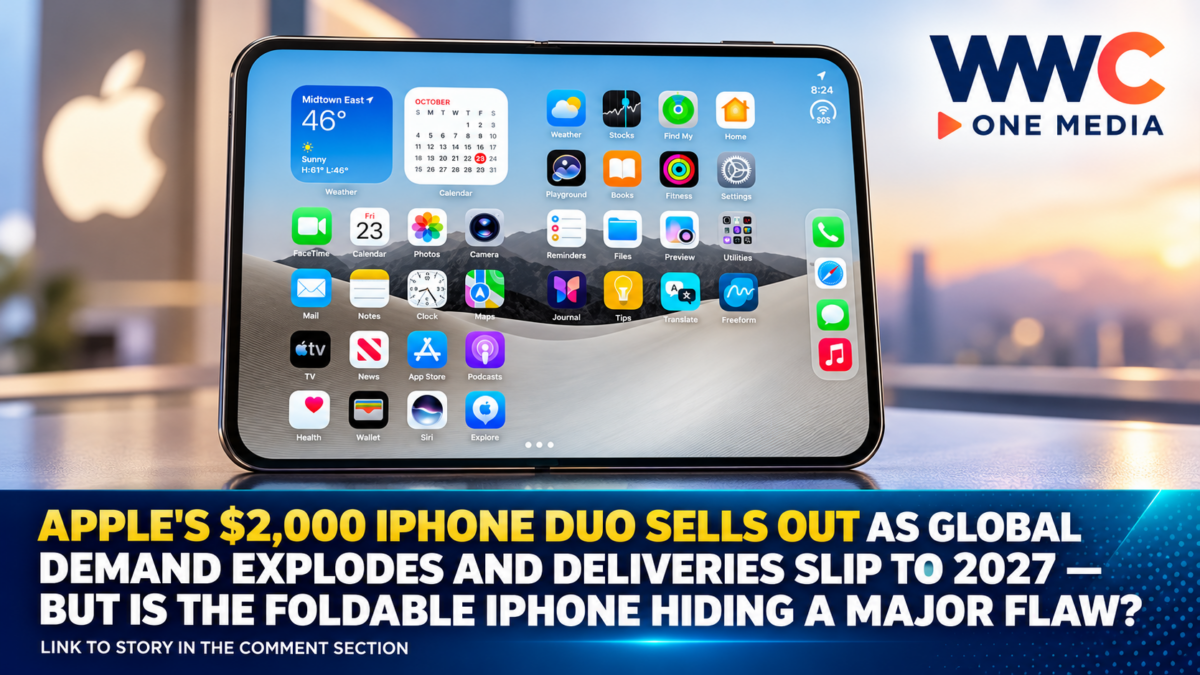
Apple has officially entered the foldable smartphone battlefield with its first-ever iPhone Duo, a nearly $2,000 device that has triggered extraordinary demand, widespread supply shortages and questions about whether the technology giant can challenge Samsung and Huawei in one of the smartphone industry’s most competitive premium segments.
The iPhone Duo officially reached stores in major markets on Friday, October 23, bringing Apple’s most ambitious smartphone redesign in years to customers eager to experience a device that transforms from a compact handset into a tablet-like screen.
But despite its premium price, getting one has already become a challenge.
Pre-orders reportedly sold out rapidly in several markets, with estimated delivery dates for certain configurations stretching into late January 2027, according to Reuters.
Apple’s highly anticipated launch has therefore become more than another product release. It represents a crucial test of whether the company can persuade consumers to pay a substantial premium for a new smartphone design — and whether its newly appointed chief executive can deliver the next major chapter in Apple’s growth.
A $2,000 smartphone that buyers are struggling to find
The iPhone Duo starts at $1,999 in the United States, placing it among the most expensive mainstream smartphones Apple has ever introduced.
Nevertheless, the hefty price tag has not prevented buyers from rushing to secure the device.
Reuters reported that Apple restricted pre-orders to two units per customer and imposed tighter purchasing rules in several countries because available inventory could not keep pace with demand.
In markets including China, France, Hong Kong, India and Japan, launch-day purchasing was restricted to customers with online orders.
Queues formed outside Apple retail stores in cities including Sydney, New York and London, although overall crowds were less dramatic than those seen during some previous iPhone launches because supplies and walk-in sales were limited.
Some consumers were willing to spend considerably more than the US starting price because of local pricing, taxes and their preferred storage configurations.
In Australia, one customer interviewed by Reuters paid A$3,899 for a 512GB model, describing the expensive purchase as a personal luxury.
The early buying surge suggests substantial enthusiasm among Apple’s most loyal customers. However, limited inventory also makes it difficult to determine how much of the apparent shortage reflects unprecedented demand rather than constrained initial production.
What makes the iPhone Duo different?
Apple’s first foldable iPhone introduces a major departure from the company’s traditional smartphone design.
The new device features a 7.6-inch internal display that unfolds into a larger workspace for watching videos, gaming, reading and running multiple applications.
When folded, its 5.4-inch external display allows it to function as a more compact smartphone.
Powered by Apple’s A20 Pro processor, the iPhone Duo also incorporates a redesigned thermal system, dual-battery architecture and an adapted version of iOS 27 designed to accommodate its folding display.
Apple has emphasized the device’s precision-engineered hinge, which aims to deliver a smoother folding experience while reducing the visible crease that has been a longstanding concern with foldable screens.
Its software also introduces expanded multitasking functionality, allowing users to move between applications and take advantage of the larger display.
For consumers who frequently alternate between smartphones and tablets, the Duo aims to offer the convenience of both categories in a single device.
However, its innovative design comes with important trade-offs.
Early reviews reveal the biggest problem with Apple’s new foldable
While the iPhone Duo has generated considerable excitement, reviewers have identified several compromises that could make its price difficult to justify.
Early assessments praised the phone’s engineering, particularly its durable hinge and relatively subtle screen crease.
But critics also highlighted its camera system and the limited number of third-party applications fully optimized for the larger folding display.
Although the Duo offers an optical-quality 2x shooting option through its main camera, it lacks a dedicated telephoto camera found on some premium flagship smartphones.
That distinction could matter to photography enthusiasts who expect Apple’s most expensive devices to offer its strongest camera capabilities.
Software optimization remains another major challenge.
The larger display creates opportunities for productivity and entertainment, but some applications may require updates to make full use of its unusual proportions.
For Apple, this means the long-term success of the iPhone Duo will depend not only on its hardware but also on how quickly developers adapt their apps.
Samsung and Huawei face a powerful new challenger
Apple is entering a market where its rivals already have years of experience.
Samsung has spent several generations refining its Galaxy Z Fold series, while Huawei and other Chinese manufacturers have developed increasingly sophisticated foldable smartphones.
Apple’s arrival could dramatically change the competitive landscape.
Research firm IDC estimates that Apple could account for 44% of global foldable smartphone market value and 31% of unit sales in 2026.
Those forecasts reflect expectations that Apple’s immense customer base, premium brand positioning and ecosystem of connected devices could encourage a broader shift toward foldable technology.
However, the projections are not confirmed sales results.
Samsung, Huawei and other manufacturers still possess substantial advantages in established foldable manufacturing processes, existing customer relationships and product development experience.
The iPhone Duo’s commercial performance over the coming months will help determine whether Apple can convert its initial excitement into sustained market leadership.
A crucial leadership test for Apple’s new CEO
The iPhone Duo launch also carries major significance for John Ternus, Apple’s new chief executive.
Formerly Apple’s senior hardware engineering executive, Ternus assumed leadership in September 2026 and unveiled the company’s first foldable smartphone during his first major product presentation as CEO.
During the retail launch, Ternus personally welcomed customers at an Apple store in Austin, Texas.
The public appearance underscored the importance Apple has attached to the device.
For Ternus, the iPhone Duo offers an opportunity to demonstrate that Apple can still deliver transformative hardware innovation in an increasingly mature smartphone market.
But it also creates expectations.
Investors and consumers will be watching whether Apple can increase production, sustain demand and persuade customers that foldable devices are more than expensive technological novelties.
What Filipino buyers need to know
The foldable iPhone is also expected to attract considerable attention in the Philippines, where premium Apple products command a dedicated following.
Apple’s official Philippine pricing starts at ₱159,990, with 256GB, 512GB, 1TB and 2TB storage options.
Apple announced that local customers could begin pre-ordering on October 16 at 8 p.m. Philippine time.
Its large internal display, multitasking capabilities and distinctive folding design could appeal to professionals, content creators and technology enthusiasts.
However, at nearly ₱160,000 for the base configuration, affordability is likely to remain one of its biggest barriers to mass-market adoption.
For prospective buyers, checking Apple’s official Philippine store for delivery estimates, available configurations and after-sales support will be particularly important while global supplies remain constrained.
Is the iPhone Duo the beginning of a smartphone revolution?
Apple’s first foldable iPhone has already accomplished something significant: it has pushed the foldable smartphone category into the spotlight of the company’s enormous global customer base.
Strong initial demand suggests many customers are prepared to spend thousands of dollars on a device that combines portability with a larger display.
Yet important questions remain unanswered.
Can Apple manufacture enough units to satisfy demand? Will developers fully embrace the new screen format? And can the company justify its premium pricing when competitors already offer advanced foldable alternatives?
For Samsung, Huawei and other manufacturers, Apple’s entry creates a powerful new competitive threat.
For Apple, it represents an opportunity to reshape expectations about what an iPhone can become.
The iPhone Duo may be selling out today, but its biggest challenge is still ahead: proving that the foldable revolution is more than a short-lived luxury trend.
As Apple battles supply shortages and rivals prepare their response, one question could determine the future of the premium smartphone industry: Has Apple just launched the next generation of the iPhone — or its most expensive experiment yet?