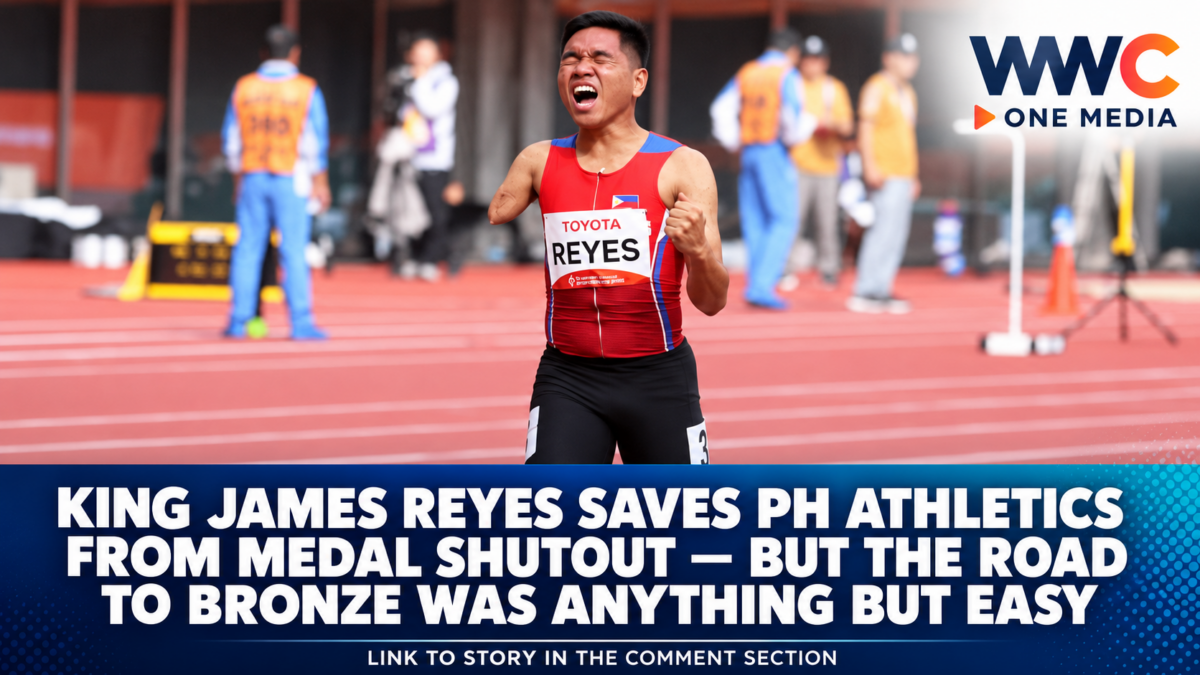
NAGOYA, Japan — Filipino para-athlete King James Reyes delivered a breakthrough performance at the 2026 Asian Para Games, capturing bronze in the men’s 1,500-meter T46 final and securing the Philippines’ first athletics medal of the competition.
Reyes clocked a personal-best 4 minutes, 13.81 seconds at the Mizuho Park Athletic Stadium on Friday, October 23, giving the Philippine delegation a much-needed podium finish after a disappointing turn of events in another 1,500-meter race the previous day.
The 24-year-old runner from Loreto, Agusan del Sur, finished behind Sri Lanka’s Wahumpurage Puwakpitikande, who claimed gold in a Games-record 4:03.25, and India’s Parmod, who took silver in 4:09.65.
Reyes crossed the line 4.16 seconds behind the silver medalist, capping his campaign with a new personal record against a competitive international field.
A personal best after years of hard work
Reyes’ bronze represents more than a place on the podium. It reflects years of training, sacrifice and determination from an athlete who has continued pursuing his sporting ambitions despite a life-changing childhood accident.
According to reports from The Philippine Star and Daily Tribune, Reyes lost his right arm after falling from a macopa tree when he was five years old. Nearly two decades later, he is competing on the international stage and adding another achievement to his growing athletic record.
The graduating Sports Science student at Adamson University credited his preparation and the sacrifices made with his coach and team for his performance.
“Personal best ko din po ito, nagbunga training namin at sacrifices,” Reyes said, as reported by The Philippine Star.
He also expressed gratitude for being able to pursue his dreams despite his disability, emphasizing that it had not prevented him from striving for success.
From a painful reversal to a crucial Philippine medal
Reyes’ achievement came a day after fellow Filipino runner Cyril Cloyd Ongcoy suffered a heartbreaking setback in the men’s 1,500-meter T12/T13 event.
Ongcoy had initially appeared to secure bronze, but a jury decision reinstated Uzbekistan’s Fakhriddin Khamraev, who had previously been disqualified. The ruling changed the medal outcome and pushed Ongcoy down to fourth place.
The reversal added pressure to the Philippine athletics campaign, making Reyes’ podium finish particularly significant for the team.
In an interview reported by PhilSTAR Life, Reyes said he felt he needed to deliver for the country after Ongcoy’s medal was taken away. He explained that he believed he had a strong chance of reaching the podium because of the preparation he and his coach had undertaken.
His bronze ultimately ensured that the Philippine para athletics team would not leave the competition without a medal.
Another bronze strengthens the Philippine campaign
Reyes was not the only Filipino para-athlete to reach the podium in athletics.
Ma. Ravinia Carpena also captured bronze in the women’s shot put F20, recording a personal-best throw of 11.39 meters. Japan’s Reina Hori won gold with 13.57 meters, while Malaysia’s Siti Noraidah Suherman took silver.
Other Philippine athletes also produced notable performances, even when they fell short of the podium. Evaristo Carbonel recorded a personal best of 27.18 meters in the men’s F11 discus throw to finish fifth, while Edwin Enguito Jr. placed fourth in the men’s T63 high jump.
In wheelchair fencing, Wilfredo Bugayong II and Violeta Sapalit reached the knockout rounds but did not advance to the medal positions.
The results underscored the range of Philippine participation across the Asian Para Games, with athletes competing in track and field as well as other para-sports.
A medal that carries a bigger message
Reyes’ performance is a reminder that success in elite sport is not measured solely by gold medals. His personal-best time, international podium finish and response to a difficult team situation made his bronze one of the notable moments of the Philippine campaign.
For the athlete from Agusan del Sur, the achievement also adds to a career built through persistence and preparation. His performance at the Asian Para Games provides another milestone as he continues to develop as a competitive runner.
The Philippine delegation’s campaign also received a boost from the medals won in para swimming and para table tennis, while Reyes and Carpena helped establish the country’s presence in athletics.
Reyes may have finished third in the 1,500 meters, but his performance delivered a significant result for Philippine para athletics—and a personal best that gives him another benchmark to chase in future international competitions.