Paris, France — October 24, 2026
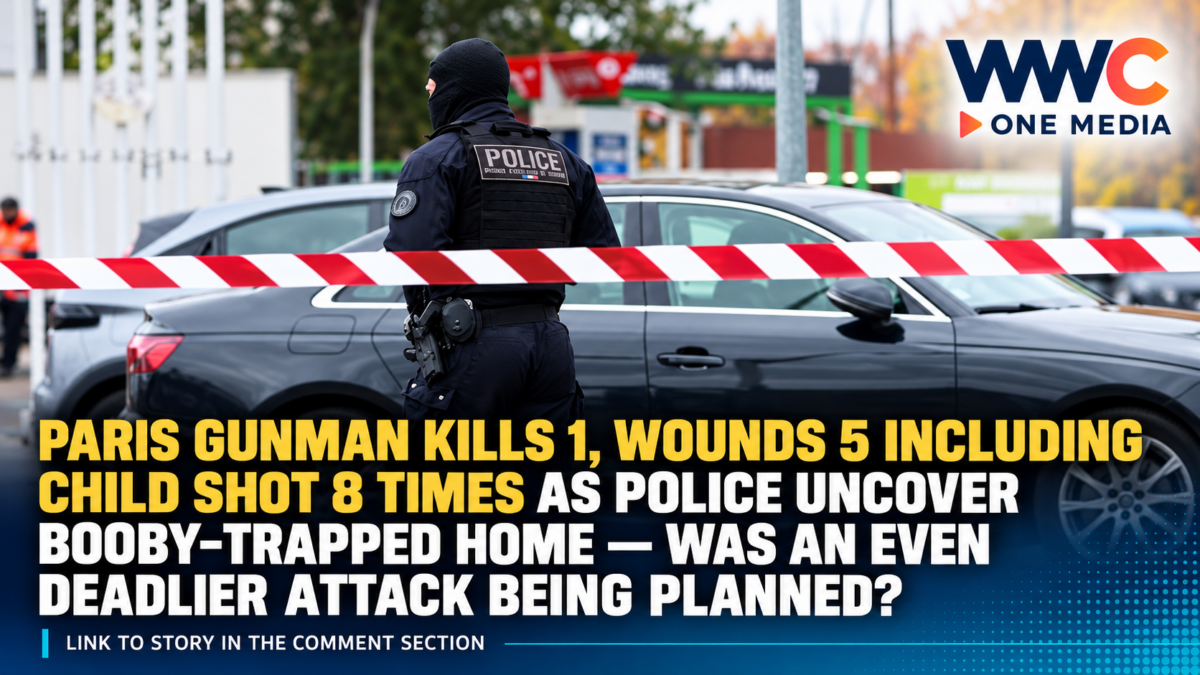
A deadly shooting rampage outside Paris has left one person dead and five others wounded, including a 12-year-old girl who was shot eight times, triggering a major terrorism investigation and renewed concerns over racial hatred and public safety in France.
French President Emmanuel Macron condemned the October 23 attack as a “racist terrorist attack,” warning that the violence represented a disturbing turning point for the country.
The gunman reportedly drove through the Paris suburbs of Trappes and La Verrière, opening fire at multiple public locations within approximately 15 minutes. The sudden attack struck a petrol station, a medical centre and an area near a children’s playground.
Three of the five surviving victims sustained life-threatening injuries, according to French Interior Minister Laurent Nuñez.
Authorities arrested a 39-year-old suspect shortly after the shootings. Investigators subsequently uncovered a submachine gun in his vehicle and a potentially deadly booby-trapped setup inside his residence.
The discoveries have raised urgent questions about whether the violence was a premeditated act of racial terrorism and whether the suspect had intended to carry out further attacks.
Gunman unleashes terror across Paris suburbs
The violence began at approximately 10:30 a.m. local time on Friday, October 23, in Trappes, a suburban community west of central Paris.
According to investigators, the attacker fired multiple bursts from a moving vehicle while travelling through Trappes and neighbouring La Verrière.
Witnesses described hearing repeated gunshots as the vehicle moved through residential areas.
Local authorities said the shooting locations included a petrol station, a medical facility and a children’s playground, raising fears that a significantly larger number of civilians could have been killed.
Trappes Mayor Ali Rabeh described the attack as an apparent attempt to cause mass casualties.
One victim died, while five others suffered injuries of varying severity.
Among those wounded was a 12-year-old girl who sustained eight gunshot wounds. La Verrière Mayor Nicolas Dainville initially reported that the child was seriously injured but in stable condition. Other official updates indicated that several victims remained in critical or medically unstable condition.
Police arrest 39-year-old suspect and discover booby-trapped apartment
French police apprehended the suspected gunman in nearby Coignières less than 20 minutes after the shooting began.
The suspect was identified by prosecutors as Kévin T., born in 1987, with his full surname withheld by authorities.
A search of his vehicle uncovered a Sten-type submachine gun and a tear-gas canister, according to the National Anti-Terrorism Prosecutor’s Office.
But the investigation took an even more alarming turn when police searched his residence.
Authorities discovered three gas cylinders connected to electrical wiring and a timer, creating what prosecutors described as a booby-trapped arrangement.
The discovery intensified concerns about the extent of the suspect’s preparations and whether the attack involved plans beyond the shootings.
A member of the suspect’s immediate family was also taken into custody for questioning.
Officials have not established publicly whether other individuals participated in planning or carrying out the attack.
Macron condemns alleged racial targeting
President Emmanuel Macron travelled to Trappes after the killings and strongly condemned the violence.
Macron said victims appeared to have been selected because of their skin colour or perceived religious identity rather than any personal connection to the suspect.
His remarks placed the attack at the centre of a wider national debate about racism, religious discrimination and extremist violence.
Mayor Ali Rabeh also raised the possibility of an Islamophobic motive, noting that several victims were of African or North African origin.
However, the precise motive remains subject to the ongoing criminal investigation.
France’s National Anti-Terrorism Prosecutor’s Office has taken charge of the case, examining possible murder and attempted murder connected to a terrorist enterprise, including potential racial or religious aggravating factors.
The terrorism investigation marks a significant escalation from an ordinary criminal inquiry, giving specialist investigators responsibility for establishing the suspect’s motive, preparations and any potential accomplices.
France already facing rising security concerns
The shooting occurred during an especially tense period for France.
Authorities were preparing for another round of nationwide demonstrations over the cost of living after unrest during the previous weekend led to confrontations, vandalism and damage to public property.
Interior Minister Laurent Nuñez announced plans to deploy approximately 70,000 security personnel across the country on October 24 to prepare for further demonstrations.
The Paris-area shooting has heightened the atmosphere of anxiety, although authorities have not established any connection between the attack and the protests.
Security officials are now confronting two distinct challenges: maintaining order during large public demonstrations and investigating what authorities believe may be an ideologically motivated act of terrorism.
The unanswered questions facing French investigators
The investigation is expected to examine the suspect’s background, weapons, communications, possible ideological influences and the explosive hazards found at his residence.
Several questions remain unresolved.
Did the suspect deliberately select victims because of their ethnicity or religion? Was he acting entirely alone? What was the intended purpose of the booby-trapped apartment? And had investigators identified every element of the alleged attack plan?
French officials have not publicly established the answers to those questions.
For residents of Trappes and La Verrière, however, the consequences are already devastating.
An ordinary Friday morning turned into a scene of deadly violence, leaving families grieving, survivors fighting to recover and communities struggling with the possibility that civilians were targeted because of their perceived identity.
As France investigates the deadly shootings, the central question is no longer simply what happened outside Paris, but whether authorities can establish the full extent of the alleged terrorist plan and prevent similar violence.