
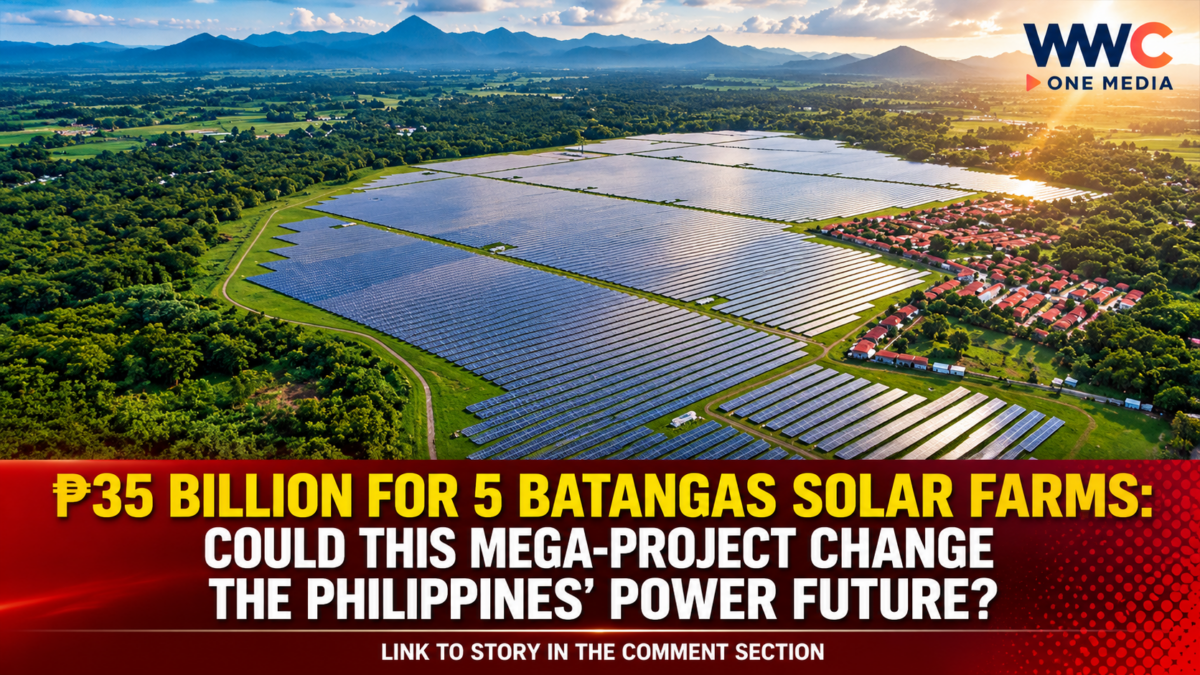
Citicore Renewable Energy Corporation (CREC) has secured more than ₱35 billion in financing for five major solar power projects in Batangas, marking a significant expansion of its renewable energy portfolio and adding momentum to the Philippines’ transition toward cleaner electricity.
The ₱35.014-billion syndicated financing, backed by the Bank of the Philippine Islands (BPI), Land Bank of the Philippines (LANDBANK), and Development Bank of the Philippines (DBP), will support 900 megawatts-peak (MWp) of new solar capacity and 120 megawatt-hours (MWh) of battery energy storage.
Reports published by Business Inquirer and corroborated by The Manila Tribune, Bilyonaryo, and Power Philippines on October 23, 2026, identify the financing as CREC’s largest syndicated project financing to date.
But the deal is about more than building solar panels. Its potential impact on electricity generation, energy security, and the country’s growing demand for power makes the project one to watch.
Five solar farms, 900 MW of capacity


9
According to reports from The Manila Tribune and Power Philippines, the five projects will consist of two large solar facilities with 300 MWp capacity each and three smaller facilities with 100 MWp capacity each. Each of the three smaller plants will include a 40-MWh battery energy storage system.
Project at a glance
Total financing
₱35.014B
New solar capacity
900 MWp
Battery storage
120 MWh
Expected annual output
1,300 GWh
Source: CREC project details reported by Power Philippines, The Manila Tribune and Bilyonaryo.
Power Philippines
+2
The projects have secured offtake allocations under the Department of Energy’s fourth Green Energy Auction (GEA-4). These commitments provide a framework for selling the electricity generated by the facilities, although the financing announcement alone does not establish when every plant will begin commercial operations.
Three major Philippine banks back the expansion
The financing brings together three major lenders:
- Bank of the Philippine Islands (BPI) — a private-sector bank participating in the syndicated facility.
- Land Bank of the Philippines (LANDBANK) — a state-owned financial institution supporting strategic development projects.
- Development Bank of the Philippines (DBP) — a government financial institution with a mandate that includes sustainable infrastructure financing.
CREC President and CEO Oliver Tan described the financing as an important milestone in accelerating the company’s renewable energy project pipeline. LANDBANK President and CEO Lynette Ortiz also highlighted the importance of partnerships in mobilizing capital for clean energy infrastructure.
The scale of the transaction is significant because utility-scale renewable energy projects require substantial upfront funding for construction, equipment, grid connections and supporting infrastructure.
Could the projects supply electricity to 550,000 households?
CREC’s five planned solar projects are expected to produce approximately 1,300 gigawatt-hours (GWh) of electricity annually once operational. Reports estimate that this output could meet the equivalent electricity needs of around 550,000 households and help avoid approximately 850,000 tonnes of carbon dioxide emissions each year. These are projections, not verified results from operating plants.
Battery storage is another important component. Solar panels generate electricity during daylight hours, while batteries can store some of that energy for later use. The three 100-MWp plants will each have 40 MWh of storage.
However, the announced 120 MWh of storage applies to those three facilities; the financing report does not establish that every one of the five plants will have its own battery system.
Batangas is becoming a major renewable energy hub
The new projects will expand CREC’s existing Batangas portfolio, which the company says includes 374 MWp of solar capacity and 560 MWh of battery storage. Another 198 MWp of solar capacity was reported to be nearing completion at the time of the announcement.
This expansion also fits into a broader national push for renewable energy investment.
In February 2026, the Department of Energy announced a 10-year Green Energy Auction plan designed to offer at least 25 GW of additional renewable energy capacity through competitive auctions between 2026 and 2035. The government aims to increase renewables’ share of the country’s power generation mix to 35% by 2030 and 50% by 2040.
In August 2026, the Philippine Information Agency reported that the country’s renewable energy share in the power generation mix had surpassed 25%, underscoring both the progress already made and the distance remaining before the 2030 target.
What this could mean for Filipino consumers
The expansion could contribute to greater domestic electricity generation and reduce reliance on imported fossil fuels over time. More renewable capacity may also diversify the country’s power supply, while battery storage can help make solar generation more flexible.
Still, the financing announcement does not mean electricity bills will immediately fall. The eventual impact on consumer rates will depend on construction and commissioning schedules, generation costs, transmission capacity, electricity market arrangements and other factors affecting power prices.
The next milestones to watch are the construction progress of the five plants, their connection to the grid and the timing of commercial operations.
For now, the ₱35-billion financing deal signals that major Philippine lenders are backing another substantial expansion of solar power—and that Batangas will remain an important location in CREC’s renewable energy plans.










