BEIJING, China — October 23, 2026
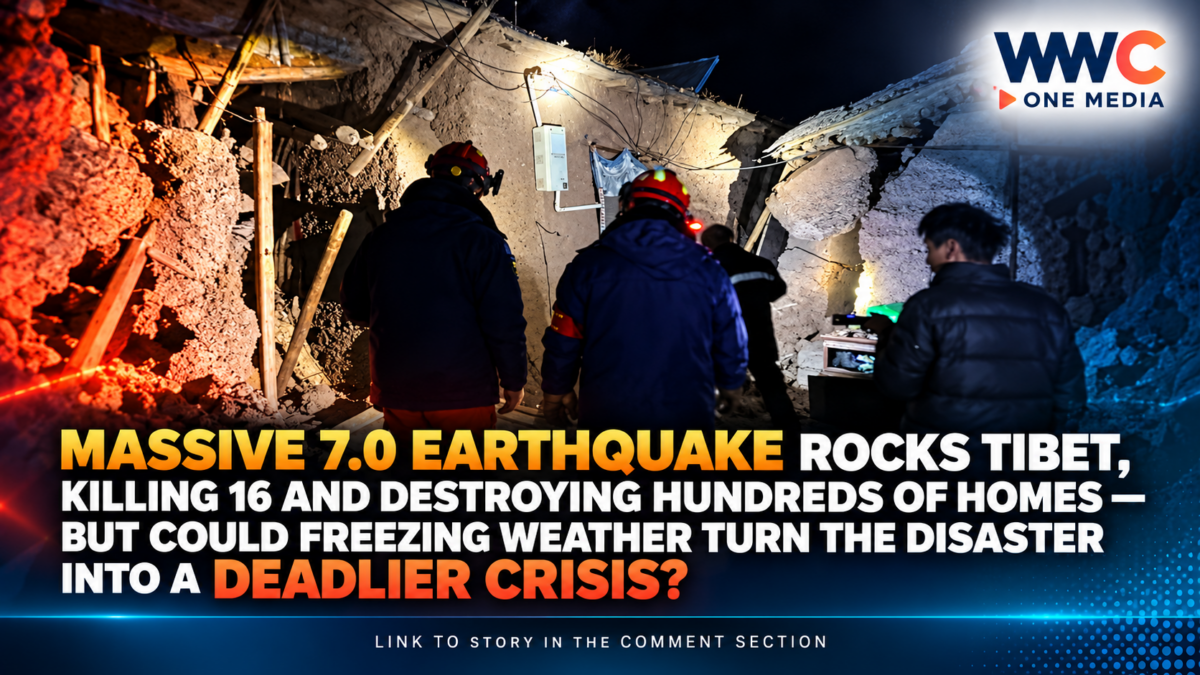
A powerful magnitude-7.0 earthquake has devastated parts of China’s Tibet region, killing at least 16 people, injuring dozens and reducing hundreds of homes to rubble, triggering an urgent rescue operation across one of the world’s most remote and unforgiving mountainous landscapes.
Chinese President Xi Jinping has ordered an all-out emergency response as rescuers race to locate survivors, restore critical infrastructure and provide shelter to families forced into the freezing Himalayan highlands.
But with dangerous aftershocks, damaged roads, disrupted communications and snowfall threatening rescue operations, authorities now face an even more difficult question: Can emergency teams reach vulnerable communities before conditions deteriorate further?
Powerful Earthquake Strikes Tibet Late at Night
The earthquake struck at approximately 10:33 p.m. local time on Thursday, October 22, catching many residents in their homes as they prepared to sleep.
According to the China Earthquake Networks Center, the tremor had a magnitude of 7.0 and originated roughly 10 kilometers beneath the Earth’s surface.
The US Geological Survey separately located the earthquake’s epicenter about 191 kilometers east-northeast of Nagqu, in northern Tibet, and estimated its depth at 18 kilometers.
The quake struck a sparsely populated, high-altitude area near Baqing County, where settlements are scattered across challenging mountain terrain.
Residents described terrifying scenes as buildings shook, household objects toppled and people rushed outdoors in darkness.
Videos broadcast by Chinese state media showed panicked residents fleeing restaurants and homes, while emergency workers searched damaged structures using flashlights.
Many families reportedly spent the night inside vehicles or temporary shelters because they feared returning to unstable buildings.
At Least 16 Dead as Hundreds of Homes Collapse
Chinese state media initially reported at least 16 fatalities and 32 injuries, including 11 people seriously hurt.
Subsequent accounts published by international news agencies and state broadcasters reported higher injury figures, highlighting the rapidly changing nature of the emergency.
Officials reported the collapse of at least 339 homes, along with damage to livestock shelters and other structures.
Entire families have been displaced, and authorities are assessing the safety of remaining buildings as aftershocks continue.
The number of people trapped or unaccounted for has not been conclusively established in the reports reviewed.
For communities living in isolated mountain settlements, damaged roads and interrupted communications could delay both rescue efforts and the delivery of essential supplies.
Xi Jinping Orders All-Out Rescue as Thousands Mobilize
President Xi Jinping called for urgent search-and-rescue operations, medical treatment for the injured and immediate support for displaced residents.
More than 1,600 local personnel have been mobilized in the affected area, supported by firefighters, police, military personnel and emergency response vehicles.
Authorities have dispatched emergency housing materials, thousands of tents, flashlights, generators and other essential supplies.
The response also includes temporary shelter arrangements for families whose homes were destroyed or rendered unsafe.
Rescue crews face enormous logistical challenges because of Tibet’s mountainous terrain, thin air and vast distances between settlements.
Damaged Roads, Power Outages and Aftershocks Threaten Rescue Efforts
Beyond the immediate destruction, the earthquake has disrupted communications and electricity supplies in affected communities.
Rockfalls forced authorities to restrict access along a section of National Highway 317, while railway services passing through the region were temporarily suspended as safety checks were conducted.
These disruptions are particularly serious for disaster response teams transporting medical personnel, heavy equipment, food and emergency shelter materials.
The US Geological Survey also recorded several significant aftershocks following the initial earthquake.
Aftershocks can further weaken already damaged buildings and pose additional hazards to residents and rescue personnel.
Snow and Extreme Altitude Create a Second Emergency
One of the greatest immediate concerns is the region’s harsh environment.
The earthquake struck a high-altitude area where cold temperatures and difficult terrain can complicate efforts to locate survivors and transport injured residents.
Chinese forecasts indicated intermittent snow over the following three days, creating concerns about visibility, accessibility and exposure among displaced families.
For those whose homes collapsed, reliable shelter and winter supplies are essential.
Authorities are working to establish temporary accommodation and maintain access to emergency services, but the scale of the damage means the recovery effort could extend well beyond the initial rescue phase.
Why Tibet Is Vulnerable to Powerful Earthquakes
Tibet sits within one of the world’s most seismically active regions, shaped by the continuing collision of the Indian and Eurasian tectonic plates.
The immense geological forces associated with this collision formed the Himalayan mountain system and contribute to repeated earthquakes across the region.
The latest disaster adds to a history of devastating tremors.
In January 2025, a powerful earthquake in Tibet’s Tingri County killed at least 126 people.
In 2010, a magnitude-7.1 earthquake in nearby Qinghai province’s Yushu area killed at least 2,698 people.
China also suffered one of its worst modern natural disasters in 2008, when a major earthquake in Sichuan province left approximately 90,000 people dead or missing.
These tragedies underline the continuing need for earthquake-resistant infrastructure, reliable emergency communications and rapid-response capabilities in remote mountain communities.
A Race Against Time in the Himalayan Highlands
For now, China’s emergency response remains focused on saving lives, treating the injured and protecting families exposed to harsh weather.
Authorities must also determine the full extent of structural damage, restore transport and communication networks, and assess whether additional settlements need assistance.
The death toll and injury figures could change as more complete information becomes available.
The central challenge is no longer the earthquake alone. Rescuers must contend with the obstacles left behind — collapsed structures, unstable roads, freezing conditions and communities that may remain difficult to reach.
As Tibet confronts the aftermath of one of the region’s most destructive recent earthquakes, a critical question remains: Will rescuers reach everyone in danger before the cold and damaged infrastructure make the emergency even worse?