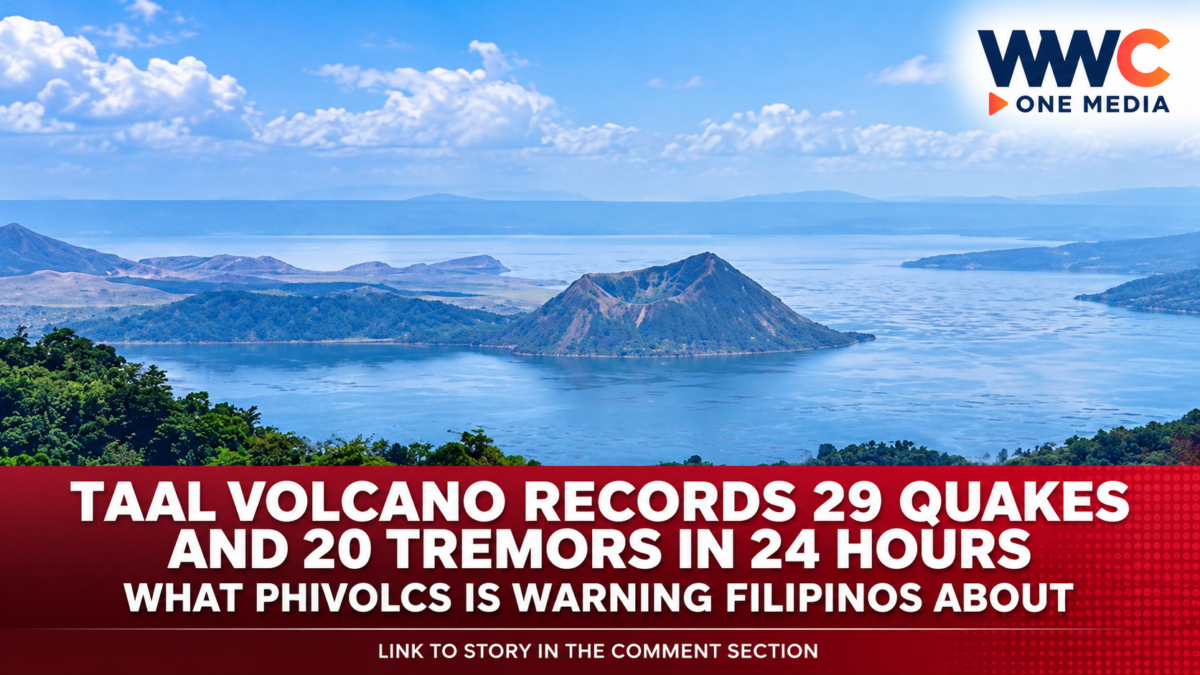
BATANGAS, Philippines — Taal Volcano’s reported seismic activity is drawing attention after monitoring data cited in an INQUIRER.net report recorded 29 volcanic earthquakes and 20 volcanic tremors within 24 hours, raising renewed questions about the volcano’s ongoing unrest.
However, earthquake and tremor counts alone do not confirm that a major eruption is imminent. The Philippine Institute of Volcanology and Seismology (PHIVOLCS) assesses multiple indicators, including volcanic earthquakes, gas emissions, steam activity and ground deformation, when evaluating a volcano’s condition.
Taal Volcano’s activity continues to change
Recent monitoring reports show that Taal Volcano has continued to experience minor eruptive activity.
In a report published on October 21, 2026, the Philippine News Agency (PNA) said a minor phreatomagmatic eruption occurred at Taal’s Main Crater between 10:07 a.m. and 10:09 a.m. on October 21. The event produced a plume that rose approximately 250 meters above the crater.
PHIVOLCS also recorded another minor phreatic eruption during the monitoring period. At the time of the PNA report, Taal remained under Alert Level 1, indicating low-level unrest.
A phreatomagmatic eruption happens when magma interacts with water, while a phreatic eruption is a steam-driven explosion that can occur when water is heated by volcanic activity.
These events can produce ash, steam and volcanic gases, even without a large magmatic eruption.
PHIVOLCS reports additional activity
In its October 22, 2026, 24-hour bulletin, PHIVOLCS reported two minor phreatomagmatic eruption events lasting approximately two to three minutes each. The agency also recorded two volcanic tremors.
The same bulletin reported sulfur dioxide emissions of 575 tonnes per day, based on measurements from October 21, and volcanic plumes reaching approximately 3,000 meters above the volcano, drifting toward the southeast and east-northeast.
PHIVOLCS also observed short-term inflation of Taal Volcano Island, an indication that ground deformation remains among the parameters being monitored.
Despite these observations, the agency maintained Alert Level 1.
These latest figures are from a different monitoring period than the 29-earthquake and 20-tremor figures cited in the original INQUIRER.net headline. They should not be combined as though they describe the same 24 hours.
What does Alert Level 1 mean?
Alert Level 1 means Taal is exhibiting low-level unrest. It does not mean that a major eruption is certain or imminent.
Nevertheless, the volcano can still generate sudden steam-driven or gas-driven explosions, volcanic earthquakes, minor ashfall and potentially dangerous accumulations or releases of volcanic gases.
In an October 20 report, GMA News also cited PHIVOLCS warnings about these hazards and reiterated restrictions around Taal Volcano Island and Taal Lake.
The continuing presence of minor eruptions underscores why authorities monitor Taal closely, even while the alert level remains unchanged.
Safety reminders for residents and visitors
PHIVOLCS continues to warn the public against entering Taal Volcano Island, which is designated a Permanent Danger Zone. Entry into the Main Crater and areas around the Daang Kastila fissures is prohibited.
Occupancy and boating on Taal Lake are also prohibited under the cited advisory. Aircraft should avoid flying close to the volcano because volcanic ash and gases can pose serious risks.
Residents in communities around Taal should follow official PHIVOLCS bulletins and instructions from local authorities. They should also remain alert for announcements concerning ashfall, volcanic gas exposure or changes in the volcano’s alert status.
What happens next?
The key question is whether Taal’s monitored activity will remain at its current level or show changes that warrant further action.
For now, the reported seismic activity should be understood alongside the latest official observations—not as proof that a major eruption is about to happen.
PHIVOLCS monitoring remains essential as scientists assess changes in seismicity, eruptive activity, gas emissions and ground deformation.
The public is urged to rely on official advisories rather than rumors or unverified predictions about Taal Volcano’s next eruption.