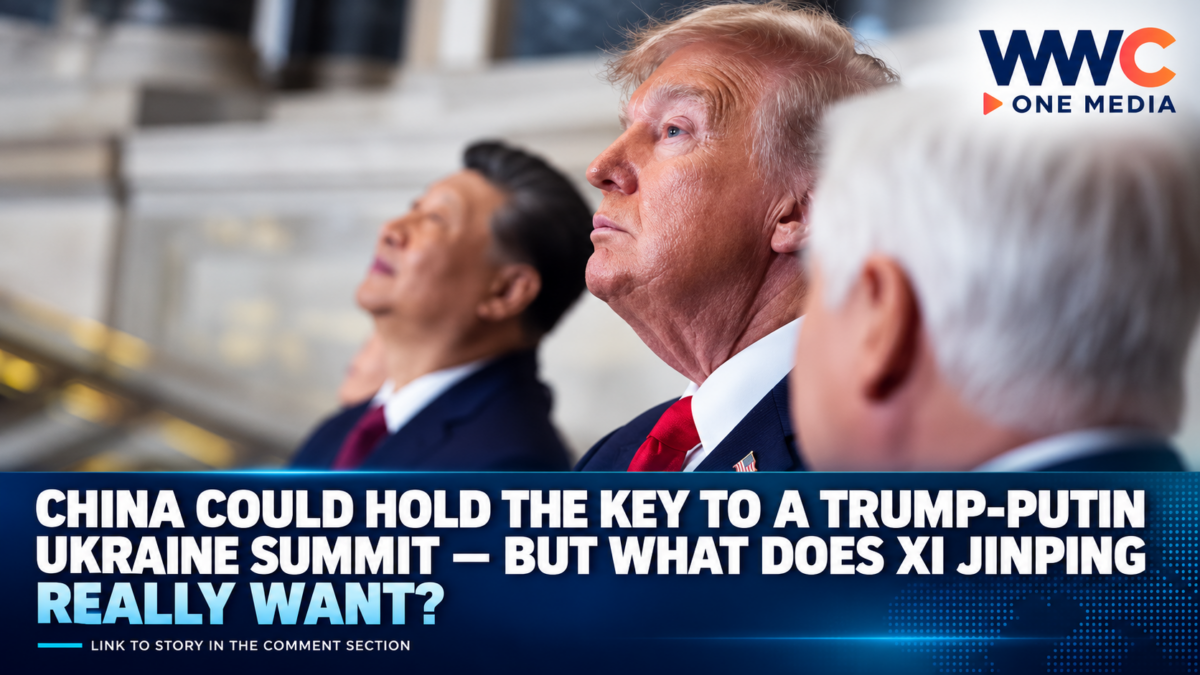
China may emerge as one of the biggest diplomatic players in a proposed summit involving U.S. President Donald Trump, Russian President Vladimir Putin, and Chinese President Xi Jinping — but Beijing faces a difficult balancing act as efforts to end the war in Ukraine continue.
The proposed meeting, reportedly raised by Putin, could take place on the sidelines of the Asia-Pacific Economic Cooperation (APEC) Economic Leaders’ Meeting in Shenzhen, China, on November 18–19. However, the three countries have yet to finalize an agreement on whether the summit will happen or what its agenda would include.
The possibility of such a meeting has raised questions about China’s ambitions, Russia’s search for diplomatic leverage, and Washington’s approach to ending the conflict — particularly because Ukrainian representatives could be excluded from the proposed format.
Reports from The Washington Post, Agence France-Presse (AFP), and other international outlets indicate that the idea remains under discussion rather than being a confirmed diplomatic event.
Why China May Want a Seat at the Center of Ukraine Diplomacy
For Beijing, a meeting with Trump and Putin could offer an opportunity to demonstrate that China is an indispensable participant in discussions about major international conflicts.
Hosting or facilitating talks among the world’s leading powers would strengthen China’s diplomatic profile and reinforce its ambition to play a greater role in shaping international affairs.
However, Beijing’s interests may extend beyond simply bringing Russia and the United States together.
China has maintained close strategic ties with Russia while also preserving extensive economic relationships with European countries. A diplomatic arrangement that openly favors Moscow or weakens China’s relationships with Europe could undermine Beijing’s broader interests.
An analysis published by ThinkChina on October 21 highlighted this dilemma: China wants greater international influence, but it may be reluctant to participate in an arrangement that allows major powers to divide the world into competing spheres of influence at the expense of smaller countries.
That distinction matters. China could benefit from being recognized as a central diplomatic power without necessarily wanting to assume responsibility for a settlement negotiated primarily by Washington and Moscow.
Putin Could Gain More Than a Photo Opportunity
For Putin, the potential summit could deliver an important political advantage even before any agreement on Ukraine is reached.
A meeting with Trump and Xi would give Russia’s president an opportunity to present Moscow as a major power capable of negotiating directly with Washington and Beijing.
It could also help Russia counter perceptions of international isolation and potentially increase its leverage in negotiations over the war.
According to The Washington Post’s October 19 report, Putin proposed a meeting involving Trump and Xi during the APEC gathering in Shenzhen. The report noted that discussions about the war could take place without Ukrainian President Volodymyr Zelenskyy.
However, a proposed summit should not be confused with an agreement to end the conflict. Any meaningful settlement would still face difficult questions involving territory, security guarantees, sanctions, and Ukraine’s future relationship with Western countries.
Trump Has Signaled Openness, but the Agenda Remains Unclear
Trump has indicated that he would be open to meeting Putin and Xi in China, although the precise arrangements remain unresolved.
AFP reported on October 19 that Trump suggested nuclear weapons and denuclearization could be the principal focus of a potential meeting, while leaving open the possibility of discussing Ukraine.
The distinction could prove important. Washington may see a three-way meeting as an opportunity to address broader strategic issues, rather than allowing the gathering to become exclusively a forum for negotiating Ukraine’s future.
Kremlin spokesperson Dmitry Peskov acknowledged that a trilateral meeting had been discussed hypothetically, but said no substantive proposals or agreements had been made concerning the meeting or its agenda.
China’s Foreign Ministry also said it had no information to provide about the proposed summit, according to the reports.
For now, the possibility of a meeting remains uncertain.
Ukraine’s Absence Could Become the Biggest Obstacle
One of the most contentious aspects of the proposal is the possibility that Ukraine could be excluded from discussions about its own war.
Ukrainian Foreign Minister Andrii Sybiha criticized the idea of a meeting between the United States, Russia, and China without Kyiv’s participation, arguing that such a format could encourage Moscow to continue the conflict rather than bring it closer to a resolution.
The concern reflects a fundamental diplomatic challenge: an agreement discussed by powerful outside countries may carry political weight, but its long-term success would depend heavily on whether Ukraine accepts the terms.
European countries could also be concerned if negotiations proceed without meaningful European participation, particularly because European governments have played a significant role in supporting Ukraine.
China must therefore weigh the potential benefits of hosting a high-profile summit against the risk of damaging relationships with Kyiv, European capitals, and other countries that oppose Russia’s invasion.
Beijing’s Balancing Act: Russia, Europe, and the United States
China’s diplomatic calculations are complicated by its competing interests.
Beijing has maintained a close partnership with Moscow, but it also has strong economic reasons to avoid a prolonged deterioration in relations with Europe and the United States.
A summit could offer China an opportunity to position itself as a mediator and advocate for negotiations. Yet appearing too closely aligned with Russia’s preferred outcome could weaken its credibility among countries that expect any peace process to respect Ukraine’s sovereignty.
China’s stated position has emphasized negotiations, political settlement, and respect for the principles of the United Nations Charter. Its official statements have also called for the legitimate security concerns of all parties to be considered.
The challenge is turning those principles into a settlement that the countries directly involved in the war would accept.
Beijing could gain diplomatic recognition from participating in a summit, but it would also face pressure to explain what concrete contribution it could make to ending the fighting.
What Happens Next?
The next major test will be whether Washington, Moscow, and Beijing can agree on a workable agenda and format for a meeting in Shenzhen.
Questions remain over whether the proposed summit will proceed, whether Ukraine-related negotiations will feature prominently, and whether the three leaders can agree on issues that extend beyond their individual national interests.
Even if the meeting takes place, a diplomatic breakthrough is far from guaranteed. Nuclear security, economic tensions, regional security, and disagreements over the future of Ukraine could complicate the discussions.
For China, the potential reward is significant: a stronger role in shaping the international order. But the risks are equally real if Beijing becomes associated with an agreement that excludes the country at the center of the conflict.
The central question is no longer simply whether Trump, Putin, and Xi will meet. It is whether a summit among three powerful leaders can help end the war — or create a diplomatic framework that leaves Ukraine and its European partners struggling to influence their own security.