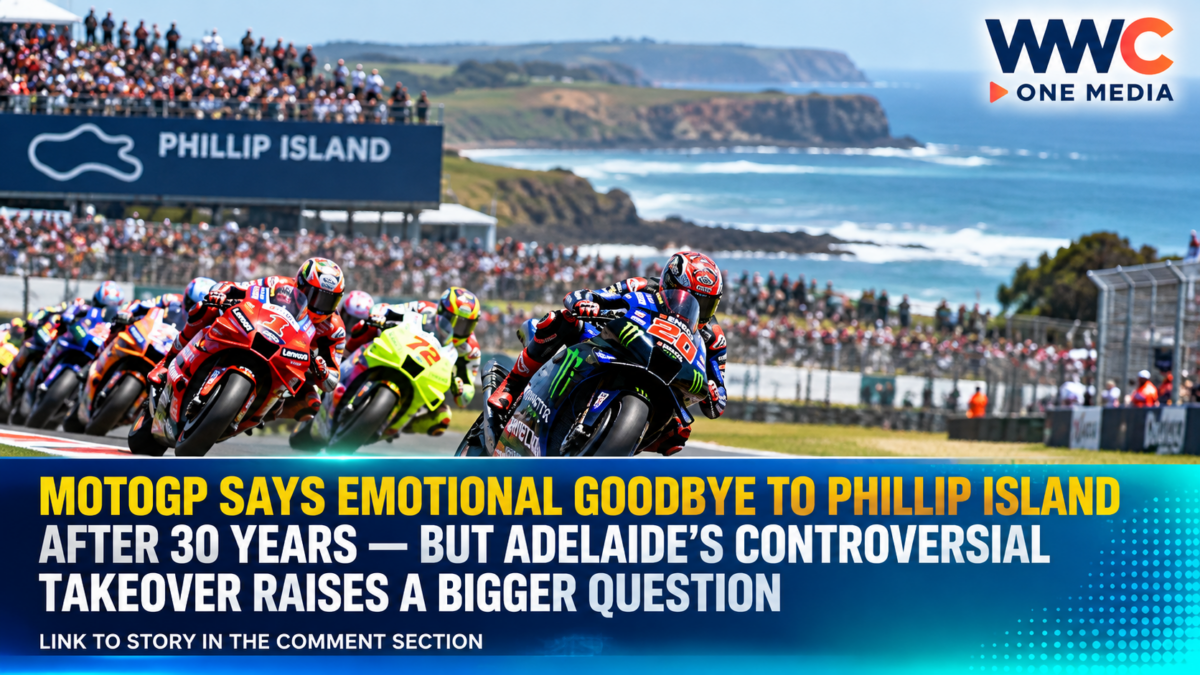
MELBOURNE, AUSTRALIA — October 22, 2026 — One of motorcycle racing’s most legendary circuits is preparing for an emotional final chapter as MotoGP returns to Phillip Island for the last scheduled Australian Grand Prix at the iconic coastal venue.
The race, set for Sunday, October 25, will bring an end to approximately three decades of MotoGP competition at the picturesque track south of Melbourne.
From its breathtaking ocean views and high-speed corners to unforgettable victories by Australian racing legends, Phillip Island has become one of the most celebrated destinations on the world championship calendar.
But the farewell comes amid controversy.
Starting in 2027, the Australian Motorcycle Grand Prix will move to a newly developed street circuit in Adelaide, South Australia, following unsuccessful negotiations to retain the event in Victoria.
The relocation has disappointed riders, former world champions and loyal supporters who believe Phillip Island offers a racing experience that few circuits can match.
Now, with heavy rain and possible storms threatening the final weekend, the iconic venue could deliver one last dramatic chapter before MotoGP moves to its new home.
Riders Prepare for an Emotional Final Race
For MotoGP’s leading competitors, the final Australian Grand Prix at Phillip Island is more than another stop on the championship calendar.
It marks the loss of a circuit renowned for its flowing corners, extreme speeds and demanding weather conditions.
Ducati rider Marc Márquez, who has won five races at Phillip Island across different classes, expressed his admiration for the venue ahead of the weekend.
He described racing there for the final time as an emotional occasion and praised the circuit’s distinctive layout.
The Spanish star has won four premier-class MotoGP races at the track.
The sense of loss extends across the paddock, with several riders describing Phillip Island as one of their favorite destinations.
Trackhouse rider Raúl Fernández, who won last year’s Australian Grand Prix, admitted that the farewell would be especially meaningful.
Fernández said he expected to become emotional, not only because the circuit delivered his first MotoGP victory but also because he had always enjoyed racing there.
For the riders, the move represents the end of an era defined by a rare combination of technical challenges, scenic surroundings and memorable racing.
Why Phillip Island Became a MotoGP Legend
Phillip Island’s history is closely tied to Australia’s greatest motorcycle racing champions.
The circuit hosted the Australian Grand Prix in 1989 and 1990 before becoming a regular fixture on the world championship calendar in 1997.
Its racing legacy includes remarkable achievements by three Australian icons.
Casey Stoner recorded six consecutive victories at Phillip Island from 2007 through 2012, establishing one of the venue’s most celebrated winning streaks.
Mick Doohan secured his fifth and final premier-class world championship with victory at the Australian Grand Prix in 1998.
Wayne Gardner, Australia’s first premier-class motorcycle world champion, won the Australian Grand Prix in both 1989 and 1990.
All three have sections of the circuit named in their honor.
Over the decades, Phillip Island has attracted millions of spectators and produced countless memorable battles.
Its fast, sweeping layout and exposure to unpredictable coastal weather have consistently challenged even the world’s most experienced riders.
Those characteristics have helped make the track a favorite among competitors and motorsport enthusiasts.
Why MotoGP Is Leaving Phillip Island
Despite its racing heritage, Phillip Island has faced growing challenges as the commercial and infrastructure requirements of modern MotoGP have evolved.
The circuit is located in a relatively remote area of Victoria, making access and large-scale event logistics more difficult than at major metropolitan venues.
Some facilities have also required significant modernization.
With the existing hosting agreement nearing its conclusion after the 2026 event, MotoGP’s commercial organizers sought a different arrangement.
According to Reuters, organizers pushed for the Australian Grand Prix to relocate to Albert Park in Melbourne, which already hosts the Formula One Australian Grand Prix.
The Victorian government declined the proposal to move the motorcycle race to Albert Park.
Negotiations ultimately failed to produce a renewed agreement.
The South Australian government subsequently secured the event for Adelaide.
The decision means Phillip Island is losing MotoGP’s Australian championship round, although the venue itself is not closing and can continue hosting other motorsport activities.
Casey Stoner Criticizes the Decision
Among the most outspoken critics of the relocation is two-time MotoGP world champion Casey Stoner.
The Australian racing legend believes more could have been done to preserve Phillip Island’s place on the MotoGP calendar.
Speaking to Australian media, Stoner questioned whether Victorian authorities and local organizers had made sufficient efforts to retain the event and develop a larger festival experience around the race.
His criticism reflects the frustration of supporters who regard Phillip Island as irreplaceable.
The Victorian government, however, maintains that it rejected MotoGP organizers’ request to transfer the event to Melbourne’s Albert Park.
The disagreement highlights the competing priorities involved in modern motorsport: historical significance, infrastructure investment, commercial viability and government support.
While some riders and fans favor protecting the island’s heritage, event promoters see opportunities in bringing MotoGP closer to a major city.
Adelaide to Host MotoGP’s First City-Centre Grand Prix in 2027
The Australian Grand Prix will begin a new chapter in Adelaide in November 2027.
MotoGP and the South Australian government have agreed to a six-year hosting arrangement running through 2032, with an option for a further extension.
The race will take place on a newly developed street circuit incorporating elements of Adelaide’s historic Formula One Grand Prix route, which hosted F1 races between 1985 and 1995.
The latest layout, unveiled in August 2026, measures approximately 4.13 kilometers and features 15 corners.
The redevelopment is projected to cost A$96 million.
The circuit will combine existing city roads with specially prepared racing surfaces, barriers and temporary gravel run-off areas.
Organizers insist that the design will meet modern motorcycle racing safety standards.
The September reaction from riders was mixed.
Some welcomed improvements to the circuit’s safety features, while others questioned whether an urban venue could deliver racing as exciting as Phillip Island.
South Australian officials believe Adelaide’s central location could attract larger audiences and generate significant economic activity.
The inaugural event is expected to draw more than 180,000 spectators across the race weekend, although that remains an attendance forecast rather than a confirmed result.
Fans Question Whether Adelaide Can Replace Phillip Island
The move to Adelaide has reopened a long-running debate in international motorsport.
Should historically important circuits be preserved even when modern commercial considerations favor new locations?
Phillip Island has built its reputation on dramatic changes of direction, high-speed racing and its extraordinary coastal setting.
Adelaide offers a different proposition: easier access to a major metropolitan area, expanded hospitality opportunities and a festival atmosphere integrated into the city.
Supporters of the new venue argue that the relocation could expose MotoGP to new audiences and strengthen its commercial appeal.
Critics worry that the championship is sacrificing one of its most distinctive tracks.
The revised circuit layout has helped address some rider concerns about safety, but questions remain about the quality of racing it will produce.
Ultimately, Adelaide’s success cannot be judged fully until motorcycles compete there in 2027.
Jorge Martín and Marc Márquez Enter a Tight Championship Battle
Phillip Island’s final race also arrives at a critical moment in the 2026 MotoGP championship.
Aprilia rider Jorge Martín leads the standings by just two points over Ducati star Marc Márquez heading into the Australian Grand Prix.
That narrow margin increases the importance of every qualifying session, sprint result and championship point.
A strong performance at Phillip Island could significantly affect the title race.
But the combination of an unfamiliar competitive order and unpredictable weather adds uncertainty.
With both riders fighting for the championship, the final Australian Grand Prix at the venue could become memorable for sporting reasons as well as its historical significance.
No winner of the October 25 main race has been established, as the event has not yet taken place.
Storm Threat Could Disrupt Phillip Island’s Farewell
Weather may become one of the biggest storylines of the weekend.
After several days of favorable conditions, forecasts cited by Reuters indicated rain could affect Saturday’s qualifying sessions.
Storms were also considered possible on Sunday, raising the prospect of delays or interruptions during the final race.
Phillip Island is known for rapidly changing weather, making wet-weather riding an important part of its reputation.
Australian rider Jack Miller, who has previously performed well in challenging conditions, appeared to welcome the possibility of another unpredictable race.
The forecast provides a fitting backdrop to a circuit famous for exposing riders to difficult conditions.
However, a storm-related cancellation or postponement had not been announced as of October 22.
Any changes to the schedule would depend on actual conditions and decisions by race officials.
What Does the Move Mean for Australian Motorsport?
The relocation represents a major change in the distribution of high-profile motorsport events within Australia.
Victoria will retain the Formula One Australian Grand Prix at Albert Park, while South Australia gains the country’s MotoGP round.
The shift could influence tourism, local spending, sponsorship opportunities and regional sporting investment.
Phillip Island’s departure from the MotoGP calendar may affect businesses that have benefited from visiting fans, including accommodation providers, restaurants and transport operators.
Adelaide, meanwhile, hopes to generate new tourism and commercial activity through its city-centre event.
The final economic impact will depend on attendance, spending, operating costs and how successfully the new venue attracts international visitors.
What Happens Next?
The 2026 Australian Grand Prix runs from October 23 to 25, with Sunday’s main race scheduled to deliver Phillip Island’s farewell to MotoGP.
Riders will be balancing the emotional significance of the occasion with the pressure of an ongoing world championship fight.
Officials will also monitor weather conditions closely as rain threatens to complicate the final weekend.
Beyond the race, attention will turn toward construction and preparation for Adelaide’s inaugural MotoGP event in November 2027.
The move has already divided opinion, and the debate is unlikely to disappear immediately.
Phillip Island has delivered some of the most unforgettable racing moments in MotoGP history. But as the Australian Grand Prix prepares to leave its legendary coastal home, the bigger question is whether Adelaide can create a new spectacle without losing the magic that made Phillip Island special.