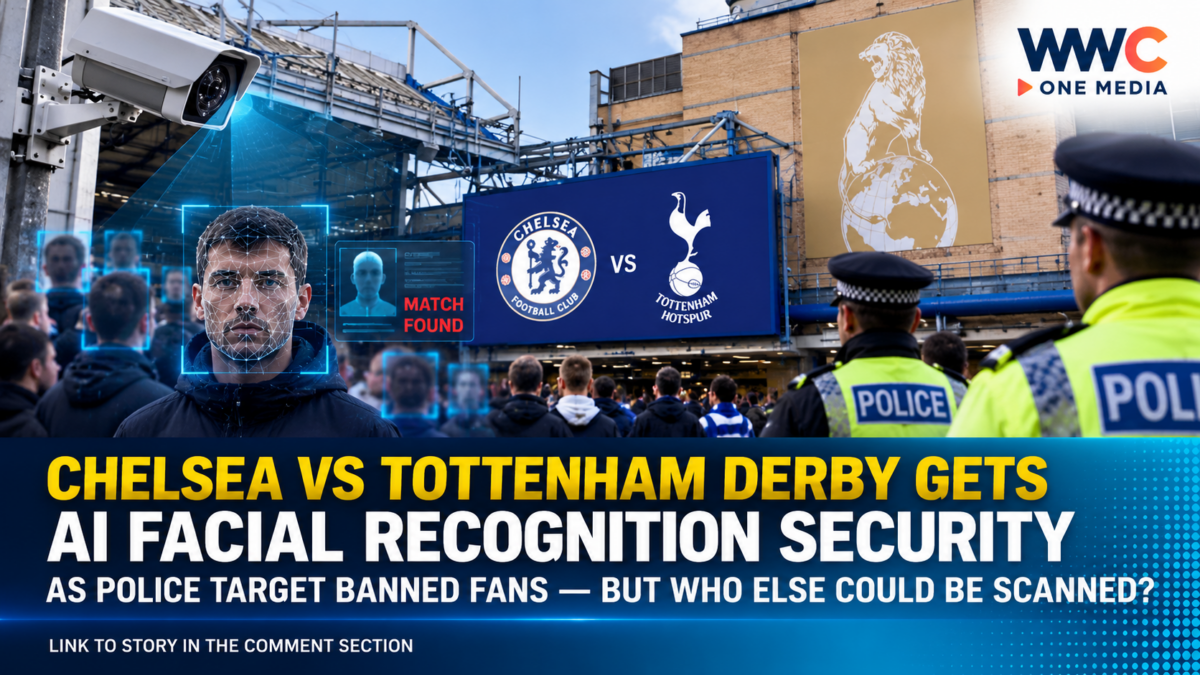
LONDON, UNITED KINGDOM — October 22, 2026 — Football supporters attending Chelsea’s Premier League showdown against Tottenham Hotspur this weekend will encounter an additional security measure as London’s Metropolitan Police prepare to deploy live facial recognition technology around the match.
The highly anticipated London derby, scheduled for Saturday, October 24, at Stamford Bridge, has been classified by police as a high-risk fixture.
Authorities plan to position two specially equipped surveillance vans near Earl’s Court and West Brompton during the period before kickoff.
The technology will scan faces captured within designated zones and compare them against police watchlists containing individuals subject to football banning orders, people wanted for serious offences and certain missing persons.
The announcement highlights the growing use of biometric identification at major sporting events, raising a wider question about the balance between protecting spectators and safeguarding personal privacy.
Police Confirm Facial Recognition Deployment
The plans emerged on Wednesday, October 21, when the Chelsea Supporters’ Trust published information it had received from the Metropolitan Police.
According to the communication, two live facial recognition vans will operate during a designated pre-match window around Earl’s Court and West Brompton.
These locations are important transport and pedestrian routes used by supporters traveling to Stamford Bridge.
The Metropolitan Police subsequently confirmed to Reuters that facial recognition would be deployed and described the measure as standard practice for high-risk football matches.
Police said the operation would follow established procedures previously used during other football-related deployments.
The Chelsea Supporters’ Trust also reported that the Premier League and relevant football stakeholders were aware of and supportive of the operation.
Importantly, the deployment is focused on particular public areas outside the stadium, rather than representing a confirmed plan to scan every supporter throughout Stamford Bridge.
How Will the Facial Recognition Cameras Work?
Live facial recognition technology uses cameras to capture images of people moving through a designated area.
Software then analyzes facial features and compares them with a predefined watchlist.
If the system identifies a potential match, police officers can review the alert and determine whether further action is appropriate.
The Metropolitan Police’s own guidance explains that the technology is designed to identify people on specific watchlists rather than establish the identity of every person passing through the area.
The Chelsea–Tottenham deployment will use watchlist categories that include individuals subject to football banning orders linked to either club, people wanted in connection with serious offences, missing persons and individuals sought under court-issued warrants.
The police communication also states that signs will be placed around the recognition zones to inform members of the public about the technology.
Why Chelsea vs Tottenham Is Classified as High Risk
Chelsea and Tottenham are longstanding London rivals, with their meetings regularly attracting substantial crowds and intense supporter interest.
Such fixtures can require additional security planning, especially around transport stations, pedestrian routes and the separation of supporter groups.
Police have classified the October 24 encounter as a high-risk match.
That classification is the reason given for the enhanced operation.
However, the announcement does not establish that a specific attack, organized disturbance or violent incident has been confirmed as imminent.
The facial recognition deployment is described as a preventive security measure rather than a response to a publicly identified immediate threat.
Premier League’s Multimillion-Pound Investment
The technology is part of a broader initiative supported by Premier League funding.
In December 2025, the league announced financial support for pilot programs using intelligence-led facial recognition to identify serious offenders attending matches in London.
The Athletic subsequently reported that the Metropolitan Police had received £3.42 million, equivalent at the time to approximately US$4.58 million, in funding associated with the trials.
The investment reflects increasing interest in using technology to strengthen security at major football fixtures.
The police have already tested live facial recognition at several Premier League matches.
According to reporting cited by Reuters, the technology had been used at six previous league fixtures, beginning with the Arsenal–Tottenham north London derby in September 2023.
It was also used at relevant fixtures during the 2025–26 season.
The Chelsea–Tottenham operation is therefore not the first use of facial recognition technology in English top-flight football.
Other Police Forces Are Also Using the Technology
The approach is no longer confined to London’s Metropolitan Police.
Merseyside Police introduced live facial recognition technology in December 2025.
According to BBC reporting cited by Reuters, the force used the technology during a Manchester United–Everton fixture in February 2026.
The expansion suggests that biometric identification is becoming a more prominent part of football security planning in England.
However, the technology is not confirmed to be in use at every Premier League match or stadium.
Deployments depend on the decisions, operational plans and legal obligations of the police forces involved.
Privacy Concerns: Are Ordinary Supporters Being Scanned?
The use of facial recognition cameras raises questions about whether members of the public can attend major sporting events without having their biometric information processed.
Although watchlists are intended to identify specific individuals, the cameras may capture images of many people who are not suspected of wrongdoing.
Privacy and civil liberties concerns surrounding facial recognition include the risk of false matches, questions about proportionality, the handling of biometric data and the extent of public oversight.
Supporters of the technology argue that identifying wanted individuals and people subject to football banning orders can help prevent disorder and protect spectators.
Critics of police facial recognition more broadly question whether such systems create unnecessarily intrusive surveillance of public spaces.
These competing concerns are particularly relevant at sporting events, where tens of thousands of people may travel through surrounding streets and transport stations.
The Chelsea–Tottenham reporting does not establish that this specific deployment has unlawfully collected or retained personal data.
What Happens if a Fan Is Incorrectly Identified?
Facial recognition technology is not infallible.
Potential mismatches can occur, and the accuracy of biometric systems depends on factors including image quality, algorithm performance and deployment conditions.
Under the Metropolitan Police’s published approach, a system alert is subject to review rather than automatically resulting in an arrest.
A police officer must assess the circumstances before deciding what action, if any, is justified.
The deployment announcement does not specify any new automatic punishment for supporters who trigger an alert.
Nor does it mean that every person passing through the area will be stopped or questioned.
The central operational question is whether the technology can help identify people legitimately sought by police while minimizing unnecessary interference with other supporters.
What Does This Mean for the Future of Football Security?
The deployment could contribute to continuing discussions about surveillance technology in professional sports.
Major football competitions already rely on substantial security infrastructure, including CCTV networks, ticketing controls, crowd-management procedures and police intelligence.
Live facial recognition introduces an additional tool capable of comparing images against selected watchlists in real time.
Its supporters see potential benefits in identifying individuals who present known security concerns.
But wider adoption would also raise questions about transparency, accountability and the appropriate limits of biometric surveillance.
Whether the technology becomes more widely used will depend on operational results, public scrutiny, applicable legal requirements and decisions made by police and football authorities.
What Happens Next?
Chelsea and Tottenham are scheduled to meet on October 24, with police deploying the surveillance vans before the match.
The Chelsea Supporters’ Trust said authorities had offered to provide a debrief within 72 hours of the operation.
That review could provide additional information about how the deployment was conducted.
However, no number of expected arrests, watchlist matches or resulting police interventions was confirmed in advance.
For supporters, the important development is that police have announced a clearly defined facial recognition operation around the match, not a blanket identification requirement for every attendee.
The Chelsea–Tottenham derby will provide another test of facial recognition technology in English football. But the question extending far beyond Saturday’s result is whether enhanced stadium security can coexist with meaningful safeguards for supporters’ privacy.