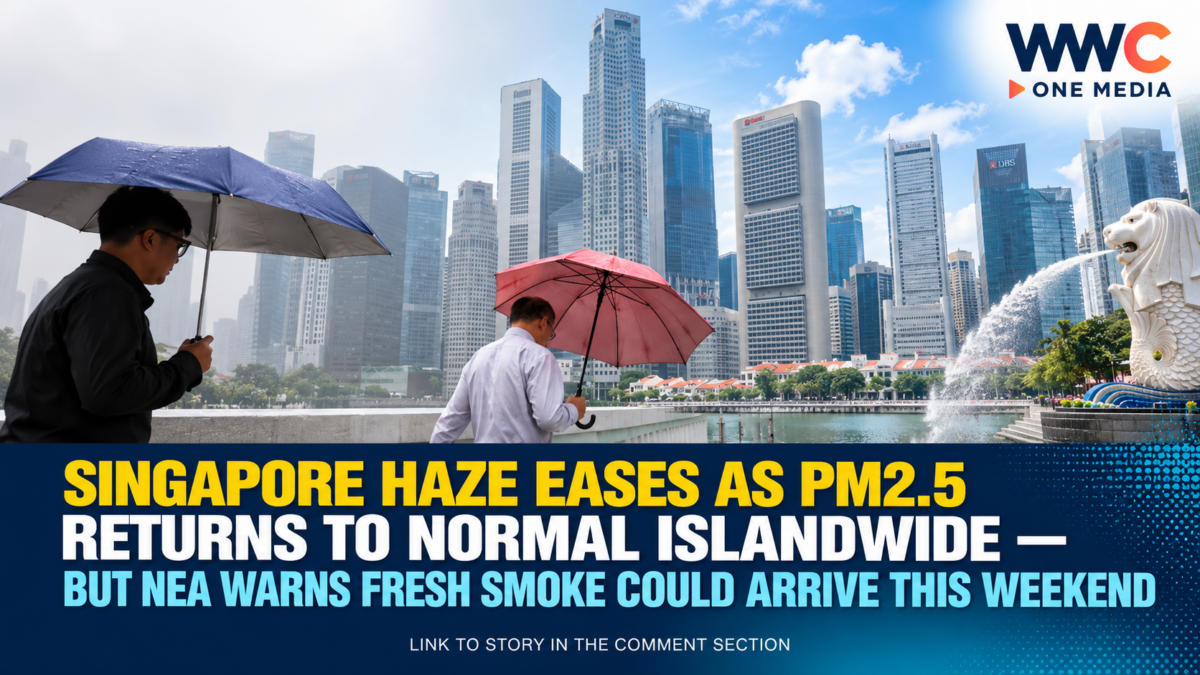
SINGAPORE — Singapore experienced an improvement in air quality on Thursday morning, October 22, with hourly fine-particle pollution readings returning to the normal range across all five regions following days of persistent haze.
But the relief may be temporary.
The National Environment Agency (NEA) has warned that smoke from fires in Indonesia could continue drifting toward Singapore, with changing wind patterns potentially bringing additional haze over the weekend.
According to Channel NewsAsia, all five regions recorded normal one-hour PM2.5 readings by 8am Thursday, ranging from 22 to 42 micrograms per cubic metre.
However, western Singapore continued to register unhealthy air quality on the longer-term 24-hour Pollutant Standards Index (PSI), with a reading of 108.
The remaining four regions recorded moderate PSI levels ranging from 74 to 95.
The difference highlights an important point: Singapore’s immediate air quality improved, but the pollution accumulated over the preceding 24 hours had not completely cleared.
Singapore’s October 22 Air Quality Readings
OCTOBER 22, 2026 — 8AM SINGAPORE TIME
Islandwide 1-hour PM2.5
22–42
µg/m³ — Normal band
Western Singapore 24-hour PSI
108
Unhealthy
Other regions’ 24-hour PSI
74–95
Moderate
NEA forecast for Oct 22
101–160
Unhealthy range forecast
Morning observations from CNA; forecast issued by NEA on October 21. Forecast values are not measured readings.
Why Normal PM2.5 Readings Don’t Mean the Haze Has Completely Disappeared
Singapore uses two important measures to assess air quality: the one-hour PM2.5 concentration and the 24-hour PSI.
The one-hour PM2.5 reading tracks the concentration of fine particles over a shorter period. It is useful when deciding whether to exercise or carry out other outdoor activities immediately.
The 24-hour PSI reflects air quality over a longer period and is more useful when planning activities for the day.
This explains why the island could record normal hourly PM2.5 readings on Thursday morning while western Singapore’s 24-hour PSI remained unhealthy.
The recent drop in fine-particle concentrations was encouraging, but earlier pollution continued to influence the longer-term index.
Understanding Singapore’s air quality categories
| 24-hour PSI | Air quality |
|---|---|
| 0–50 | Good |
| 51–100 | Moderate |
| 101–200 | Unhealthy |
| 201–300 | Very unhealthy |
| Above 300 | Hazardous |
For the one-hour PM2.5 indicator, the normal band extends up to 55 µg/m³, while concentrations of 56–150 µg/m³ fall within the elevated band.
These indicators should not be treated as interchangeable.
Why the Haze Could Return Over the Weekend
The NEA’s October 21 advisory identified smoke haze from fires in Kalimantan and Sumatra as continuing regional concerns.
Although showers were forecast in parts of Singapore and surrounding areas, dry weather was expected over southern Kalimantan.
Prevailing east-southeasterly or southeasterly winds could transport smoke toward Singapore on Thursday.
The agency also warned that regional smoke could continue affecting Singapore on Friday.
By Saturday, a shift in wind direction could create conditions favorable for haze from Sumatra to drift toward the island.
NEA’s regional haze outlook
Thursday, October 22
Potential transport of smoke from Kalimantan toward Singapore.
Friday, October 23
Some regional smoke haze could continue reaching Singapore.
Saturday, October 24
Changing winds could bring smoke from Sumatra toward Singapore.
Weather-dependent forecast, not a confirmed prediction of unhealthy air quality on each day.
Where Is the Smoke Coming From?
Singapore’s recurring haze episodes are often associated with smoke from vegetation and land fires elsewhere in Southeast Asia.
During the latest episode, the NEA observed smoke haze from Kalimantan in Singapore’s vicinity and identified smoke over Sumatra.
Regional fire hotspots, dry conditions and wind direction can combine to transport fine particles across national borders.
This is known as transboundary haze.
However, the precise contribution of individual fires to Singapore’s air quality can be difficult to determine. The NEA cautioned that cloud cover affected the visibility of some hotspots and smoke in satellite observations.
It would therefore be inaccurate to assign all of Singapore’s pollution to a particular fire or plantation without supporting evidence.
Why Health Authorities Remain Cautious
Fine particulate matter, or PM2.5, refers to airborne particles small enough to enter deep into the lungs.
Exposure may irritate the eyes, nose and throat and can pose greater risks for people with existing respiratory or heart conditions.
Singapore’s Ministry of Health advises residents to adjust outdoor activities according to air quality, individual health conditions, and the duration and intensity of physical exertion.
Even when hourly pollution readings improve, people should continue checking updated information because concentrations may change as weather and wind conditions shift.
Singapore’s Haze Emergency: How Conditions Have Changed
The October 22 improvement follows a prolonged period of poor air quality.
On October 18, The Straits Times reported that western Singapore’s PSI reached 230, placing it in the very unhealthy category. The country had also experienced a sustained run of unhealthy air quality readings.
By October 19 and 20, rainfall and shifts in wind direction were helping reduce pollution in some regions. By the morning of October 22, all five regions had returned to the normal hourly PM2.5 band.
Reported readings at different times, not a continuous monitoring series.
065130195260Oct 18 peakOct 22, 8amReadings are snapshots from October 18 and October 22, not measurements taken at identical times. Sources: The Straits Times and CNA.
What Residents Should Do While Haze Conditions Remain Uncertain
Singapore’s official health guidance varies by individual vulnerability and the intensity of outdoor activity.
| Group | Advice when 24-hour PSI is forecast unhealthy |
|---|---|
| Healthy adults | Reduce prolonged or strenuous outdoor physical exertion |
| Children, elderly and pregnant women | Minimise prolonged or strenuous outdoor physical exertion |
| People with chronic heart or lung disease | Avoid prolonged or strenuous outdoor physical exertion |
For immediate outdoor plans, use the latest one-hour PM2.5 readings. If concentrations rise into the elevated band, vulnerable individuals should avoid strenuous outdoor activity for the next hour, while healthy individuals should reduce strenuous activity.
Singapore’s Ministry of Health also advises that well-fitting N95 or equivalent masks may help reduce exposure to fine particles when conditions warrant them. Surgical and cloth masks are less effective at filtering fine particles.
For the latest official readings, consult Singapore’s official haze information portal or the myENV app.