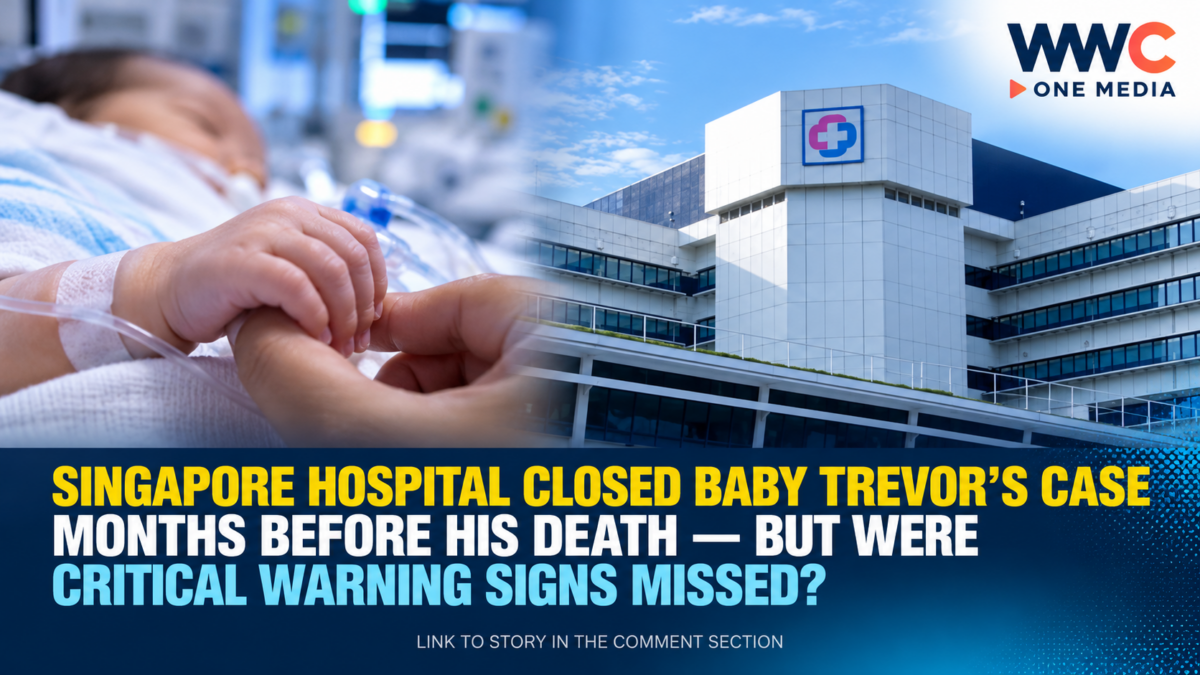
SINGAPORE — New details have emerged about the medical care of eight-month-old Trevor Neo Yu Hin, who died in September 2024 after suffering prolonged abuse by his parents, raising questions about how healthcare providers and child protection systems assess warning signs involving vulnerable children.
On Thursday, October 22, 2026, KK Women’s and Children’s Hospital (KKH) explained that Trevor had undergone extensive medical examinations during an admission months before his death.
The hospital said doctors found no injuries at the time and subsequently provided follow-up support to the family. His case was eventually closed after hospital staff assessed that no outstanding concerns remained.
The statement follows the October 21 sentencing of Trevor’s parents, Neo Jia Ming, 27, and Chloe Gan Ci Xuan, 23, who received prison terms of 16 years and 15 years and three months, respectively, for offences connected to their son’s abuse and death.
Although the criminal proceedings have established the parents’ responsibility, the case has brought renewed attention to a separate question:
Could the warning signs identified during Trevor’s earlier medical visits have led to additional protection before his death?
The available reporting does not establish that KKH breached medical protocols or that the tragedy could definitively have been prevented.
Baby Was Hospitalised When He Was Just Over One Month Old
Trevor was admitted to KKH from January 18 to January 23, 2024, when he was slightly older than one month.
His father brought him to the hospital because of reduced milk intake, vomiting and concerns that his mother had shaken him.
According to KKH medical board chairman Associate Professor Eileen Lew, the hospital conducted several examinations to assess his condition.
These included a brain scan, an eye examination and X-rays.
The hospital said Trevor was alert and conscious during the assessment, with no injuries detected.
KKH also said there was no reported loss of consciousness during its clinical assessment. However, subsequent court proceedings heard that Trevor had become unresponsive before his parents sought medical attention.
That difference between the clinical account and the evidence later heard in court is important when understanding the sequence of events.
The hospital maintained that it evaluated the child based on the clinical findings and information available at the time.
Hospital Developed a Care Plan Before Discharging Trevor
During the January admission, KKH staff worked on a care plan for the baby and his parents.
Both parents agreed to follow the arrangements before Trevor was discharged.
KKH said it continued monitoring the case after his release, including helping the family access parenting and child development support services.
Associate Professor Lew stated that the case was eventually closed because no outstanding concerns had been identified during follow-up.
However, CNA’s October 22 report did not provide the full details of the care plan, its precise duration or the criteria used to close the case.
The distinction matters because providing family support and making a formal referral to statutory child protection services are not necessarily the same process.
Additional reporting on the case indicates that Trevor had not been referred to the Ministry of Social and Family Development’s Protective Service or a social service agency for suspected abuse before his death.
CNA
+1
Trevor Returned to Hospital in April After Nanny Raised Concerns
A second medical visit occurred on April 2, 2024.
Trevor’s nanny had noticed bleeding inside the infant’s mouth and insisted that his parents take him to a doctor.
According to facts presented in court, his father had put his fingers into Trevor’s mouth to stop him from crying.
A doctor at KKH observed localized trauma and redness beneath the baby’s tongue.
In its response to CNA, the hospital said Trevor appeared well and that no tear or active bleeding was detected during the examination.
KKH also said the parents reported that the baby habitually sucked his fingers and hands, and provided accounts that appeared consistent with the clinical findings.
Trevor was discharged the same day.
These details highlight the difficulty of assessing possible abuse when healthcare professionals must interpret physical findings alongside explanations from caregivers.
They do not, by themselves, establish that a particular medical professional knowingly overlooked abuse.
CNA
The Timeline: From Hospital Visits to Court Sentencing
January 18–23, 2024
Trevor admitted to KKH; medical examinations find no injuries. A care plan is arranged.
April 2, 2024
Trevor examined after his nanny notices an injury inside his mouth. He is discharged that day.
September 1–2, 2024
Trevor suffers the fatal abuse incident and is pronounced dead at KKH.
October 12, 2026
Both parents plead guilty to charges connected to the prolonged abuse and death.
October 21, 2026
Father sentenced to 16 years; mother receives 15 years and three months.
October 22, 2026
KKH publicly explains its earlier medical examinations and follow-up care.
Chronology drawn from CNA court and hospital reporting and The Straits Times.
Parents Sentenced to More Than 15 Years in Prison
On October 21, Singapore’s High Court sentenced the two parents after both pleaded guilty to offences relating to their son’s abuse.
Neo Jia Ming, father
16 years
Prison sentence
Chloe Gan Ci Xuan, mother
15 years, 3 months
Prison sentence
Sentences imposed October 21, 2026.
The court heard that Trevor had endured repeated physical abuse during much of his short life.
Both parents had participated in the mistreatment.
The mother pleaded guilty to causing Trevor’s death, while the father pleaded guilty to allowing his death.
The father also admitted a separate domestic abuse offence involving his wife.
Justice Hoo Sheau Peng rejected the argument that their youth and lack of parenting experience sufficiently mitigated their conduct.
The judge emphasized their responsibility for the child’s safety and noted that the family had access to support from relatives and a nanny.
Trevor was pronounced dead at KKH shortly after midnight on September 2, 2024.
The court also heard that an autopsy could not establish a definitive medical cause of death. The criminal convictions should therefore be reported in terms of the offences admitted and determined by the court, rather than claiming the autopsy conclusively identified one mechanism of death.
The Straits Times
+1
What KKH Says About Its Child Protection Procedures
KKH has explained that suspected cases of child abuse are assessed by paediatricians and medical social workers, with other specialists involved where necessary.
According to the hospital, assessments take account of clinical findings as well as social and behavioural indicators.
Cases that raise a reasonable concern of harm may be referred to the Ministry of Social and Family Development through Singapore’s National Anti-Violence and Sexual Harassment Helpline.
For other families, the hospital may arrange follow-up support or referrals to community services.
These procedures reflect the importance of combining medical evaluation with assessments of a child’s broader safety and welfare.
However, the existence of such procedures does not establish precisely how they were applied at each stage of Trevor’s case.
The hospital’s statements also do not amount to an admission of negligence.
The Larger Issue: When Should Suspected Abuse Be Escalated?
The tragedy illustrates a difficult problem in child protection.
Some injuries may be subtle, absent during an examination or accompanied by explanations that appear medically plausible.
At the same time, repeated concerning incidents may warrant closer scrutiny when viewed together.
Child protection decisions often depend on information gathered across healthcare providers, families, social workers and other professionals.
The critical challenge is identifying when the combination of medical and behavioural concerns justifies escalation.
For Trevor’s case, the published information does not fully establish why a statutory protection referral was not made or whether different interventions were considered.
Those are questions that would require a fuller assessment of records, protocols and the information available to the professionals involved.
Why This Case Matters Beyond Singapore
The case is relevant to wider discussions about child safety across Asia, including the Philippines.
It demonstrates the importance of reviewing possible abuse concerns in context, especially when a very young child cannot explain what happened.
Healthcare professionals, educators, childcare workers and social service agencies can each observe different pieces of information.
Effective communication and appropriate referral processes can therefore be important safeguards.
The case should not be interpreted as evidence that all unexplained childhood injuries are caused by abuse, nor that every medical examination can identify maltreatment.
Instead, it underlines the need for careful evaluation, documentation and coordinated follow-up.
The Bigger Question: Were There Opportunities for Earlier Intervention?
The most significant development in KKH’s October 22 statement is not a new criminal charge or a finding of wrongdoing against the hospital.
It is the confirmation that Trevor had received medical assessments and follow-up support months before his death, with his case later closed.
That fact has prompted understandable questions about how the system distinguishes between families needing general support and children facing a potential risk of serious harm.
The bottom line: KKH says Trevor Neo Yu Hin had no injuries detected during his January 2024 admission and that the hospital subsequently closed his case after follow-up. His parents have since been sentenced for offences connected to his abuse and death. Whether additional measures should have been taken during the earlier medical encounters has not been conclusively established in the reporting reviewed.