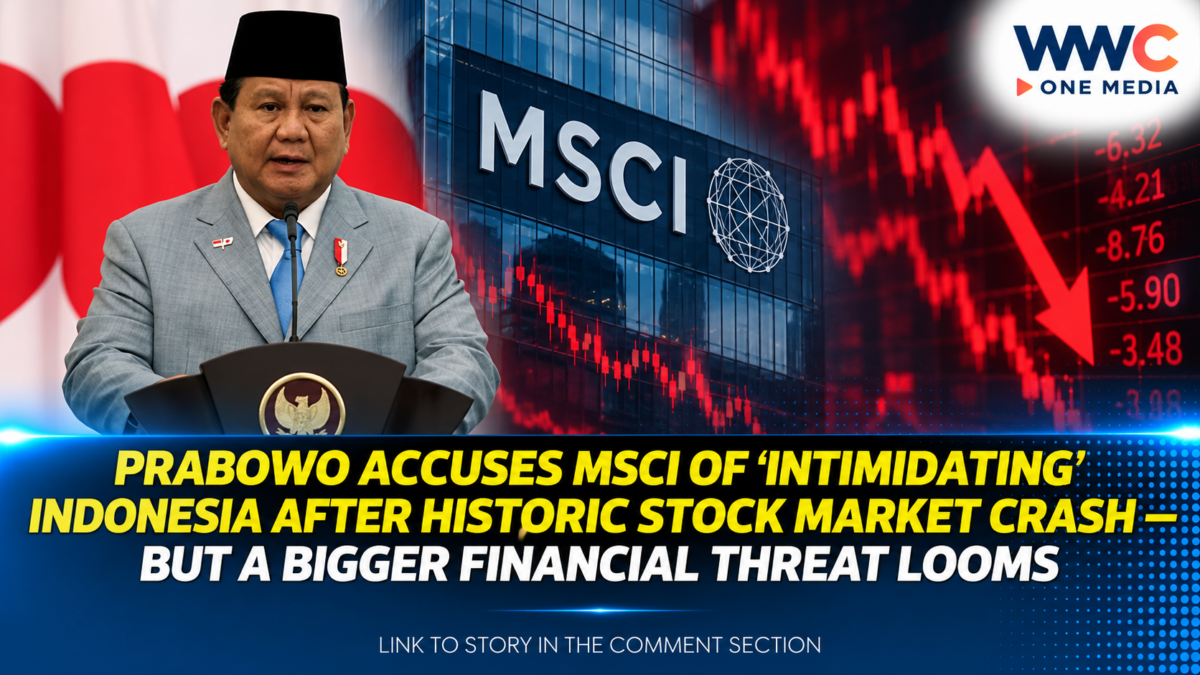
JAKARTA, INDONESIA — Indonesian President Prabowo Subianto has accused global index provider MSCI of attempting to intimidate Indonesia after its warning about a possible stock market downgrade triggered a historic selloff, raising concerns about foreign investment, capital flight and confidence in Southeast Asia’s largest economy.
Speaking during a nationally broadcast Cabinet meeting on Wednesday, October 21, Prabowo declared that Indonesia would not bow to outside pressure.
His remarks marked his first public response to MSCI’s announcement that Indonesian equities could be downgraded from emerging-market classification to standalone-market status because of continuing concerns about trading practices and market transparency.
The warning sparked a severe market rout, sending Indonesian stocks to their lowest levels in years and exposing the country to the possibility of substantial foreign capital outflows.
But MSCI has pushed back against the criticism, maintaining that its decisions follow established, transparent, rules-based methodologies.
The crucial question now is whether Indonesia can restore investor confidence and address MSCI’s concerns before a potential downgrade further disrupts international investment flows.
Prabowo: Indonesia Will Not Be Intimidated
Prabowo delivered his remarks in a forceful address to senior government officials, rejecting the suggestion that Indonesia should accept outside pressure without question.
He accused MSCI of attempting to intimidate the country following its decision to publicly raise the possibility of a downgrade.
The president said Indonesia would not be frightened into submission and emphasized the country’s national strength and willingness to overcome economic difficulties.
His comments came after days of intense market volatility, with investors reacting to the prospect that Indonesian shares could lose their place in major emerging-market benchmarks.
Prabowo also referred to concerns about outside interference, although he did not provide evidence establishing that foreign governments or institutions had coordinated an effort to destabilize Indonesia.
His accusations are political claims, not verified findings of misconduct by MSCI.
What Triggered Indonesia’s Stock Market Crisis?
The market turmoil began after MSCI warned on October 16 that it was considering reclassifying Indonesia’s equities as a standalone market.
MSCI cited insufficient progress in addressing concerns about coordinated trading activities and the overall functioning of the Indonesian stock market.
The announcement was particularly significant because MSCI’s indexes are widely followed by global fund managers.
Investment funds use these benchmarks to determine which countries and companies should be included in their portfolios.
If Indonesia loses its emerging-market classification, index-tracking investors may need to reduce or eliminate exposure to certain Indonesian equities.
That risk contributed to intense selling pressure as investors attempted to anticipate the potential consequences.
Indonesian Stocks Suffer Historic Selloff
INDONESIA MARKET CRISIS — KEY FIGURES
October 16 decline
−11.6%
Jakarta Composite Index
October 19 decline
−5%+
Additional selling pressure
2026 market performance
Nearly −40%
Reported year-to-date decline around the selloff
Indonesia economy
$1.5T
Approximate economy size in US dollars
Market figures from Reuters and The Wall Street Journal, reflecting their respective reporting dates. These are not live October 21 closing prices.
The Jakarta Composite Index plunged approximately 11.6% on Friday, October 16, in its worst daily performance since the 1998 Asian financial crisis.
The selloff continued on Monday, October 19, when Indonesian stocks declined by more than 5%, taking the benchmark to a six-year low.
The sharp declines also triggered trading interruptions and renewed anxiety about the country’s financial-market stability.
Indonesia’s currency, the rupiah, weakened as investors reassessed the country’s outlook.
Although MSCI’s warning was a major immediate catalyst, broader concerns about fiscal policy, governance and economic performance have also weighed on Indonesian assets.
Jakarta Composite Index: Two-Day Selloff
Daily percentage declines reported on October 16 and 19, 2026; Monday’s decline is shown at approximately 5%.
0%4%8%12%16%Oct 16Oct 19Magnitude of daily losses, not cumulative return. Source: Reuters market reporting.
What Happens If MSCI Downgrades Indonesia?
MSCI classifies stock markets based on factors including market accessibility, investability and the ability of international investors to trade efficiently.
Indonesia currently holds emerging-market status.
A move to standalone status would represent a serious setback for its international market standing.
| Market classification | What it means for investors |
|---|---|
| Emerging market | Eligible for inclusion in major emerging-market indexes, subject to MSCI’s security selection rules |
| Standalone market | Tracked separately from the main emerging- and frontier-market classifications |
| Potential consequences | Benchmark-related selling, reduced passive-fund exposure and higher uncertainty for international investors |
MSCI has not announced that the downgrade is final.
The company is evaluating Indonesia’s market conditions and its response to the concerns identified.
This is an important distinction: Indonesia faces a potential reclassification, not a confirmed immediate expulsion from all international investment markets.
Even in a standalone category, investors would still be able to invest in Indonesia, although benchmark-driven capital flows could change significantly.
Reuters
+2
MSCI Rejects Accusations of Political Pressure
In response to Prabowo’s comments, MSCI defended its decision-making procedures.
The company said its classification decisions follow transparent methodologies and established rules.
It also confirmed that it would continue monitoring Indonesian markets and engaging with local authorities and market participants.
MSCI did not acknowledge attempting to intimidate Indonesia.
The dispute therefore involves competing positions.
Prabowo views the warning as undue pressure on Indonesia, while MSCI maintains that its scrutiny reflects legitimate concerns about market practices.
No independent finding presented in the verified reporting establishes that MSCI acted on the instructions of a foreign government or manipulated its methodology to target Indonesia.
Singapore’s GIC and Temasek Dragged Into Controversy
The crisis took another turn when former Indonesian trade minister Muhammad Lutfi alleged that Singapore’s state investment institutions had helped pressure MSCI.
Lutfi claimed that GIC and Temasek were involved in efforts to influence the index provider’s decision.
Both institutions rejected the allegations.
GIC described the claims concerning its organization and staff as false, emphasizing that its investment decisions are based on the fundamentals of individual assets and businesses.
The sovereign wealth fund also said it had invested in Indonesia for more than 30 years and would continue seeking suitable opportunities there.
Temasek likewise rejected the accusations.
Fock Wai Hoong, the company’s head of Asia Pacific excluding China and India, said that neither Temasek nor its employees had approached MSCI to influence decisions involving regional stock exchanges.
The allegations have not been substantiated in the reporting reviewed, and should not be presented as evidence of Singaporean interference.
Indonesia’s Economic Minister Questions MSCI’s Transparency
The concern about MSCI is not limited to the president.
Senior economic minister Airlangga Hartarto questioned why the downgrade warning was not raised during meetings with Indonesian officials in Bangkok just days before MSCI’s announcement.
He argued that the timing created questions about the communication between the index provider and Indonesian authorities.
Other Indonesian lawmakers have called for greater scrutiny of MSCI’s methodology.
Hanif Dhakiri, a member of the parliamentary committee overseeing financial affairs, said Indonesia should examine criticism carefully while also demanding objectivity and consistency.
Opposition lawmaker Said Abdullah similarly urged the government to take MSCI’s concerns seriously without treating the index provider as beyond scrutiny.
These reactions show that Indonesia’s domestic debate includes both criticism of MSCI and recognition that the country’s stock market may need reforms.
Bank Indonesia Holds Interest Rates as Currency Pressures Mount
The stock-market turmoil has coincided with a difficult period for monetary policymakers.
On October 21, Bank Indonesia kept its benchmark seven-day reverse repurchase rate unchanged at 5.75%.
The central bank also announced adjustments to other monetary policy tools aimed at supporting liquidity and maintaining financial stability.
According to The Wall Street Journal, the measures included an increase in the overnight deposit facility rate to 5%, along with plans to reduce banks’ reserve requirements in stages.
The decisions reflect the competing pressures facing policymakers.
Indonesia wants to support economic growth, but aggressive monetary easing could place additional pressure on the rupiah if investors remain concerned about capital outflows.
Inflation was reported at 3.28% in September, within the central bank’s target range.
The challenge is to restore confidence without unnecessarily weakening economic activity.
Why International Investors Are Paying Close Attention
Indonesia is the largest economy in Southeast Asia and an important producer of commodities including nickel, coal and palm oil.
Its financial markets attract international investors seeking exposure to regional growth, infrastructure development and natural resources.
A serious downgrade by MSCI could affect how some investment funds allocate capital.
It could also influence perceptions of market governance and the cost of raising financing.
However, the effects would not be uniform.
Passive funds tracking specific indexes may be required to adjust their holdings, while actively managed funds can make their own investment decisions.
The severity of any capital outflow will depend on the final MSCI decision, index methodology, investor positioning and the government’s policy response.
Financial Times: Global Index Providers Are Becoming Powerful Market Gatekeepers
In additional analysis published October 21, the Financial Times examined the growing influence of global index providers.
The publication described how firms such as MSCI, FTSE Russell and S&P Dow Jones can influence international investment flows by changing market classifications and index eligibility.
As more capital follows passive investment strategies, index decisions can have substantial effects on stock valuations and the availability of foreign capital.
The Financial Times also noted the wider debate over whether index companies now exercise influence resembling a regulatory function, despite being private businesses.
Supporters of strict index standards argue that they protect investors by encouraging more transparent and reliable markets.
Critics question whether private firms should wield so much influence over national capital markets.
Indonesia’s crisis has made that debate particularly urgent.
Why This Matters for ASEAN and the Philippines
Indonesia’s market turmoil could influence investor sentiment across Southeast Asia.
International funds frequently evaluate ASEAN markets together when considering regional opportunities.
A sharp decline in one major economy may cause investors to reassess governance practices, liquidity and market accessibility elsewhere.
For the Philippines, this highlights the importance of predictable financial regulation, transparent trading conditions and effective investor protection.
However, Indonesia’s threatened MSCI downgrade does not mean the Philippine stock market faces the same classification action.
Any impact on Philippine stocks would depend on regional fund flows and broader market conditions, rather than an automatic change in Philippine market status.
The Bigger Question: Can Indonesia Rebuild Investor Confidence?
The immediate political confrontation between Prabowo and MSCI has attracted international attention.
But the longer-term issue concerns the strength and credibility of Indonesia’s financial markets.
Investors will be watching whether regulators can demonstrate progress on trading oversight, market transparency and enforcement.
They will also assess how the government communicates with international institutions and whether its reforms address the underlying concerns.
Indonesia’s leaders argue that MSCI’s decisions must be fair and properly explained.
MSCI maintains that its methodology is rules-based and that Indonesian authorities still have opportunities to engage.
The bottom line: President Prabowo has rejected what he describes as intimidation by MSCI after a historic stock-market crash. But Indonesia’s most consequential challenge is restoring investor confidence and preventing a possible classification downgrade that could disrupt international capital flows.