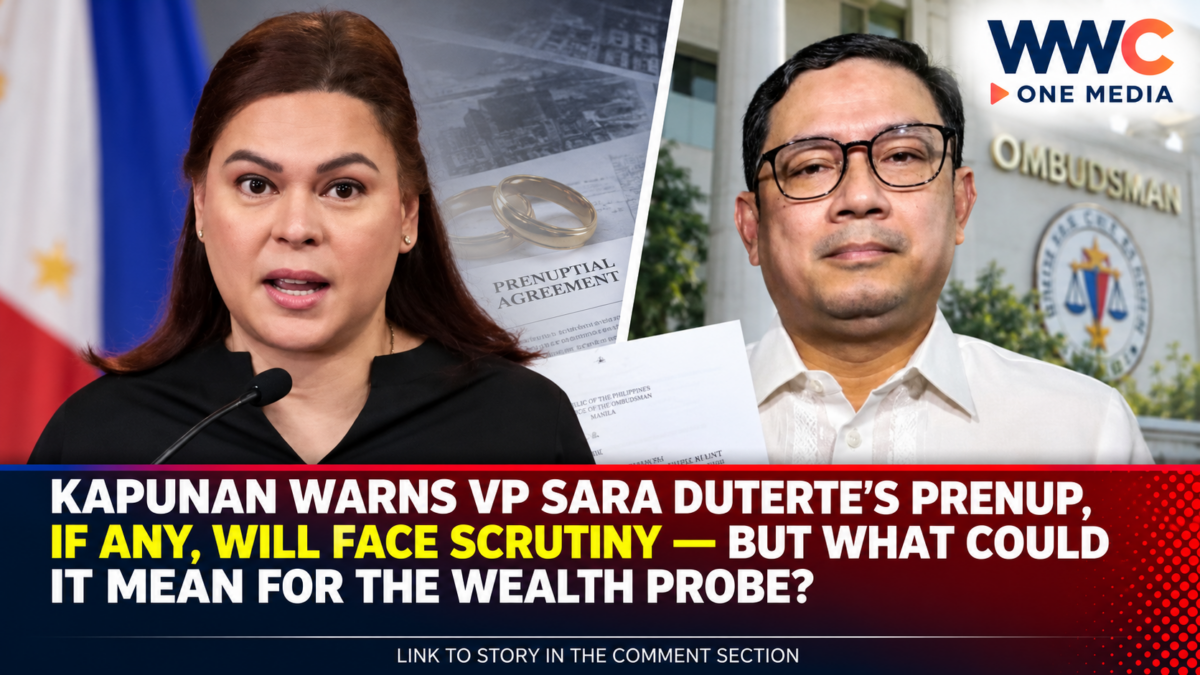
MANILA, Philippines — The question of whether Vice President Sara Duterte and her husband, lawyer Manases “Mans” Carpio, have a prenuptial agreement has become a significant legal issue in the ongoing scrutiny of their finances, with private prosecutor Lorna Kapunan emphasizing that any such agreement would face examination.
The issue goes beyond marital arrangements. It concerns how investigators and the Senate impeachment court may assess the couple’s assets, income, bank accounts and financial declarations as prosecutors pursue allegations of unexplained wealth against the Vice President.
However, subsequent developments in the impeachment proceedings have added an important detail: the defense reportedly confirmed that the couple had no prenuptial agreement, a point cited by the impeachment court when it allowed access to Carpio’s financial records.
Why the Prenuptial Agreement Matters
Under the Philippine Family Code, the property relations of married couples are generally governed by the absolute community of property regime when no valid marriage settlement provides otherwise, subject to applicable legal exceptions.
Articles 74 and 75 of the Family Code recognize marriage settlements as the primary basis for determining a couple’s property regime. Article 76 provides that modifications to marriage settlements must be made before the marriage, subject to the Code’s specified exceptions.
This distinction matters because a couple’s applicable property regime can affect how assets, income and liabilities are considered when authorities examine a public official’s declared wealth.
Former Integrated Bar of the Philippines president Domingo Cayosa previously explained in reports by GMA News and the Daily Tribune that spouses generally cannot simply treat their marital assets as entirely separate when the law places them under the absolute community of property regime.
The existence of a valid prenuptial agreement, however, would not automatically resolve every question about the couple’s finances. Its terms, validity, applicable legal provisions and relevance to the assets under investigation would still need to be established.
Senate Court Allows Examination of Carpio’s Financial Records
The issue became more consequential after the Senate impeachment court granted most of the prosecution’s requests for subpoenas covering the financial and tax records of Duterte, Carpio and businesses linked to them.
According to a July 2026 announcement from the House of Representatives, the court found the requested records relevant to the allegations concerning the Vice President’s unexplained wealth.
The ruling also addressed the defense’s objections to obtaining Carpio’s bank records. The court cited the confirmation that the couple had no prenuptial agreement and concluded that examining the husband’s financial records was necessary to establish a financial baseline against which Duterte’s wealth and lawful income could be assessed.
The House prosecution panel subsequently received copies of the requested bank and tax records, according to the Philippine News Agency’s September 3 report.
The development marked a major step in the prosecution’s effort to examine the couple’s financial activities and compare available records with their official declarations.
Prosecutors Raise Questions About Undeclared Assets
The financial scrutiny has since expanded, with prosecution witnesses presenting analyses of bank transactions, assets and income during the impeachment proceedings.
A report by GMA News on October 6 said the Senate impeachment court discussed discrepancies between the couple’s reported net worth and the volume of their bank transactions, based on testimony from Anti-Money Laundering Council Executive Director Ronel Buenaventura.
In another development, Daily Tribune reported on October 9 that forensic expert Alexander Cabrera estimated alleged unexplained wealth totaling ₱817.87 million for the period from 2022 to 2025.
The reported estimate incorporated financial information concerning Duterte and Carpio, including alleged undeclared cash, personal properties, business interests and income. The report also noted that Cabrera found no established prenuptial agreement or judicial decree separating the couple’s property.
These figures represent claims and findings presented during the proceedings, not a final judicial determination that the wealth was illegally acquired.
What Happens if a Prenuptial Agreement Is Presented?
If a valid marriage settlement were presented, the court would need to assess its legal effect and whether it changes the treatment of particular assets or financial interests.
But if no valid agreement exists, the default property regime may be central to determining which assets and income must be considered in evaluating the Vice President’s financial declarations.
Even then, the existence or absence of a prenuptial agreement would not, by itself, prove wrongdoing. Investigators and the impeachment court must still evaluate the documentary evidence, the applicable property rules, the origins of the assets and the explanations offered by the parties.
The distinction is crucial: financial discrepancies can prompt further investigation, but they do not automatically establish criminal liability or prove that wealth was unlawfully acquired.
A Critical Issue in the Impeachment Proceedings
The prenuptial agreement question has become part of a wider examination of Duterte’s declared assets, financial transactions and business interests.
The proceedings also carry significant political consequences. The Vice President has denied the allegations against her, while her defense has challenged aspects of the evidence and the prosecution’s approach.
With financial documents and expert testimony now playing a central role, the focus is increasingly on whether the evidence can substantiate the allegations under the standards applicable to the impeachment trial.
The central question remains: Can the prosecution establish that the financial discrepancies amount to unexplained wealth under the law, and will the evidence withstand scrutiny by the impeachment court?
The answer will depend not simply on whether a prenuptial agreement exists, but on what the financial records establish, how the couple’s assets are legally classified and how the court ultimately evaluates the evidence.