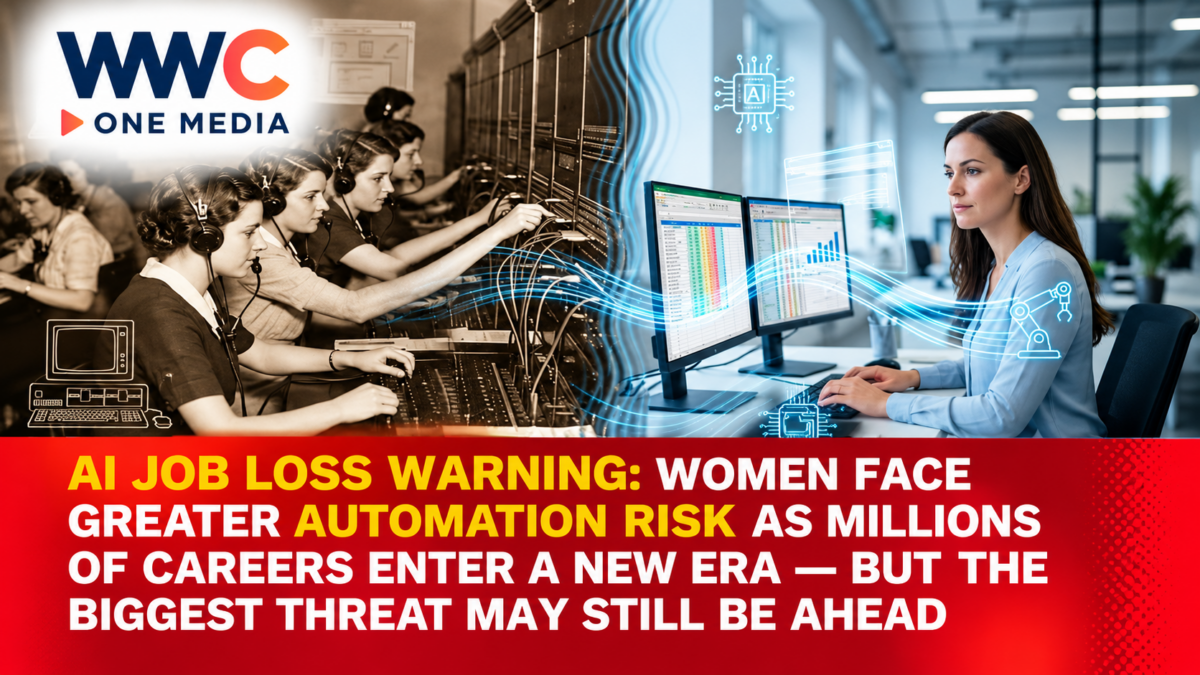
Artificial intelligence is transforming workplaces worldwide, but a growing body of research suggests that women could face disproportionately greater disruption as employers increasingly automate administrative, clerical and professional tasks.
The global artificial intelligence revolution is raising an uncomfortable question: Will women pay a higher price as businesses race to replace routine work with increasingly powerful AI systems?
As companies adopt generative artificial intelligence to improve productivity, research indicates that women face significantly greater exposure to workplace automation than men, particularly in occupations traditionally dominated by female employees.
The implications could extend far beyond Silicon Valley, potentially reshaping employment opportunities in banking, customer service, accounting, administration and the Philippines’ multibillion-dollar business process outsourcing industry.
Research from the International Labour Organization (ILO) indicates that female-dominated occupations are nearly twice as likely to be exposed to generative AI as male-dominated occupations.
According to the ILO’s March 2026 analysis, approximately 29% of female-dominated occupations face exposure to generative AI, compared with 16% of male-dominated occupations.
Around 16% of female-dominated occupations also fall into the highest AI-exposure categories, compared with just 3% of male-dominated occupations.
These findings raise concerns about whether the technology could deepen existing gender inequalities, especially if workers in vulnerable occupations cannot access retraining or new employment opportunities.
WHY WOMEN FACE GREATER AUTOMATION RISKS
The risks are closely connected to the types of occupations women and men currently hold.
Women are heavily represented in administrative support, clerical operations, payroll processing, reception services and accounting assistance.
Many tasks associated with these jobs involve managing information, preparing documents, processing transactions or responding to routine inquiries.
Those are precisely the activities that generative AI systems are becoming capable of assisting with or partially automating.
Meanwhile, many traditionally male-dominated jobs involve physical activities, including construction, mechanical repairs and skilled trades, that cannot be replaced by text-based AI software as easily.
However, exposure to artificial intelligence does not automatically translate into unemployment.
The ILO emphasizes that many occupations are more likely to undergo substantial changes in daily responsibilities rather than disappear entirely.
MILLIONS OF JOBS COULD CHANGE WORLDWIDE
A major ILO assessment published in May 2025 estimated that approximately one in four jobs worldwide involves some degree of exposure to generative AI.
Only 3.3% of global employment falls into the research’s highest exposure category, with women disproportionately represented.
The findings suggest that businesses may increasingly reorganize existing roles around human-AI collaboration, potentially reducing repetitive work while increasing demand for analytical judgment, oversight and specialized expertise.
However, the distribution of those benefits remains uncertain.
Without accessible retraining, companies could improve productivity while leaving some workers facing reduced responsibilities, fewer opportunities or pressure to move into lower-paying occupations.
HISTORY REVEALS AN UNEXPECTED TWIST
The October 19 CNBC report examines how earlier technological revolutions affected women’s employment, including the transition away from telephone switchboard operators and the arrival of personal computers.
As automatic telephone switching reduced the need for human operators, a once-prominent source of employment for women declined.
Other technological innovations, including household appliances and computers, changed the allocation of work and the types of occupations available to women.
Economic research examining these transitions suggests that fears about permanent losses of employment opportunities do not always materialize as expected.
However, generative AI raises a new concern.
Modern systems can automate information-processing tasks across multiple industries simultaneously, potentially affecting a broader range of professional roles.
That makes the speed of adaptation, availability of alternative jobs and access to new skills particularly important.
PHILIPPINES FACES ITS OWN AI EMPLOYMENT CHALLENGE
For the Philippines, the issue is particularly significant because of the country’s large services sector and reliance on IT-enabled employment.
A February 2026 ILO research brief estimated that approximately 12.7 million Philippine jobs, representing more than one-quarter of national employment, are exposed to generative AI.
However, only 3.6% of Philippine jobs were classified in the highest AI-exposure category.
The study also found that women face approximately twice the AI-exposure rate of men in the Philippines.
The National Capital Region stands out, with approximately two in five jobs exposed to generative AI.
Central Luzon and Calabarzon also have exposure rates exceeding 30%.
For business process outsourcing companies, this could mean a gradual shift away from routine data processing and basic customer interactions toward more complex services requiring human judgment, industry expertise and AI supervision.
At the same time, the transition could create opportunities in AI-assisted customer support, compliance monitoring, specialized analytics and technology management.
Whether those opportunities compensate for displaced work will depend on business investment, employment policies and worker training.
GLOBAL NEWS REPORTS SHOW BOTH RISKS AND OPPORTUNITIES
Reporting from Reuters, the Associated Press and the Financial Times highlights the uncertain employment outlook.
Reuters’ coverage of ILO research emphasized that jobs traditionally held by women could face greater technological disruption, while also noting that many roles could change instead of disappearing entirely.
The Associated Press reported that administrative professionals in the United States were increasingly using AI tools to handle repetitive tasks, freeing time for strategic work and relationship management.
Meanwhile, an October 2026 Financial Times survey of 94 economists found expectations that AI would improve economic productivity across major economies over the coming decade.
The survey also suggested that routine cognitive tasks would be especially vulnerable, even though economists did not generally anticipate universal mass unemployment.
The contrasting findings underscore a central uncertainty: Artificial intelligence could simultaneously eliminate certain positions, transform existing occupations and generate new sources of employment.
GLOBAL LEADERS WARN ABOUT THE RISKS
At the October 2026 International Monetary Fund and World Bank meetings, IMF Managing Director Kristalina Georgieva warned that the risks associated with rapidly advancing AI could outweigh its economic benefits without appropriate safeguards and responsible governance.
Concerns about employment disruption, inequality and the need for stronger protections have become increasingly important as technology adoption accelerates.
The warnings signal that AI is no longer merely a technology-sector issue.
It is becoming a major economic and labor-policy challenge for governments worldwide.
THE BIGGEST QUESTION: WHO WILL BENEFIT FROM AI?
The biggest question is not simply how many jobs artificial intelligence can automate.
It is whether workers will share in the economic gains created by the technology.
For women already facing barriers to higher-paying technical positions, access to AI training, career advancement and equitable hiring practices could determine whether the coming transformation expands opportunities or reinforces existing inequalities.
Companies that use AI to augment employees may experience productivity gains without extensive layoffs.
Others may reduce hiring or restructure workforces as automated tools become increasingly capable.
The outcome is far from settled.
As AI moves deeper into the global economy, the defining challenge may not be whether machines can perform human tasks, but whether millions of workers can transition quickly enough to the jobs that remain and the opportunities that emerge.
For the Philippines and the wider Asian labor market, the decisions made today could influence employment competitiveness for years to come.