UNITED STATES — One of the world’s most recognizable fast-food chains is making a historic break with its longtime beverage partner.
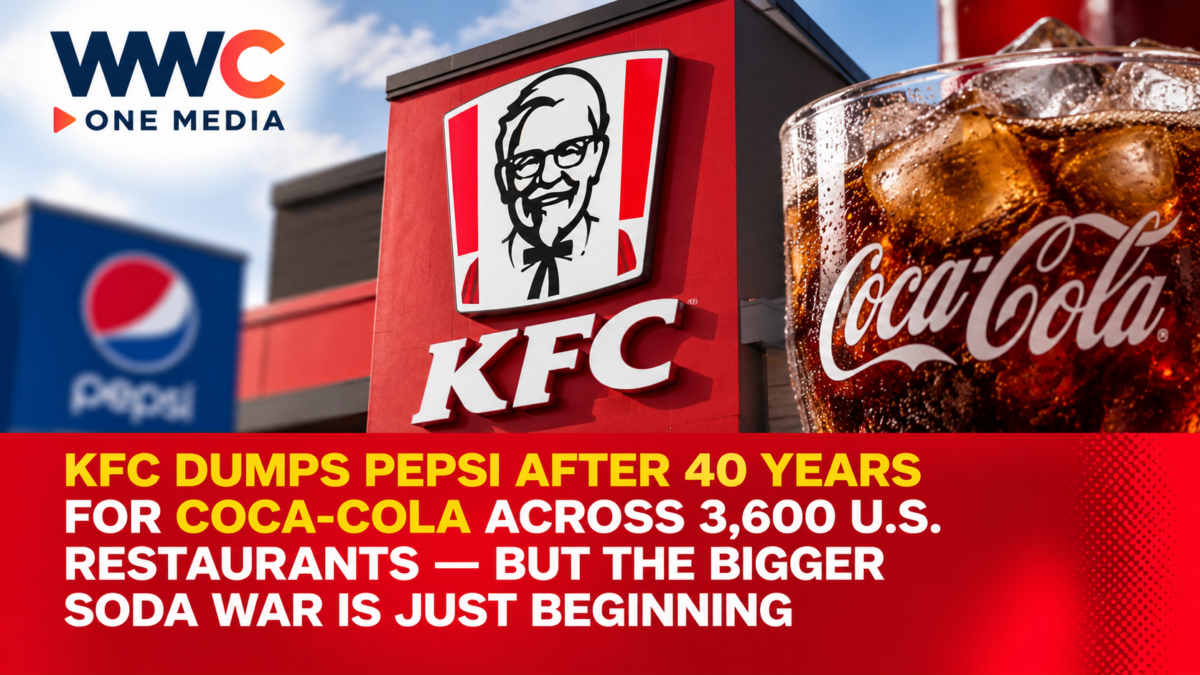
KFC has announced that it will replace PepsiCo drinks with Coca-Cola products across approximately 3,600 restaurants in the United States, ending a relationship that has lasted nearly four decades and delivering a major competitive victory to Coca-Cola.
The switch will begin in January 2027, with Coca-Cola beverages expected to be available throughout KFC’s U.S. restaurant network by spring.
Announced on October 15, 2026, the agreement is part of KFC’s ambitious turnaround campaign, called the Kentucky Fried Comeback, as the fried-chicken giant attempts to revive customer traffic, modernize its menu and reclaim lost ground against increasingly aggressive rivals.
For Coca-Cola, the partnership expands its presence in the highly competitive restaurant beverage market.
For PepsiCo, it marks the loss of a high-profile customer with deep historical ties to the company.
But behind the headlines about Coke replacing Pepsi lies a much bigger question: Can changing the drinks served alongside its famous fried chicken help KFC reverse years of competitive pressure?
After Nearly Four Decades, KFC Says Goodbye to Pepsi in America
KFC’s relationship with PepsiCo dates back to 1986, when PepsiCo acquired the fried-chicken chain.
At the time, KFC was a major Coca-Cola fountain-drink customer, second only to McDonald’s among Coca-Cola’s restaurant accounts.
PepsiCo’s acquisition changed that arrangement, bringing KFC into the company’s beverage distribution network.
In 1997, PepsiCo separated its restaurant businesses into a new company that later became Yum! Brands, the parent of KFC, Taco Bell and Pizza Hut.
Even after the corporate separation, KFC’s U.S. restaurants continued serving PepsiCo beverages.
That nearly 40-year association will now come to an end in the American market.
Under the newly announced agreement, KFC will introduce Coca-Cola’s beverage portfolio in phases starting in January 2027.
The company expects the nationwide transition to be completed by spring 2027.
The deal’s financial terms have not been disclosed.
Coca-Cola Wins Access to Thousands of KFC Restaurants
The agreement gives Coca-Cola another major restaurant partner in the United States.
According to the company’s official announcement, the transition covers approximately 3,600 KFC restaurants.
Reuters separately reported that KFC had 3,718 U.S. locations.
The difference reflects the restaurant counts used by the sources and does not change the central development: Coca-Cola is securing a major national fast-food beverage account.
Coca-Cola already supplies beverages to prominent restaurant operators, including McDonald’s and Wendy’s.
The KFC agreement further strengthens its position in the foodservice sector, where beverage companies compete for long-term supply contracts, fountain-drink placements and promotional partnerships.
The new arrangement goes beyond simply providing bottled or fountain soft drinks.
It creates opportunities for beverage innovation, restaurant marketing, new drink concepts and food-and-beverage combinations.
Dagmar Boggs, Coca-Cola’s president of Foodservice and On-Premise for North America, welcomed the partnership as an opportunity to combine two globally recognized brands.
The companies intend to use their respective product portfolios and marketing capabilities to improve the overall KFC customer experience.
Why KFC Is Making Such a Major Change
The beverage switch forms part of a wider effort to strengthen KFC’s performance in the United States.
Although KFC remains a globally recognized fast-food brand, its American business has faced intense competition from rival chicken chains.
Companies such as Chick-fil-A and Popeyes have built strong positions through their menus, customer experience, restaurant expansion and marketing.
KFC has been working to regain momentum through new products, refreshed restaurant experiences and a renewed focus on what consumers want.
The company’s Kentucky Fried Comeback initiative aims to make KFC more relevant to American customers.
KFC U.S. President Catherine Tan-Gillespie described the Coca-Cola arrangement as part of the brand’s broader transformation.
Management views the partnership as an opportunity to introduce new drink experiences and create more reasons for customers to visit its restaurants.
But the challenge extends well beyond beverages.
Winning back customers also requires competitive prices, convenient ordering, consistent food quality, effective service and compelling menu options.
The Coca-Cola partnership is therefore one component of KFC’s turnaround strategy rather than a guaranteed solution to its business challenges.
PepsiCo Faces Another Setback in America’s Cola Wars
Losing KFC’s U.S. restaurant business represents a significant symbolic defeat for PepsiCo.
The company has been working to strengthen its North American beverage operations while also confronting changing consumer preferences and pressure on its snacks business.
PepsiCo’s challenges have attracted attention from investors, including activist investment firm Elliott Investment Management.
Reuters reported that the company has faced concerns about rising costs, weaker demand in certain product categories and slower-than-expected progress in restoring growth and profitability.
The departure of KFC adds another competitive concern.
However, the financial impact should not be exaggerated.
The companies did not disclose the value of the outgoing beverage contract, and the loss of one restaurant account does not mean PepsiCo’s overall business is in crisis.
PepsiCo remains one of the world’s largest beverage and snack companies, with substantial brands, distribution networks and international operations.
Its future performance will depend on a broader range of factors, including product innovation, pricing, cost management and competition across multiple markets.
Pepsi Is Not Disappearing From Every KFC Restaurant Worldwide
One of the most important details in the announcement is its geographic scope.
The new Coca-Cola arrangement applies to KFC restaurants in the United States.
It does not establish a worldwide change across every KFC outlet.
PepsiCo has confirmed that its relationship with KFC International continues.
It has also renewed beverage agreements involving Taco Bell, including a separate 10-year arrangement.
This means PepsiCo will maintain an important presence within Yum! Brands’ wider restaurant network.
Several KFC restaurants outside the United States already serve Coca-Cola beverages, depending on their local supplier arrangements.
For customers in the Philippines, the announcement does not automatically mean that their local KFC restaurant will change beverage suppliers.
Any Philippine rollout would require a separate announcement or confirmation from the local operator.
Coca-Cola’s Restaurant Strategy Goes Beyond Soft Drinks
The deal reflects a broader shift in how beverage companies compete for restaurant partners.
Soft-drink manufacturers are no longer selling only cola, lemon-lime soda and traditional fountain beverages.
They are also offering technology, consumer insights, menu development support, marketing programs and specialized drink options.
Coca-Cola has developed systems such as Coca-Cola Freestyle, which allows consumers to choose among numerous beverage combinations at participating restaurants.
It also offers restaurant partners tools designed to support menu planning and customer engagement.
The KFC partnership could give Coca-Cola another platform for developing beverages that complement fried chicken, sandwiches and other restaurant offerings.
However, KFC has not confirmed that every U.S. restaurant will receive Coca-Cola Freestyle machines or a particular new specialty drink lineup.
Those possibilities should not be presented as guaranteed elements of the agreement.
What Happens to Mountain Dew at KFC?
One of the most recognizable drinks associated with KFC is Mountain Dew Sweet Lightning, a honey-peach-flavored beverage introduced exclusively at the chain in 2019.
The product developed a loyal following among customers who enjoyed the sweet flavor alongside KFC’s savory chicken menu.
Its future has become a concern as the restaurant chain prepares to transition away from PepsiCo beverages.
Subsequent reporting indicates that Sweet Lightning is expected to leave KFC’s U.S. menu at the end of 2026.
PepsiCo has indicated interest in exploring alternative ways to offer the flavor, but no specific replacement retail launch has been confirmed.
For fans of the beverage, the KFC switch represents more than a corporate supplier change.
It could mean saying goodbye to a drink closely associated with their restaurant experience.
Coca-Cola and Pepsi Compete for More Than Restaurant Contracts
The rivalry between Coca-Cola and PepsiCo has shaped the global soft-drink industry for decades.
Both companies compete through retail distribution, restaurant partnerships, advertising, sponsorships and product innovation.
Major restaurant agreements are especially valuable because they place beverage brands directly in front of customers during routine food purchases.
A successful restaurant partnership can strengthen brand exposure and influence consumer habits.
However, a high-profile contract does not automatically translate into a large increase in overall corporate earnings.
Barron’s reported that the KFC deal could add only around 0.1% to 0.2% to Coca-Cola’s revenue, based on estimates.
The partnership may therefore be more important strategically and symbolically than its immediate financial contribution suggests.
The broader significance lies in Coca-Cola’s ability to win an established PepsiCo account while maintaining its extensive restaurant distribution network.
Can KFC’s Beverage Switch Help It Beat Chick-fil-A and Popeyes?
KFC’s management hopes the Coca-Cola partnership will support its broader comeback.
But consumers choose restaurants for many reasons.
Food quality, menu variety, pricing, convenience, restaurant cleanliness and service often play major roles.
The availability of Coca-Cola beverages may appeal to customers who prefer those brands, but it is unlikely to determine every purchasing decision.
KFC must also compete with rivals that have invested heavily in chicken sandwiches, digital ordering, loyalty programs and restaurant operations.
The company’s success will depend on whether its wider turnaround strategy improves customer traffic and sales.
No publicly disclosed forecast establishes how many additional customers the Coca-Cola agreement will attract.
Nor has KFC announced a specific sales target attributable solely to the beverage change.
The measurable results will emerge after the rollout begins.
What This Means for Filipino Consumers and Businesses
Although this is a U.S.-specific agreement, it offers useful lessons for the Philippine restaurant industry.
Beverage partnerships can influence restaurant operations, customer preferences, supply-chain arrangements and promotional activity.
Large fast-food brands regularly evaluate suppliers based on commercial terms, consumer demand, service support and marketing opportunities.
The KFC-Coca-Cola agreement demonstrates that even partnerships lasting several decades can change when companies reassess their strategic priorities.
For Philippine customers, the immediate effect is limited because the announcement does not cover a confirmed local beverage transition.
For local restaurant operators, however, the case illustrates how supplier relationships can form part of a broader competitive strategy.
The Bigger Question: Can Coca-Cola Help Deliver KFC’s Comeback?
KFC’s decision to leave PepsiCo after nearly four decades is one of the most notable restaurant beverage changes of 2026.
The agreement provides Coca-Cola with a significant new U.S. customer while ending a longstanding association between PepsiCo and the fried-chicken chain.
It also sends a clear message about KFC’s willingness to make major changes as it attempts to rebuild momentum in its home market.
But winning a beverage contract and reviving a fast-food business are two different challenges.
KFC will still need to strengthen its menu, improve the customer experience and compete effectively against established chicken restaurant rivals.
For Coca-Cola, the agreement offers expanded distribution and visibility.
For PepsiCo, it adds pressure to demonstrate that its North American turnaround strategy can deliver results.
After nearly 40 years of Pepsi, KFC is preparing to serve Coca-Cola across the United States. But the real test is whether switching the drink beside America’s famous fried chicken can help revive a restaurant giant—or whether the next chapter of the cola wars will be decided by much bigger forces.