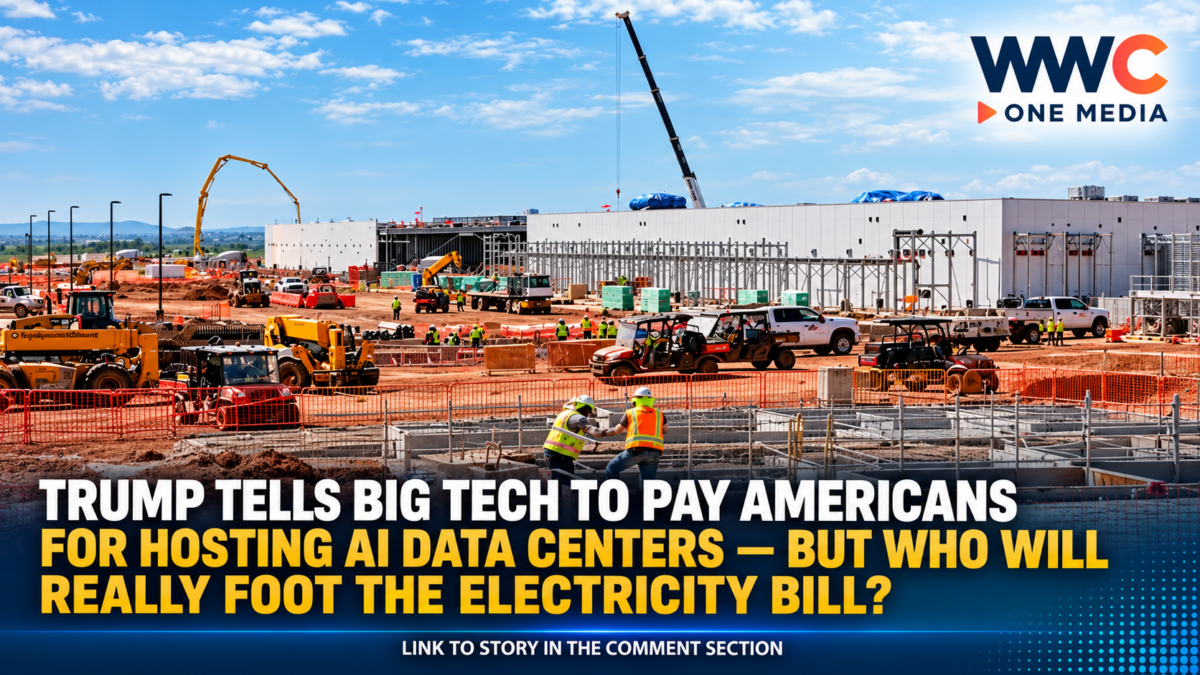
WASHINGTON, October 21, 2026 — US President Donald Trump is calling on companies building massive artificial intelligence (AI) data centers to compensate the communities hosting them, proposing financial “dividends” for residents as opposition to the rapidly expanding industry intensifies across the United States.
The proposal could reshape the relationship between America’s technology giants and local communities, putting household electricity costs, economic benefits and infrastructure development at the center of the country’s AI boom.
In a post on Truth Social on Wednesday, Trump argued that financial agreements could turn unpopular data center developments into projects welcomed by nearby residents.
“I have watched the process closely, and Data Centers that were highly unpopular in a certain area, have become extremely popular when a financial deal is struck,” Trump wrote.
His message was straightforward: Companies benefiting from America’s race to dominate artificial intelligence should ensure that the communities accommodating their infrastructure receive a share of the economic rewards.
Trump Wants Data Centers to Generate Their Own Electricity
Beyond community compensation, Trump reiterated his position that major data center operators should produce their own electricity rather than rely entirely on existing power infrastructure.
He also called for surplus electricity to be supplied or sold to surrounding communities or the power grid.
The objective is to prevent enormous AI facilities from driving up electricity costs for ordinary consumers while potentially expanding the local power supply.
However, building dedicated power generation facilities requires significant investment and regulatory approvals. The availability of excess electricity would depend on the type of generating facilities, local grid arrangements and actual consumption.
Trump’s statements reflect his preferred approach to the industry’s expansion, but they do not establish a nationwide cash-payment program for residents.
AI Data Centers Face Growing Opposition Across America
The rapid expansion of AI infrastructure is generating economic opportunities, but it is also creating conflicts in communities asked to accommodate increasingly large facilities.
Data centers house the servers and computing equipment essential for artificial intelligence systems, cloud services, digital platforms and other online operations.
Unlike traditional commercial buildings, some large AI installations require substantial electricity supplies, extensive cooling equipment and supporting infrastructure.
Communities considering new projects have raised concerns about rising electricity bills, water consumption, noise, land use and the impact on existing neighborhoods.
These issues have increasingly attracted opposition from voters across political lines, creating potential obstacles for technology companies seeking to accelerate construction.
For local governments, the challenge is balancing promised investment and tax revenue against the long-term costs and environmental consequences of major infrastructure developments.
Big Tech Faces Pressure to Share AI’s Economic Benefits
The debate comes as major technology companies, including Microsoft, Amazon, Google and Meta, continue investing heavily in infrastructure designed to support artificial intelligence and cloud computing.
These companies are among the industry’s most significant data center operators and customers, although Trump’s latest remarks did not announce a specific financial requirement for any of them.
Community agreements could potentially involve direct payments, local infrastructure investments, education funding, tax arrangements or programs designed to reduce household energy expenses.
Such benefits would depend on individual negotiations and applicable laws. Trump has not announced a standard dividend amount, payment schedule or universal eligibility requirement.
The central question is whether financial incentives can build lasting public support without adequately addressing concerns about electricity demand, water usage and environmental effects.
Trump’s Proposal Could Change the Economics of America’s AI Race
The United States is competing to expand the computing infrastructure necessary for increasingly sophisticated artificial intelligence systems.
But the competition is no longer limited to semiconductor technology, advanced software and corporate investment.
Access to reliable electricity, sufficient land, transmission infrastructure and local government approval is becoming increasingly important.
For technology companies, offering community benefits could become another significant cost of developing large AI facilities.
For residents, the prospect of receiving direct financial compensation or lower utility expenses could influence how proposed developments are evaluated.
Yet financial payments alone may not resolve every controversy, particularly where water availability, environmental protection or energy infrastructure remain major concerns.
A Bigger Question: Who Really Benefits From the AI Boom?
Trump’s comments highlight an emerging debate about the distribution of artificial intelligence’s economic gains.
Technology companies stand to benefit from expanding demand for computing power, while local communities may be required to accommodate the physical infrastructure supporting those businesses.
The president’s proposed dividends are intended to narrow that divide.
However, crucial questions remain unanswered: Who would qualify for payments? How much would residents receive? Would companies be required to guarantee lower electricity prices? And who would enforce any agreements?
For now, Trump’s comments amount to a public call for financial deals rather than a detailed federal compensation policy.
As America’s AI infrastructure boom accelerates, the biggest test may be whether technology companies can persuade communities that hosting massive data centers will improve local livelihoods rather than simply increase demand for already strained resources.
The future of America’s AI expansion may ultimately depend not only on the technology inside these facilities, but also on the agreements reached with the people living outside them.