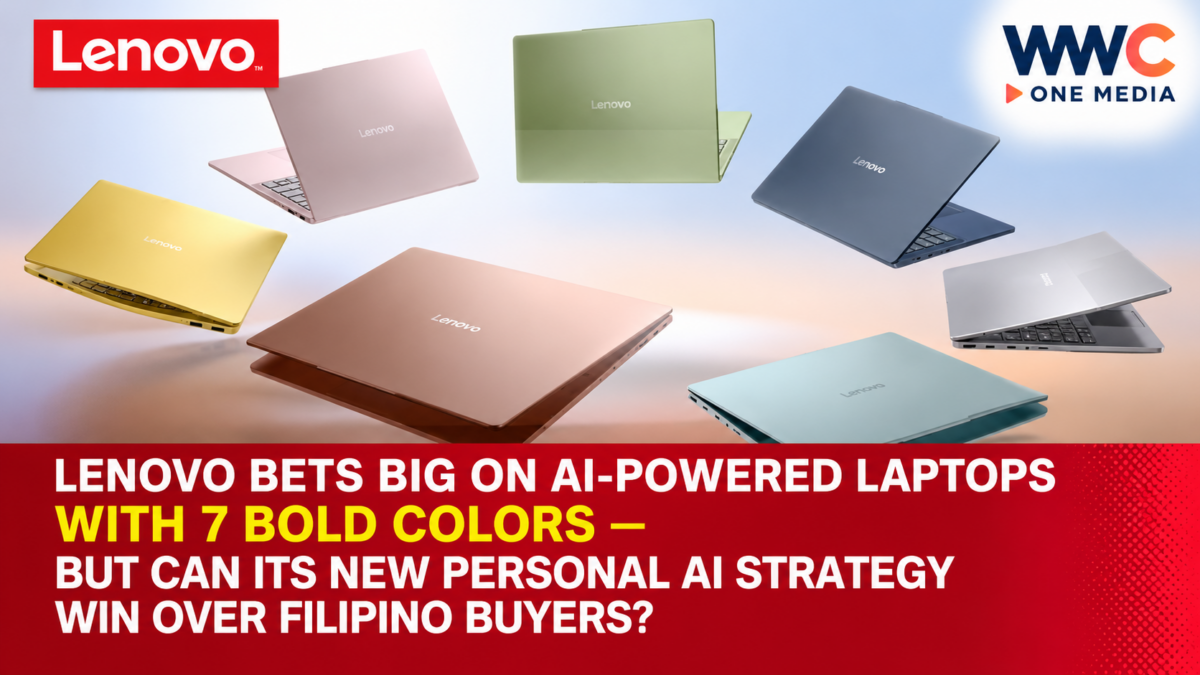
MANILA, Philippines — Global technology giant Lenovo is stepping up its battle for the next generation of personal computers, introducing colorful AI-powered laptops and redesigned desktops that promise to make everyday computing smarter, more personalized, and more accessible.
As artificial intelligence reshapes the PC industry, Lenovo is moving beyond traditional selling points such as processor speed, storage, and battery life. Its latest strategy combines intelligent software, fashionable designs, and connected digital experiences aimed at students, professionals, families, and technology-conscious consumers.
Leading the push are the Lenovo IdeaPad Vibe laptop series and IdeaCentre AIO i all-in-one desktops, products that represent the company’s broader ambition to make artificial intelligence a practical part of everyday computing.
For Filipino consumers, the launch could introduce more choices in the growing AI PC market, with the IdeaPad Vibe series expected to reach the Philippines by January 2027.
But the bigger question is whether Lenovo can convince price-conscious buyers that personalized AI capabilities are worth paying for.
Seven Colors, AI Power: Lenovo Reinvents the Everyday Laptop
Lenovo’s new IdeaPad Vibe series puts personal expression at the center of its design philosophy.
Developed in consultation with the Pantone Color Institute, the laptops come in seven distinctive colors: Dreamy Violet, Spicy Gold, Zen Green, Chill Blue, Radiant Coral, Moody Blue, and Lowkey Grey.
The devices will be offered in 14-inch and 15-inch configurations, with processor options including Qualcomm Snapdragon X and AMD Ryzen AI 400 Series chips.
Depending on the configuration, users can expect AI-assisted productivity, real-time translation, intelligent video conferencing effects, and features designed to improve daily multitasking.
Selected versions also offer OLED displays, expandable storage, and memory configurations suited to different workloads.
The 14-inch models start at approximately 1.3 kilograms, positioning the series as a portable option for students, mobile workers, and consumers who prioritize convenience.
Lenovo is also introducing customizable keycaps on supported models, adding another way for buyers to personalize their devices.
The strategy signals an important shift: laptops are increasingly being marketed not only as productivity tools but also as lifestyle products.
Lenovo Qira: The AI Assistant That Could Change How People Use Computers
Beyond colorful hardware, Lenovo is investing in a potentially bigger differentiator: personal artificial intelligence.
Its Lenovo Qira platform is designed to create connected AI experiences across compatible PCs, smartphones, tablets, wearable devices, and supported applications.
Instead of treating every device as a separate digital environment, Lenovo wants users to interact with an assistant capable of helping retrieve information and complete tasks across connected services.
Through supported integrations, including email, calendars, and collaboration applications, Qira aims to reduce the need to constantly switch between programs.
For example, the system is designed to support natural-language requests that help users locate relevant information or coordinate everyday activities.
The vision is especially relevant as consumers increasingly divide their digital lives among laptops, smartphones, cloud applications, and online communication platforms.
However, Qira availability and functions depend on supported devices, services, software versions, and rollout conditions.
That distinction matters because not every AI feature being promoted will necessarily be available on every model at launch.
Lenovo Brings Personalized AI Into the Family Desktop
Lenovo is not limiting its strategy to portable computers.
The company has also unveiled the IdeaCentre AIO i, an all-in-one desktop designed for households seeking a cleaner workspace, intelligent features, and flexible viewing options.
Available in 23.8-inch and 27-inch versions, the new desktops feature Intel Core Series 3 processors, selected configurations with touch-enabled displays, and ergonomic stands.
The product lineup also introduces multiple color options, allowing families and home-office users to match their computers with their surroundings.
One highlighted innovation is AI-powered Adaptive Lighting, designed to provide customizable lighting modes for different activities. The feature is planned for a subsequent software update.
For households where one computer may serve as a workstation, entertainment center, and study device, Lenovo is betting that flexibility and convenience can become powerful selling points.
AI PCs Are Becoming the Next Major Battleground
Lenovo’s latest push comes as the global computer industry undergoes a transformation driven by artificial intelligence.
Research firm Gartner projected in August 2025 that AI PCs would account for approximately 55% of worldwide PC shipments in 2026, equivalent to around 143 million units.
The forecast indicates that AI-capable hardware is moving from a specialized product category toward mainstream adoption.
Meanwhile, Lenovo’s previously reported financial results showed that AI PCs had already accounted for roughly one-third of its PC shipments during its second fiscal quarter of 2025/26.
These figures underscore why manufacturers are racing to integrate AI processors, intelligent software, and personalized features into their latest devices.
However, the shift also creates a marketing challenge.
Consumers may increasingly expect AI features as standard, making it harder for manufacturers to justify higher prices based on AI capabilities alone.
That could intensify competition around battery life, device reliability, compatibility, practical AI functionality, and affordability.
What This Means for Filipino Consumers
The Philippines is an important potential market for AI-powered consumer computers because laptops and desktops support education, remote work, content creation, online businesses, and household productivity.
Lenovo’s expansion could appeal to Filipinos who want devices capable of handling both everyday applications and emerging AI-assisted workflows.
Students may benefit from translation, productivity, and video conferencing features, while professionals could find value in connected services and intelligent task assistance.
For families, the new all-in-one desktops may offer a more integrated computer setup for shared household use.
Yet affordability remains an important consideration.
The IdeaPad Vibe series is expected to arrive in the Philippines by January 2027, but Lenovo has not announced confirmed local prices or the exact configurations that will be sold.
International launch prices cannot be treated as Philippine retail prices because taxes, exchange rates, distribution costs, and local product specifications can differ.
Potential buyers will also need to evaluate whether AI-powered features meaningfully improve their daily activities compared with less expensive conventional computers.
The Bigger Challenge: Turning AI Hype Into Everyday Value
Lenovo’s personalized computing strategy reflects a broader change in the technology industry.
Artificial intelligence is increasingly becoming part of the basic expectations surrounding new computers rather than a standalone premium feature.
For Lenovo, the objective is to build stronger connections among hardware, software, personal preferences, and daily digital tasks.
But success will depend on more than colorful designs or impressive technical specifications.
Consumers will ultimately judge these products on whether their AI functions are reliable, convenient, secure, and worth the price.
With the anticipated Philippine launch approaching in January 2027, Lenovo has an opportunity to strengthen its position in the consumer PC market.
The real test will come when Filipino buyers decide whether the future of personal computing deserves a place in their budgets—or whether AI is becoming another feature they expect without paying extra.