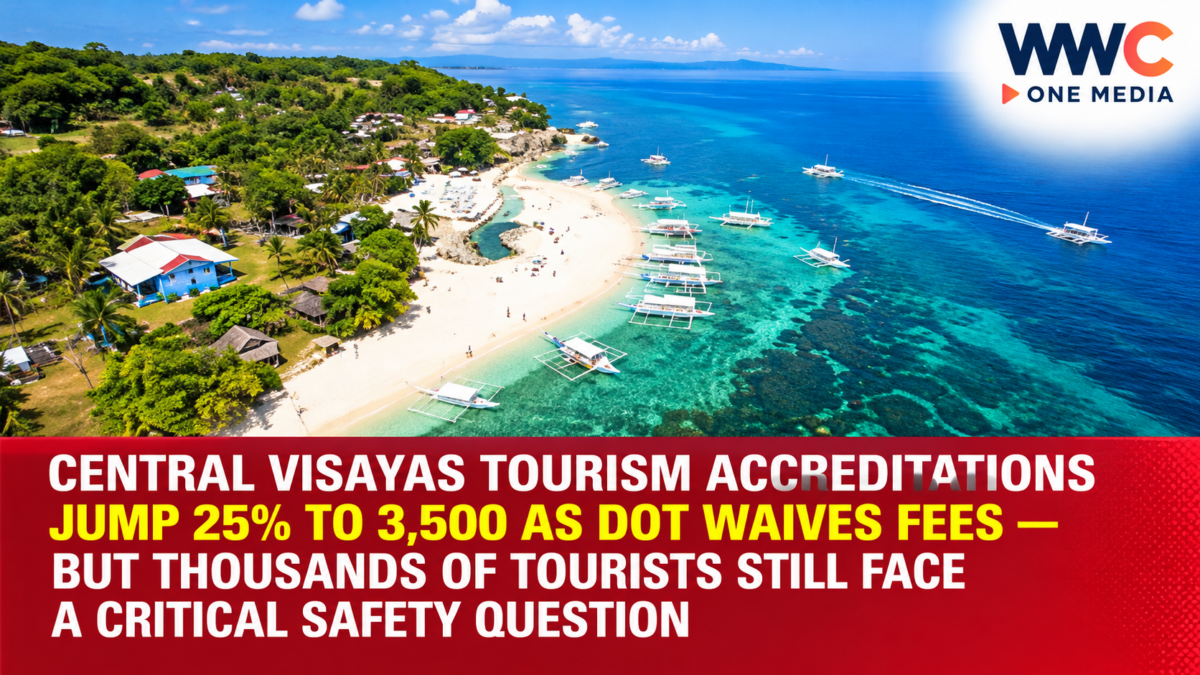
CEBU CITY, Philippines — Hundreds more tourism businesses in Cebu and Bohol have entered the government’s accreditation system, pushing Central Visayas’ total number of Department of Tourism-accredited enterprises to 3,500 as of September 30, 2026.
That represents an increase of approximately 25% from the 2,804 accredited enterprises recorded on the same date last year.
The increase comes as the Department of Tourism in Central Visayas, also known as DOT Region 7, continues to waive accreditation fees and streamline application requirements.
For hotels, resorts, travel agencies, tour operators and transport providers, accreditation can offer more than regulatory recognition.
It can also provide access to government training, tourism promotions, trade events and selected endorsements.
But the rising figures raise a more important question for one of the Philippines’ leading tourist regions.
Can stronger accreditation participation translate into better visitor safety, higher service standards and more business for tourism operators—or is the region still facing a difficult challenge in turning registrations into real improvements?
DOT Central Visayas Records 696 Additional Accredited Enterprises
The latest figures show significant year-on-year growth.
As of September 30, 2025, DOT-7 had recorded 2,804 accredited tourism enterprises.
By September 30, 2026, that number had increased to 3,500.
The difference amounts to 696 additional accredited enterprises, equivalent to approximately 24.8% growth.
Independent coverage by The Freeman and BusinessMirror confirms the same totals.
The data indicate increasing participation in the accreditation system, including among businesses outside the traditional accommodation sector.
However, these are counts of accredited enterprises at two reporting dates.
They do not establish that 696 entirely new tourism businesses opened during the year.
The increase may include previously operating businesses that obtained accreditation, as well as changes in accreditation status.
Likewise, the figures do not establish that tourist arrivals, hotel occupancy or tourism revenues increased by 25%.
Those outcomes require separate measurements.
DOT Extends Free Accreditation to Help Businesses
A central factor behind the increase is the government’s continued waiver of accreditation-related fees.
The relief originated under DOT Memorandum Circular No. 2022-001, introduced during the tourism industry’s recovery from the COVID-19 pandemic.
The circular provided for the waiver of accreditation application and renewal fees, along with specified related charges, unless later department issuances provided otherwise.
The DOT subsequently extended the measure after the original pandemic emergency period ended.
As of October 2026, DOT-7 officials continue to encourage qualified businesses to take advantage of the policy.
Removing processing fees can reduce an administrative cost for small tourism operators.
For larger establishments, the previously applicable charges could run into thousands of pesos.
But the waiver does not eliminate all legal obligations.
Businesses must still comply with the relevant standards and application requirements.
It also should not be mistaken for a waiver of local business permits, national taxes or unrelated regulatory charges.
Gelena Asis-Dimpas Calls for Wider Industry Participation
DOT-7 officer-in-charge Gelena Asis-Dimpas is encouraging more establishments and service providers to seek accreditation.
Her message is that recognized businesses can gain access to services and opportunities beyond receiving a certificate.
These include capacity-building programs, participation in government-supported trade events and promotional activities that connect businesses with potential customers.
Asis-Dimpas has also emphasized the importance of accreditation in supporting tourist safety and improving standards.
For tourism-dependent communities, encouraging legitimate operators to participate in a common regulatory system can help government agencies better understand the industry’s needs.
But accreditation is only one component of industry development.
Authorities must also maintain meaningful verification, monitoring and enforcement.
A certificate should represent compliance with relevant requirements—not merely successful submission of an online form.
Why Tourism Accreditation Matters
Tourism accreditation is a government recognition process for enterprises that satisfy applicable DOT standards.
Under Republic Act No. 9593, or the Tourism Act of 2009, primary tourism enterprises are generally required to obtain DOT accreditation.
These include categories such as accommodation establishments, travel and tour agencies, and tourist land and water transport operators.
Some secondary tourism enterprises may seek accreditation voluntarily, depending on their category and the applicable rules.
The distinction matters because not every tourism-related business operates under identical accreditation requirements.
For travelers, accreditation provides an additional way to identify operators recognized by the government.
For businesses, it may help demonstrate compliance and eligibility for certain industry programs.
However, an accredited establishment is not automatically guaranteed to provide flawless service.
Accreditation is also different from a local business license.
Tourism providers must comply with other applicable legal and safety requirements.
Water Transport Operators Become a Major Focus
Island-hopping and diving are important parts of the tourism experience in Cebu and Bohol.
These activities rely on boat operators, crews, equipment and weather-sensitive marine transportation.
DOT-7 reported that 263 water transport operators had obtained accreditation across Central Visayas as of September 30.
The operators manage vessels that include 560 motorized boats used for tourism activities.
The figures highlight the importance of regulating water-based services in a destination region known for beaches, diving and island excursions.
Travelers booking boat trips should understand that the existence of an accredited operator is useful but does not replace individual safety checks.
Boat condition, authorized passenger capacity, crew competence, weather conditions and compliance with maritime regulations also matter.
Tourists should confirm the credentials of the operator and follow official safety advisories.
DOT Urges Tourists to Verify Operators Before Booking
Marlon Barrientos, chief of DOT-7’s Tourism Regulations Division, is advising travelers and travel agencies to check a provider’s accreditation before paying for services.
This is especially relevant when booking through unfamiliar social media accounts or third-party agents.
A tourism business may present attractive photographs and low prices, but consumers should still verify its legal identity and the services it is authorized to offer.
The official DOT accreditation system can assist with these checks.
Travelers should also confirm important booking details, including cancellation policies, inclusions, refund procedures and emergency contacts.
For marine tours, accreditation should be considered alongside compliance with Maritime Industry Authority requirements and other applicable safety rules.
The goal is to reduce preventable travel risks without giving visitors a false sense that accreditation alone guarantees safety.
Online Applications Make Accreditation More Accessible
DOT has moved accreditation processing to an online platform.
Businesses can apply or renew through the department’s official accreditation portal.
The digital process can reduce the need for repeated in-person visits and simplify some administrative steps.
This may be particularly helpful to small tourism operators managing limited staff and resources.
However, businesses still need to prepare the documents required for their particular category.
Applications also remain subject to verification and applicable standards.
Online submission is therefore a convenience measure, not automatic approval.
For operators with limited internet access or difficulty navigating the application system, the department offers additional support through its outreach programs.
Mobile Accreditation Caravans Reach Local Operators
DOT-7 also conducts Mobile Accreditation Caravans with local government units.
These activities bring accreditation information and assistance closer to tourism communities.
They may help operators who would otherwise need to travel to regional offices for guidance.
For businesses outside major cities, the cost of transportation and time away from normal operations can be barriers to completing administrative requirements.
By providing local assistance, government agencies can encourage a wider range of enterprises to enter the accreditation system.
This matters for small accommodation providers, tour operators and other enterprises serving visitors in provincial destinations.
But the success of outreach programs should be evaluated through the quality of applications processed and the continued compliance of participating businesses.
Discover More to Love Gives Accredited Businesses Wider Exposure
Accredited tourism enterprises may also benefit from the DOT’s newly expanded Discover More to Love platform.
The initiative allows travelers to explore tourism offers, accommodation deals, activities and booking information.
For participating businesses, it provides another channel to present products and promotions to potential customers.
The department can promote eligible tourism offerings through its network of 12 overseas offices and five market representatives.
According to TTG Asia’s October 20 report, Central Visayas tourism businesses are among those featured through the platform.
Examples include promotional accommodation offers in Cebu and Bohol.
Such programs can improve market visibility, particularly for smaller enterprises without large advertising budgets.
However, inclusion is subject to eligibility and promotion arrangements.
Accreditation does not automatically guarantee a business a listing, discount campaign, customer booking or government endorsement.
Official DOT Recognition Can Open Other Opportunities
Beyond promotional visibility, DOT accreditation can support applications for selected government endorsements.
For example, qualified tourist land transport operators may seek DOT endorsements connected with franchise applications to the Land Transportation Franchising and Regulatory Board.
Certain accommodation establishments and restaurants may also request endorsements connected with exemptions from election-period liquor restrictions, subject to the relevant government requirements.
Accredited establishments can be considered for referrals to embassies, travel trade organizations and event-related business opportunities.
These are possible benefits, not automatic entitlements.
The agency receiving an endorsement remains responsible for its own decision.
This distinction is important for operators evaluating the commercial value of accreditation.
Recognition can make a business eligible for additional opportunities, but it does not replace other permits or regulatory approvals.
Accreditation Could Help Small Tourism Businesses Compete
For independent tourism entrepreneurs, stronger credibility and access to promotion can matter.
Large hotel groups often have established brands and substantial marketing resources.
Smaller homestays, tour organizers and local service providers may struggle to reach customers beyond their immediate communities.
DOT accreditation can provide a recognizable form of government validation when combined with reliable service and transparent business practices.
It may also allow operators to join industry training sessions and tourism-related events.
For Cebu and Bohol, wider participation could help distribute some tourism opportunities across more businesses.
However, financial benefits cannot be assumed.
The department has not released a verified estimate showing how much additional revenue the newly accredited enterprises generated.
A rise in certificates is therefore an encouraging administrative development, not a direct measure of higher business profits.
Training and Standards Are Critical to Tourism Growth
The tourism industry depends heavily on the quality of interactions between visitors and service providers.
Guests expect accommodations to be properly managed.
Travelers joining excursions expect reliable information and suitable safety procedures.
Tour operators need to communicate prices, schedules and cancellation conditions clearly.
DOT-supported training can help enterprises strengthen operational practices.
Programs may address service standards, customer relations, safety and other industry needs.
But training participation alone does not establish that every business has implemented the lessons effectively.
Standards must be maintained after accreditation is issued.
For regulators, this makes inspections, complaint handling and renewal procedures important.
The goal should be sustained compliance rather than simply increasing the number of listed businesses.
The Accreditation Surge Comes During Economic Pressure
The continuing waiver also forms part of broader government efforts to ease costs for households and enterprises.
DOT-7 linked the policy with the national government’s Unified Package for Livelihood, Industry, Food, and Transport, or UPLIFT.
The initiative seeks to help businesses and communities manage economic pressures associated with the Middle East crisis.
Tourism operators can be sensitive to changes in fuel prices and household travel spending.
Higher transportation costs may affect island tours, airport transfers and other tourism services.
Businesses may also face rising costs for food, utilities and maintenance.
Removing accreditation charges can reduce one administrative expense.
But the waiver does not guarantee that businesses will be protected from wider cost increases.
Its value lies in making regulatory participation more accessible during a difficult operating environment.
Cebu and Bohol Remain Important Philippine Tourism Destinations
Central Visayas continues to attract travelers interested in beaches, marine activities, cultural destinations, food and outdoor experiences.
Cebu provides a mix of urban tourism, historic attractions, diving areas and island destinations.
Bohol is known for its natural attractions, cultural sites and beach resorts.
These destinations depend on a network of hotels, tour providers, transport operators, restaurants and supporting businesses.
A stronger accreditation system can help establish common standards across that network.
But tourism development must also account for environmental sustainability, infrastructure capacity and the well-being of local communities.
Expanding visitor activity without adequate safeguards can create pressure on marine ecosystems, water supplies and transport networks.
Responsible tourism growth requires both commercial opportunity and effective management.
What Tourists and Businesses Should Do Next
For tourism businesses, the immediate opportunity is to check accreditation requirements and determine whether they qualify for the continuing fee waiver.
Operators should use official DOT channels and verify the documents required for their enterprise classification.
For travelers, checking government accreditation before booking unfamiliar establishments or excursions is a sensible precaution.
The DOT Central Visayas website provides information about accredited enterprises, although directory entries may require confirmation if the latest update date is unclear.
Travelers should also review recent service information and confirm booking arrangements directly with the provider.
For operators, accreditation should be treated as the beginning of an ongoing compliance responsibility rather than the final step.
Maintaining service standards remains essential after approval.
The Bigger Test: Will 3,500 Accredited Businesses Mean Better Tourism?
The Department of Tourism’s latest figures indicate growing participation in Central Visayas’ accreditation system.
The number of recognized enterprises reached 3,500 by September 30, an increase of nearly 25% from the same date in 2025.
The fee waiver, simplified applications and mobile caravans appear to be supporting wider engagement among tourism businesses.
Government promotions and overseas marketing channels may also offer additional opportunities for qualified operators.
But the next challenge is more difficult to measure.
The region must determine whether accreditation is improving safety, service quality, consumer confidence and opportunities for local businesses.
That requires monitoring, reliable standards and evidence of real benefits.
Central Visayas has recorded a 25% increase in DOT-accredited tourism enterprises, bringing the total to 3,500. But the real victory for Cebu and Bohol will come when more certified businesses translate into safer travel, stronger local livelihoods and visitor experiences that encourage tourists to return.