RIYADH, SAUDI ARABIA — October 14, 2026 — Saudi Arabia’s ambition to become a global financial powerhouse is facing a major security challenge after deadly Houthi missile and drone attacks struck strategic locations across the kingdom, disrupting air travel and raising concerns among international investors just days before Riyadh hosts one of the world’s most prominent investment conferences.
The latest attacks, including a deadly strike on King Khalid International Airport and damage to a building at Saudi oil giant Aramco’s headquarters complex, have intensified uncertainty surrounding the kingdom’s efforts to attract foreign capital.
Saudi Arabia is preparing to host the 10th Future Investment Initiative (FII) from October 26 to 29, a gathering often described as “Davos in the Desert” because of its prominence among international business leaders, investment bankers and government officials.
Executives from some of the world’s largest financial institutions have been listed among the event’s speakers.
But the escalating conflict with Yemen’s Iran-aligned Houthi movement is forcing organizers to consider how foreign participants can attend safely.
According to Reuters, Saudi authorities are preparing a hybrid format that would allow executives to participate remotely rather than travel to Riyadh.
The development highlights an increasingly difficult challenge for Crown Prince Mohammed bin Salman.
His government wants to transform Saudi Arabia into a leading destination for finance, technology, tourism and international business.
Yet the repeated attacks are threatening the perception of security that major investors require before committing billions of dollars to long-term projects.
Deadly Houthi Attacks Shake Saudi Arabia
The latest escalation has brought the conflict in Yemen directly into some of Saudi Arabia’s most important economic and transportation facilities.
On October 10, an attack on Riyadh’s King Khalid International Airport killed 13 people and injured more than 300, according to casualty figures cited by Reuters Breakingviews.
Further attacks followed on October 11, causing additional casualties and damage.
The strikes disrupted commercial aviation and forced airlines to reassess their operations.
The Houthis claimed responsibility for attacks on Saudi airports and energy facilities, presenting them as retaliation for Saudi military operations in Yemen.
Saudi officials have condemned the assaults and continued defensive operations against incoming missiles and drones.
The attacks have raised questions about how effectively the kingdom can protect widely dispersed infrastructure from increasingly sophisticated threats.
But they do not mean Saudi Arabia’s air defenses have completely failed.
Authorities have reported intercepting multiple missiles and drones even as some attacks have caused casualties and damage.
The central concern is whether repeated strikes can continue disrupting travel, investment and business activity despite substantial defense spending.
Aramco Building Hit as Energy Infrastructure Comes Under Threat
Saudi Arabia’s energy industry is also facing renewed security risks.
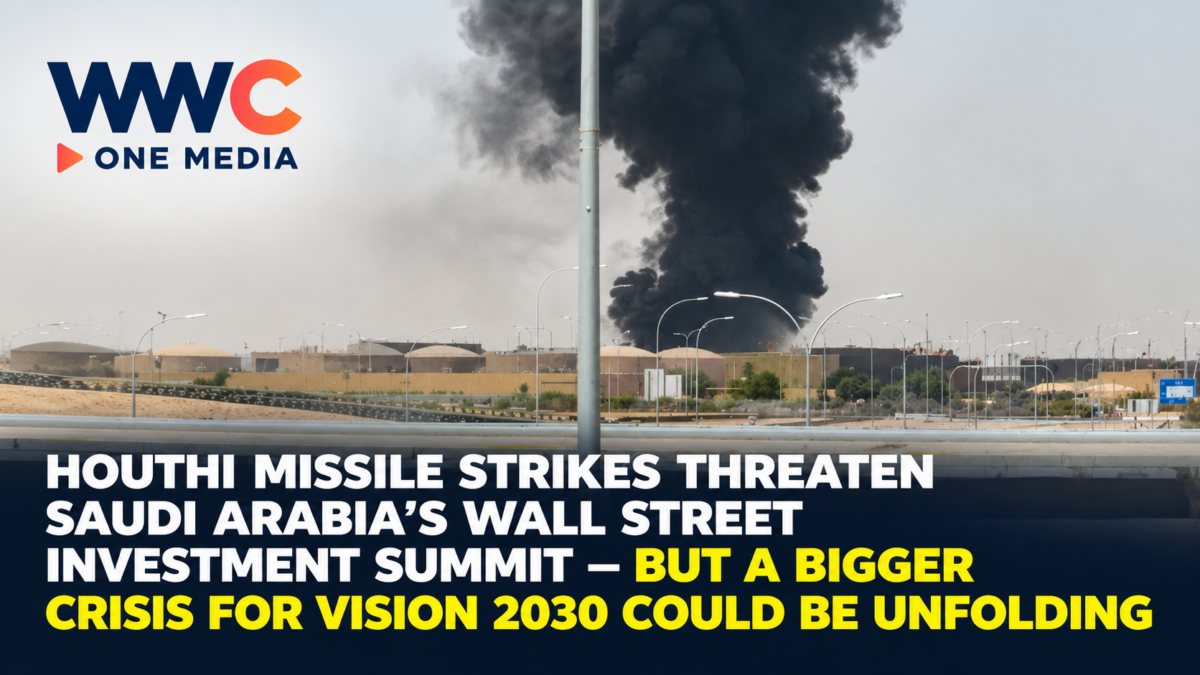
On October 13, an attack affected an administrative building at Saudi Aramco’s Dhahran headquarters complex.
The Saudi Energy Ministry reported a limited fire and damage but no injuries associated with the incident.
The exact circumstances of the impact, including whether the damage resulted from a direct strike or falling debris, were not fully established in the initial reporting.
The incident followed additional Houthi attacks involving missiles and drones aimed at locations around Riyadh and southern Saudi Arabia.
Saudi authorities also launched strikes against Houthi-held facilities in Yemen.
The cycle of attacks and retaliation is increasing the risk of a prolonged confrontation.
For international investors, attacks near major energy installations create concerns beyond the immediate physical damage.
Oil and gas assets require dependable infrastructure, secure transportation and the ability to operate without repeated interruption.
Even relatively limited incidents can affect financing decisions when companies fear that a larger disruption could follow.
Saudi Arabia Prepares a Hybrid Investment Summit
Despite the attacks, Saudi Arabia plans to proceed with the 10th Future Investment Initiative.
The conference is scheduled for October 26 to 29 at the King Abdulaziz International Conference Center in Riyadh.
According to the FII Institute, the gathering will focus on investment, technology, economic development and long-term global growth.
The event is expected to attract international investors, business executives and policymakers.
However, Reuters reported October 13 that Saudi organizers were preparing to accommodate remote participation by executives unable or unwilling to travel.
Some attendees may attempt to enter the country through alternative airports and ground routes.
Others may participate virtually because of security warnings and flight disruptions.
Major financial institutions including Goldman Sachs, Citi and Standard Chartered have appeared on the summit’s speaker roster.
But appearing on a conference program does not prove that a particular executive will attend in person.
The hybrid arrangements reflect Saudi Arabia’s determination to keep its business diplomacy active even as the security environment deteriorates.
The Wall Street Challenge Is About Confidence
Saudi Arabia’s long-term economic strategy depends heavily on attracting international financial institutions and foreign investors.
Large investment banks can support the kingdom’s ambitions through advisory services, capital raising, infrastructure financing and connections to global institutional investors.
The Future Investment Initiative has become a central venue for building these relationships.
But financial commitments depend on more than attractive returns.
Investors assess political stability, physical security, regulatory predictability and the ability of executives and employees to travel safely.
A conflict that repeatedly affects airports or critical infrastructure can alter those assessments.
Some firms may delay decisions until the situation stabilizes.
Others could demand higher expected returns or stronger contractual protections to compensate for additional risks.
However, no credible evidence establishes that Wall Street has collectively abandoned Saudi Arabia.
The immediate concern is that the attacks could make attracting new capital more difficult and expensive.
Oil Executives Withdraw From Riyadh Conference
The disruption has already affected another major international event.
The World Petroleum Congress, held in Riyadh this week, was expected to feature executives from some of the world’s largest energy companies.
According to Reuters Breakingviews and the Financial Times, the chief executives of ExxonMobil, Shell, BP and TotalEnergies were expected to attend but withdrew amid the security crisis.
Their absence illustrates the practical effect of the attacks on high-level business travel.
Even companies with substantial interests in the region must account for employee safety and international travel restrictions.
The cancellations do not necessarily mean those companies have withdrawn their commercial operations or investment interests in Saudi Arabia.
But they represent a setback for Riyadh’s efforts to promote itself as a reliable destination for major international events.
For future conferences, organizers may face greater pressure to provide alternative travel arrangements, remote participation and enhanced security.
Vision 2030 Faces a Bigger Economic Test
The wider significance of the attacks lies in Saudi Arabia’s Vision 2030 economic transformation program.
Launched under Crown Prince Mohammed bin Salman, the strategy seeks to reduce the country’s dependence on oil revenues and expand sectors including tourism, finance, logistics, technology and manufacturing.
Saudi Arabia wants Riyadh to become a major global business hub capable of competing with established international financial centers.
The kingdom has invested heavily in infrastructure and high-profile development projects.
It has also promoted tourism, international entertainment, aviation and major sporting events as ways to attract investment and diversify economic activity.
But these sectors depend significantly on international visitors and business confidence.
Security disruptions affecting airports and urban infrastructure can therefore undermine multiple parts of the strategy at once.
Reuters Breakingviews reported that Saudi Arabia has a goal of attracting approximately $100 billion in annual foreign direct investment by 2030.
That is a future target, not an amount already guaranteed or secured.
The current crisis raises concerns about whether the kingdom can meet that ambition if regional instability persists.
Foreign Investors May Demand a Security Premium
One of the most important consequences of the attacks could be a higher cost of attracting foreign investment.
Security analysts describe this as a risk or security premium.
Investors may require higher financial returns when they believe a country faces greater risks of conflict, disruption or asset damage.
In an October 14 Fortune report, Middle East analyst Andreas Krieg of King’s College London warned that the return of a security premium could lead to delayed investment decisions and greater reliance on government funding.
Former Saudi Public Investment Fund executive James Reeve also warned that fresh foreign investment could be more vulnerable than investments already committed.
The distinction matters.
Companies with existing operations may decide to remain because withdrawing would be expensive and disruptive.
But businesses considering entirely new projects have more flexibility to postpone or redirect their capital.
For Saudi Arabia, this could create a difficult financial challenge.
If private investment slows, the government and its sovereign wealth fund may need to finance more projects themselves.
That could place additional pressure on public resources.
Saudi Arabia’s Budget Is Already Under Pressure
The kingdom’s fiscal position has become more challenging as spending on economic diversification continues.
Fortune reported that Saudi Arabia recorded a budget deficit of approximately 160 billion riyals, or $42.7 billion, during the first half of 2026.
That represented an increase of roughly 71% from the same period a year earlier.
Government spending has remained substantial as the country supports major infrastructure and development plans.
At the same time, the wider Middle East conflict has complicated economic planning and energy markets.
Higher oil prices can support revenue for major petroleum exporters, but conflict also brings additional costs and uncertainty.
Military spending, infrastructure protection and disruptions to aviation or tourism can weigh on financial planning.
The government must therefore balance security requirements with long-term development priorities.
A prolonged deterioration in investor confidence could make that balancing act more difficult.
Riyadh Airport Disruption Threatens Business Travel
King Khalid International Airport is one of the most important gateways to Saudi Arabia’s capital.
It is also central to Riyadh’s ambition to become a major international aviation hub.
The airport normally serves tens of thousands of travelers every day.
Repeated attacks have forced authorities to restrict operations while safety checks and security assessments take place.
International airlines have suspended or delayed some services.
Fortune reported that Air France-KLM had suspended Riyadh flights until October 31, while Delta Air Lines postponed the planned launch of an Atlanta–Riyadh service until March 2027.
These changes create logistical problems for international companies.
Business travel is important for negotiations, project inspections and relationship-building.
Virtual meetings can reduce some disruptions, but they cannot replace every activity involved in major investment projects.
Reliable air connectivity remains a key requirement for the global financial center that Saudi Arabia wants to build.
The Conflict in Yemen Is Becoming More Dangerous
The Saudi security crisis is closely connected to the renewed conflict involving Yemen’s Houthi movement.
The Houthis control significant territory in Yemen and have developed increasingly sophisticated capabilities involving drones and missiles.
The group has received support from Iran, although analysts also describe it as an organization capable of making its own strategic decisions.
Fighting intensified as Saudi-backed Yemeni forces launched operations and Houthi forces expanded activity near the Red Sea.
The strategic Bab el-Mandeb Strait has become an important concern because it links the Red Sea with the Gulf of Aden.
Disruption near the waterway can affect international shipping routes and energy transportation.
The conflict is therefore not confined to Saudi domestic security.
It has broader implications for maritime trade, oil exports and regional stability.
A prolonged escalation could increase shipping costs and contribute to additional market volatility.
Saudi Arabia Faces a Military and Economic Dilemma
Crown Prince Mohammed bin Salman now faces difficult strategic choices.
A forceful military response could demonstrate Saudi Arabia’s determination to protect its territory and infrastructure.
But an expanded conflict could increase casualties, military spending and disruption to economic activity.
Negotiations or de-escalation could reduce immediate risks, although reaching a durable agreement may prove difficult.
Reuters reported October 7 that fighting in Yemen had opened a dangerous new phase of the broader Middle East conflict.
The Houthis’ improved capabilities and difficult terrain could complicate attempts to achieve a quick military victory.
At the same time, Saudi authorities are seeking to avoid the impression that the kingdom’s economic transformation has been derailed.
The government has repeatedly emphasized that Vision 2030 and investment plans must continue.
The challenge is maintaining progress on those long-term ambitions while responding to immediate security threats.
Saudi Stocks React to the Escalation
Financial markets are also responding to the crisis.
Reuters reported that Saudi Arabia’s benchmark stock index declined approximately 0.7% on October 14 after the attack affecting Aramco’s Dhahran premises.
Shares of Saudi National Bank fell around 1.3%, while Aramco declined approximately 0.5%.
These movements illustrate investor sensitivity to security developments.
However, a single trading day’s decline does not prove a sustained capital outflow or an imminent financial crisis.
Stock markets react to numerous factors, including oil prices, company earnings, interest rates and broader investor sentiment.
The longer-term implications will depend on whether attacks continue, whether essential infrastructure remains operational and whether foreign companies maintain their investment plans.
Why the Stakes Extend Beyond Saudi Arabia
Saudi Arabia is an important global oil producer and a major source of capital for international investments.
Its sovereign wealth fund has invested in businesses and projects across technology, infrastructure, sports and other sectors.
Disruptions to its economy could influence investment decisions beyond the Middle East.
Asian businesses and investors also have significant commercial relationships with Saudi Arabia.
The kingdom is an important energy supplier and destination for construction, engineering and service-sector activity.
Countries including the Philippines depend on stable international energy markets and have substantial numbers of workers employed across the Gulf.
A prolonged regional conflict could create risks involving travel, energy prices and business activity.
However, the October attacks do not establish that Saudi Arabia’s oil exports have stopped or that all international investment relationships are at risk.
The economic effects will depend on the duration and severity of the escalation.
What Happens Next?
The immediate focus will be whether the Future Investment Initiative can proceed successfully from October 26 to 29.
Investors will watch how many senior executives attend in person, which companies choose remote participation and whether major commercial agreements are announced.
Saudi authorities will continue assessing threats to airports, energy infrastructure and key business districts.
The government’s ability to restore predictable international travel will be important for business confidence.
Markets will also monitor whether the fighting in Yemen escalates or moves toward de-escalation.
For Crown Prince Mohammed bin Salman, the stakes go well beyond a single conference.
Saudi Arabia has spent years trying to persuade investors that Riyadh can become a safe and attractive international financial capital.
That ambition remains possible, but the latest attacks have exposed the security risks confronting the project.
Houthi missile and drone strikes are threatening Saudi Arabia’s ability to welcome Wall Street leaders to Riyadh, but the bigger challenge is whether the kingdom can sustain its Vision 2030 transformation while renewed conflict raises the cost of attracting foreign investment.