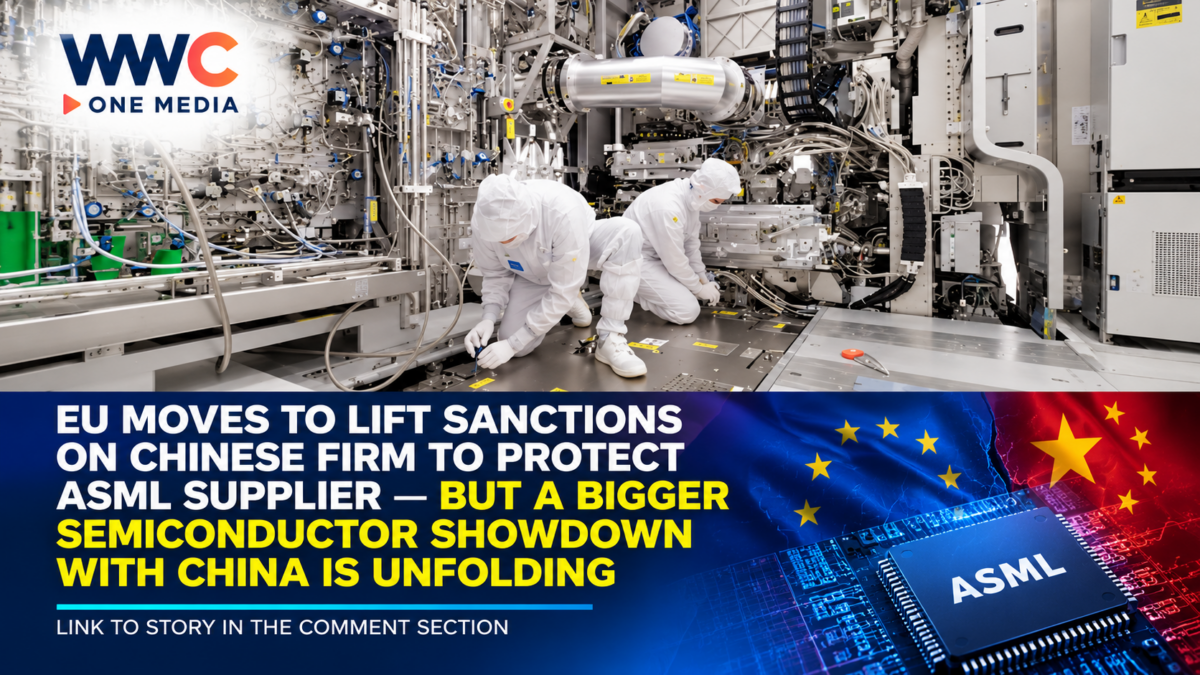
BRUSSELS / AMSTERDAM — October 14, 2026 — The European Union is reportedly preparing to remove a sanction imposed on a Chinese company in an effort to protect a supplier to ASML, the Dutch technology giant whose chipmaking machines are essential to the global semiconductor and artificial intelligence industries.
The potential reversal highlights an increasingly difficult reality for Brussels: restrictions intended to address geopolitical and security concerns can also disrupt the intricate international supply chains supporting Europe’s most valuable technology companies.
According to Bloomberg’s October 14 report, the EU is set to lift a sanction affecting a Chinese firm to safeguard an ASML supplier.
Reuters separately circulated a brief acknowledging Bloomberg’s report, while financial news service Newsquawk also reported the development.
But the proposed move raises questions beyond the immediate company involved.
Can Europe reduce strategic dependence on China while continuing to rely on Chinese-linked materials, components and industrial suppliers?
And how far should policymakers go in protecting European technology businesses when sanctions threaten their own manufacturing networks?
Brussels Prepares a Sanctions Adjustment
The reported EU decision centers on a Chinese business whose sanction threatens to disrupt a company supplying ASML.
The Netherlands-based group produces advanced lithography machines used by semiconductor manufacturers to print microscopic circuitry onto silicon wafers.
The company’s equipment is critical for producing the chips that power artificial intelligence systems, smartphones, high-performance computers and other technologies.
Because ASML relies on a specialized international supplier network, disruptions affecting individual manufacturers can potentially have consequences beyond the businesses directly targeted by sanctions.
A sanctioned company may face restrictions involving trade, financial transactions or access to particular customers, depending on the legal measures imposed.
Those restrictions can also create difficulties for unrelated businesses that rely on its products or services.
Bloomberg’s reported development suggests European officials are attempting to prevent such consequences from damaging an important part of ASML’s supply chain.
However, the exact scope of the proposed relief has not been independently confirmed.
It remains important to distinguish a potential removal of sanctions from a narrowly drafted exemption or temporary authorization.
Each would have different legal and commercial implications.
Why ASML Matters to the Global Chip Industry
ASML occupies a uniquely important position in semiconductor manufacturing.
It is the only commercial supplier of extreme ultraviolet, or EUV, lithography machines used in the most advanced chip-production processes.
These highly sophisticated systems are central to the manufacturing plans of major chipmakers, including Taiwan Semiconductor Manufacturing Company, Samsung Electronics and Intel.
ASML also produces deep ultraviolet, or DUV, lithography systems used across a broad range of semiconductor manufacturing processes.
The company’s technology is therefore important to the wider electronics industry, not only to the production of advanced AI processors.
A disruption affecting ASML’s equipment production could influence the schedules and expansion plans of major semiconductor manufacturers.
That makes the stability of its supplier network strategically important.
The reported EU sanctions adjustment reflects the difficulty of managing political restrictions around a manufacturing ecosystem built through decades of international specialization.
ASML Reports Strong Earnings as AI Demand Accelerates
The sanctions story arrives at a particularly significant moment for ASML.
On October 14, Reuters reported that the Dutch company raised its 2026 sales outlook to between €44 billion and €45 billion as artificial intelligence-related investment continued driving demand for semiconductor equipment.
ASML reported approximately €11.7 billion in third-quarter sales and €4.96 billion in net profit.
The company also indicated that demand for its advanced machines could exceed supply during 2027 and 2028.
Some customers are already discussing equipment needs for 2029 and 2030.
This creates intense pressure on ASML to expand production capacity and maintain dependable component deliveries.
Demand alone does not guarantee that machinery can be manufactured and delivered on schedule.
Advanced lithography systems require highly specialized engineering, optical components, precision manufacturing and complex international logistics.
When one important supplier encounters a serious problem, the consequences can extend through multiple stages of production.
For European officials, protecting continuity in that network is an increasingly important industrial consideration.
The EU Has Faced Similar Problems Before
The reported October decision is not the first example of European sanctions colliding with the needs of domestic manufacturers.
In May 2026, Bloomberg reported that the European Commission was preparing to propose temporary relief for Chinese semiconductor producer Yangzhou Yangjie Electronic Technology.
The company had been included in an EU sanctions package associated with restrictions on Russia.
European automotive companies warned that the measures could disrupt their supplies of essential electronic components.
Reuters subsequently reported the proposed exemption, while noting that it had not independently verified Bloomberg’s account.
That earlier episode demonstrated how sanctions on Chinese manufacturers could affect European businesses with no direct involvement in the conduct being targeted.
It also exposed the limited flexibility companies may have when important electronic components are sourced through highly concentrated supply chains.
The October ASML-related report reflects a similar policy challenge.
However, the available evidence does not establish that the Chinese company in the latest report is Yangzhou Yangjie.
The two developments should not be treated as the same transaction without further confirmation.
Europe Is Struggling to Reduce Its Dependence on China
The European Union has been pursuing a strategy often described as de-risking.
Rather than ending economic relationships with China, the objective is to reduce excessive dependence in strategically important industries.
Those industries include semiconductors, electric vehicles, batteries, rare earth minerals and other technologies.
But changing established supply chains takes time.
European businesses may depend on Chinese suppliers because of manufacturing capacity, technical specialization, cost competitiveness or the difficulty of finding alternatives.
Restrictions imposed before alternative supply arrangements are established can therefore create immediate economic problems.
For policymakers, the challenge is deciding where restrictions are necessary and how quickly businesses can adapt.
The proposed sanctions relief illustrates that the European economy remains deeply connected to Chinese manufacturing, even as political pressure for greater economic independence intensifies.
ASML Warns Against More Restrictions on Chipmaking Equipment
The debate is becoming more complicated because the United States is also considering additional restrictions on semiconductor technology exports to China.
On October 14, Reuters reported that ASML Chief Financial Officer Roger Dassen criticized a proposed U.S. law known as the MATCH Act.
The measure would tighten restrictions on certain DUV lithography equipment and related services involving China.
Dassen argued that limiting Chinese access to equipment could encourage Beijing to accelerate development of domestic alternatives.
His comments highlight a central disagreement over technology restrictions.
Supporters of tighter controls argue that limiting advanced equipment exports is necessary for national security and to prevent the development of strategically sensitive technologies.
Critics warn that excessive restrictions could harm established suppliers and strengthen incentives for competitors to develop substitute products.
The debate is particularly important for ASML because China is a significant market for some of its equipment.
However, the proposed U.S. export restrictions are legally separate from the EU sanctions adjustment reported by Bloomberg.
The two should not be described as one policy decision.
China Is Developing Its Own Chipmaking Technology
China has invested heavily in strengthening its domestic semiconductor industry.
The country is seeking alternatives to imported manufacturing equipment, advanced materials and specialized components.
Chinese companies are pursuing domestic lithography systems, although the most sophisticated technology remains difficult to reproduce.
The Financial Times reported in September that Huawei has supported efforts to develop Chinese semiconductor equipment through investments and industrial partnerships.
These initiatives illustrate how geopolitical restrictions can encourage governments and companies to invest in technological independence.
But developing competitive alternatives requires years of research, engineering and industrial testing.
China’s growing investment does not mean it has already matched ASML’s most advanced EUV systems.
For Europe, the strategic challenge is maintaining technological leadership while managing a commercial relationship with a major market and manufacturing partner.
European Leaders Face a Tougher Trade Relationship With Beijing
The proposed sanctions relief comes amid wider tensions between the EU and China.
On October 14, Reuters reported that European leaders were considering additional trade measures as Chinese manufactured exports continued to put pressure on European industry.
The EU’s trade deficit with China reached approximately €360 billion in 2025, according to the report.
European policymakers are concerned about competition in industries including automobiles, steel and other manufactured goods.
At the same time, the two sides remain major trading partners.
Brussels must therefore balance pressure to protect domestic businesses with the need to maintain access to important materials and components.
The ASML-related sanctions decision captures that dilemma.
Europe wants stronger industrial independence, but some of its most technologically advanced companies still depend on international supply networks that include China.
Does the Report Signal a Broader Easing of EU Sanctions?
The reported action should not automatically be interpreted as a general reversal of Europe’s sanctions policy.
Governments sometimes introduce exemptions, licenses or amendments to address unintended economic consequences while leaving wider restrictions in place.
A company-specific adjustment would not necessarily change the rules affecting other sanctioned entities.
Nor would it automatically alter restrictions involving Russia, sensitive semiconductor technology or other areas of EU foreign policy.
The precise implications will depend on the final legal text, if and when it is adopted.
Until the relevant measure is publicly confirmed, claims that the EU has broadly abandoned its restrictions on Chinese firms would be premature.
What Happens Next?
Attention will now turn to whether the European Union formally approves the reported sanctions change and discloses its exact scope.
Investors and industry participants will want to know which companies are covered, whether the relief is permanent or temporary, and what conditions apply.
For ASML, supply-chain reliability is especially important as the company expands production to meet extraordinary demand from semiconductor customers.
For China, the development may signal that European officials are willing to adjust particular restrictions when the economic consequences for European businesses become significant.
For Brussels, the challenge is more complex.
The EU must maintain credible policies addressing security and geopolitical concerns while avoiding avoidable damage to its own technology industry.
Europe may be preparing to ease a sanction on a Chinese firm to protect an ASML supplier, but the bigger question is whether the bloc can achieve technological independence without disrupting the global manufacturing relationships that keep its most important companies operating.