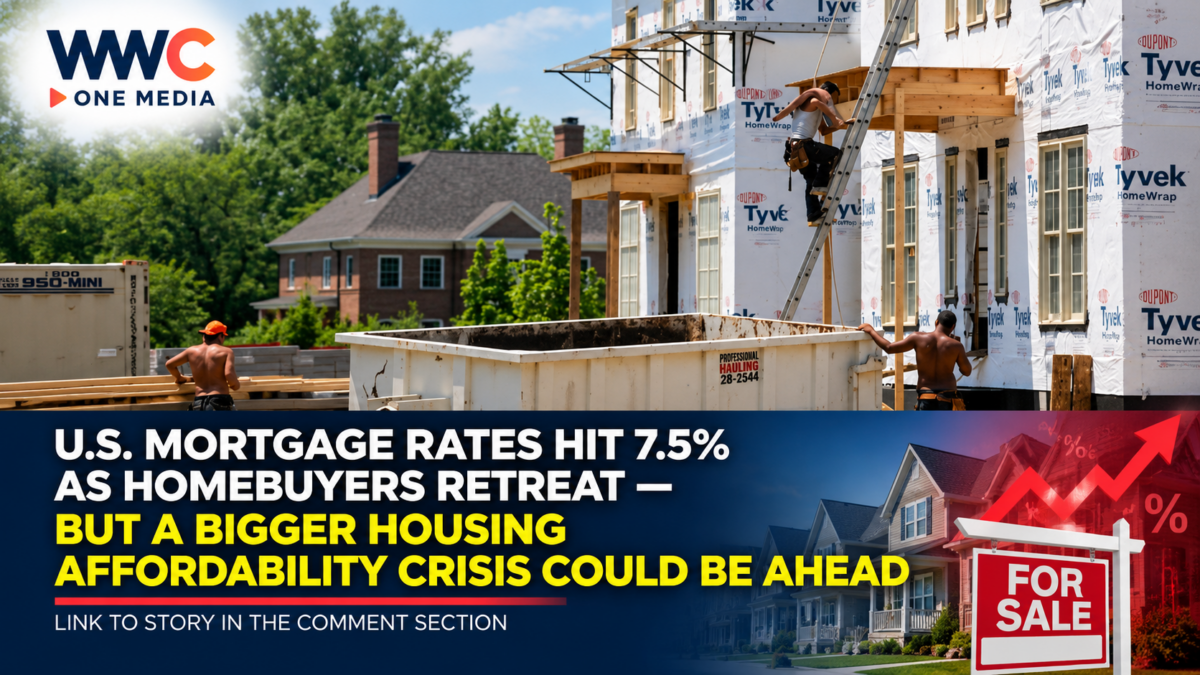
WASHINGTON, UNITED STATES — October 14, 2026 — America’s housing market is facing another major setback as mortgage rates climb to approximately 7.5%, pushing homeownership further out of reach for millions of prospective buyers and deepening concerns about a prolonged real estate slowdown.
The latest increase in borrowing costs is weighing on applications for home-purchase loans, while record-high September home prices and limited affordability continue to discourage buyers.
According to Bloomberg’s October 14 report, U.S. mortgage rates have reached the 7.5% level, extending a period of weakness in home-purchase activity.
Separate figures from the Mortgage Bankers Association and Freddie Mac confirm that borrowing costs have climbed to their highest levels in nearly three years.
Meanwhile, data released by the National Association of Realtors show that existing-home sales remained below an annualized pace of four million in September.
The developments are creating a difficult combination for the U.S. property market: expensive loans, elevated home prices, cautious buyers and homeowners reluctant to sell.
But the deeper concern is whether the housing market can recover while inflation fears and high bond yields keep mortgage financing unusually expensive.
Mortgage Rates Reach Their Highest Levels in Nearly Three Years
The average interest rate on a 30-year fixed mortgage has returned to levels not seen since late 2023.
The Mortgage Bankers Association reported on October 7 that the average contract rate for a conforming 30-year mortgage reached 7.49% during the week ended October 2.
That was the highest level in almost three years.
Freddie Mac’s separate weekly survey showed the average 30-year fixed-rate mortgage rising to 7.40% in the week reported October 8.
The figure represented the seventh consecutive weekly increase.
One year earlier, Freddie Mac’s comparable rate was approximately 6.30%.
Although mortgage rates vary across lenders and borrowers, the broader trend is clear.
Financing a home purchase has become substantially more expensive than it was a year ago.
For prospective buyers, even a relatively small increase in mortgage rates can mean hundreds of dollars in additional monthly payments.
When combined with high property prices, those expenses can prevent households from qualifying for the loan amounts they need.
Mortgage Applications Continue to Decline
Higher borrowing costs are already affecting demand for housing loans.
The Mortgage Bankers Association’s October 7 report showed total mortgage application volume falling 4.2% from the previous week.
Applications to purchase homes declined 2% on a seasonally adjusted basis.
On an unadjusted basis, purchase applications were 15% lower than during the same week in 2025.
Refinancing activity was even weaker.
The MBA’s refinance index fell 8% from the preceding week and stood 56% below its year-earlier level.
The figures show how quickly demand can weaken when borrowing costs rise.
Homebuyers may postpone purchases, search for cheaper properties or reconsider whether they can afford monthly payments.
Existing homeowners, meanwhile, have little incentive to refinance when they already hold loans with substantially lower interest rates.
The latest available primary-source figures confirm the deterioration through the October 7 release.
Bloomberg’s October 14 headline indicates that the slump continued, although the exact October 14 application movements could not be independently established from the accessible primary-source release.
Why a 7.5% Mortgage Rate Matters So Much
Mortgage interest rates affect the total cost of purchasing a property.
When rates rise, monthly payments increase even if the home’s selling price remains unchanged.
This can reduce how much a buyer qualifies to borrow.
For first-time buyers, the impact is especially significant because they generally do not have substantial equity from a previous property sale.
Households may need to save larger down payments, accept smaller homes or move to less expensive locations.
Higher rates can also reduce demand for properties at price levels that previously attracted more buyers.
However, this does not automatically lead to an immediate decline in home prices.
If homeowners remain financially secure and choose not to sell, available supply may remain too constrained to produce large price reductions.
The current market reflects precisely that tension.
Demand is weakening, but many property owners are reluctant to reduce their asking prices significantly.
U.S. Home Prices Hit a September Record
The affordability challenge is being intensified by historically expensive homes.
According to the National Association of Realtors, the median price of an existing home sold in September reached $417,500.
That was the highest September median price on record.
The figure represented an increase of approximately 1.3% from a year earlier.
The combination of elevated property prices and higher mortgage rates creates a double burden.
Even households with stable incomes can struggle to qualify for loans or meet monthly payment requirements.
For younger workers and first-time buyers, saving enough for a down payment is becoming more difficult.
The market has also become increasingly divided between households that already own homes and those attempting to purchase their first property.
Existing owners may have substantial accumulated equity and mortgages secured at much lower rates.
New buyers face the full impact of current market prices and financing conditions.
This imbalance is one of the central reasons affordability remains such a persistent problem.
Existing-Home Sales Remain Near Historic Lows
The National Association of Realtors reported on October 13 that existing-home sales increased 1.5% in September.
Sales reached a seasonally adjusted annual rate of 3.99 million units.
At first glance, the monthly increase might appear encouraging.
But the broader picture remains weak.
Sales were 2.2% lower than in September 2025, and activity remained below four million annualized units for the second consecutive month.
The housing market has struggled since mortgage rates began climbing sharply in 2022.
Annual sales have remained far below the pace considered typical in stronger housing markets.
The September increase also reflects transactions whose contracts were often signed earlier, when mortgage rates were lower.
That means the impact of the latest rate increases may become more visible in subsequent sales reports.
Economists and housing analysts are therefore cautious about interpreting September’s small improvement as the start of a sustainable recovery.
Pending Home Sales Signal Further Weakness
Another warning comes from pending home sales.
Pending sales measure homes that have gone under contract but have not yet completed the closing process.
They can provide an earlier indication of future housing activity.
According to a separate Bloomberg report published October 12, Redfin data showed pending home sales dropping 4% in September from the previous month.
That was the steepest monthly decline in more than three years.
The indicator reached its lowest level since 2014, excluding the early period of the COVID-19 pandemic.
The weakness suggests that buyers are continuing to retreat as higher financing costs reduce purchasing power.
It also raises the possibility that completed home sales could decline further in the coming months.
However, pending sales are an indicator rather than a guarantee of future results.
Actual closings can still be influenced by financing approvals, contract cancellations and regional market conditions.
Why Mortgage Rates Are Rising Again
The latest increase in mortgage rates is linked partly to developments in the U.S. bond market.
Mortgage rates are strongly influenced by yields on longer-term Treasury securities, particularly the benchmark 10-year U.S. Treasury note.
When investors demand higher yields on government bonds, mortgage financing costs often rise as well.
The relationship is not exact because mortgage-backed securities also reflect other risks and market conditions.
Nevertheless, Treasury yields are a key benchmark for mortgage lenders.
In early October, the 10-year Treasury yield climbed to approximately 5.29%, its highest level since 2002, according to Associated Press reporting.
The increase reflected concerns about inflation, economic uncertainty and the impact of international energy-market disruptions.
Higher Treasury yields make financing more expensive throughout the economy.
They can affect mortgages, corporate loans and other forms of long-term borrowing.
For the housing market, the effect is particularly visible because residential mortgages commonly extend over decades.
Middle East Conflict Adds Pressure Through Energy Prices
The conflict involving Iran has contributed to volatility in international energy markets.
Higher oil prices can increase transportation, production and distribution costs.
These pressures can feed into broader inflation expectations.
When investors believe inflation may remain elevated, they may demand higher yields to hold long-term bonds.
This can push mortgage borrowing costs upward even without an immediate change in the Federal Reserve’s policy interest rate.
The Federal Reserve controls short-term benchmark rates, but it does not directly set mortgage rates.
Mortgage lenders also consider funding costs, market competition and the risks associated with long-term lending.
This distinction is important.
A future Federal Reserve rate cut would not automatically guarantee a corresponding reduction in 30-year mortgage rates.
Much would depend on the direction of inflation expectations and longer-term bond yields.
The Mortgage Lock-In Effect Is Keeping Owners From Selling
One of the most unusual features of the current housing market is the mortgage lock-in effect.
Many American homeowners refinanced or purchased properties when mortgage rates were extremely low.
Some hold loans with rates near 3% or 4%.
Selling those homes and purchasing another property could require taking out a new mortgage at roughly 7.5%.
That would significantly increase borrowing costs.
As a result, some homeowners prefer to remain where they are, even when they would otherwise consider moving.
This can reduce the supply of homes available to buyers.
It also slows activity among real estate agents, mortgage brokers and related service providers.
The effect does not mean homeowners never move.
Job changes, family needs, retirement and financial circumstances can still lead to property sales.
But higher rates create an additional financial obstacle to normal housing-market activity.
More Homes Are Available, but Buyers Remain Cautious
Despite the lock-in effect, housing inventory has been increasing.
The National Association of Realtors reported that approximately 1.60 million existing homes were available for sale at the end of September.
That represented the largest supply since November 2019.
Inventory stood at approximately 4.8 months of supply at the current sales pace.
This is a notable change from the intense competition seen during parts of the pandemic-era housing boom.
Buyers in some markets now have more properties to choose from.
Sellers are also becoming more willing to negotiate on price or offer concessions.
According to the Associated Press, approximately 21% of September listings experienced price reductions.
However, additional supply has not automatically restored affordability.
High interest rates can still prevent buyers from qualifying for loans, even when sellers offer discounts.
The market has therefore shifted toward buyers in some respects without becoming genuinely affordable for many households.
First-Time Buyers Face an Especially Difficult Market
First-time buyers are among the most vulnerable groups in the current housing slowdown.
They generally lack the equity that existing homeowners can use toward another purchase.
They may also be dealing with student loans, rising rental costs and limited savings.
According to the National Association of Realtors, first-time buyers accounted for approximately 31% of existing-home transactions in September.
That share remains below the roughly 40% level often associated with a healthier balance in the housing market.
The figures illustrate how expensive borrowing and property prices can create barriers to entry.
When younger households delay homeownership, the effects may extend beyond real estate transactions.
They can influence household formation, geographic mobility and long-term wealth accumulation.
Homeownership has historically been an important source of wealth building for many American families.
Persistent affordability barriers could widen the financial gap between people who already own properties and those who do not.
Builders and Real Estate Businesses Face Growing Pressure
The mortgage slowdown also affects businesses connected to housing.
Homebuilders depend on buyers’ ability to obtain affordable financing.
When rates rise sharply, potential customers may cancel contracts or postpone purchases.
Builders may respond by offering mortgage-rate buydowns, price reductions or other incentives.
These measures can support sales but may also reduce profit margins.
Mortgage lenders face lower application volumes, while real estate agents and home-related service companies must compete for fewer transactions.
Furniture retailers, home-improvement businesses and construction suppliers can also be affected when people move less frequently.
The housing sector therefore plays a broader role in economic activity than home sales alone.
Sustained weakness can reduce spending and employment in industries connected to residential construction and property transactions.
However, the impact varies by region and company.
Some local markets may remain resilient because of employment growth, population increases or limited housing supply.
Could Home Prices Finally Start Falling?
One of the biggest questions facing the market is whether weaker demand will translate into substantial price declines.
Higher mortgage rates generally reduce buyers’ purchasing power.
That can create downward pressure on property prices.
But the extent of any decline depends on supply, employment and sellers’ willingness to accept lower offers.
The Wall Street Journal reported on October 14 that many homeowners are resisting significant price reductions.
Substantial home equity and relatively low mortgage delinquency rates are allowing some owners to wait rather than sell at a discount.
Redfin data also show that the number of available sellers exceeds active buyers by a considerable margin in some markets.
These conditions create opportunities for qualified buyers to negotiate.
However, they do not establish that a nationwide housing price collapse is imminent.
Unlike the housing crisis of 2008, many current homeowners have substantial equity and long-term fixed-rate loans.
A severe downturn would likely require additional economic stress, such as widespread unemployment or a sharp deterioration in household finances.
Housing Market Could Remain Weak Into 2027
The outlook for the coming year remains uncertain.
The Mortgage Bankers Association announced on October 11 that it expects mortgage originations to decline approximately 5% in 2027 as mortgage rates remain above 7%.
That forecast suggests the industry is preparing for continued difficult conditions.
Meanwhile, other market analysts expect home sales to remain subdued if borrowing costs stay elevated.
The outlook could improve if Treasury yields decline, inflation eases and household incomes strengthen.
But affordability may remain a challenge even if mortgage rates fall moderately.
Home prices are still high compared with incomes in many markets.
A durable recovery may require a combination of lower borrowing costs, stronger income growth and increased housing supply.
No single policy change is likely to resolve every affordability issue immediately.
The Political Stakes Are Rising Ahead of U.S. Midterms
Housing affordability is becoming an increasingly important political issue ahead of the November 3 congressional elections.
For many Americans, the prospect of purchasing a home is closely connected to perceptions of economic opportunity.
High mortgage rates and expensive property prices are affecting voters across income groups.
Republicans argue that policies encouraging domestic investment, energy production and economic growth can help improve affordability over time.
Democrats emphasize housing supply, consumer protections and measures intended to reduce costs for working families.
The debate also involves the Federal Reserve, although its monetary policy decisions are made independently of electoral campaigns.
Ultimately, voters are likely to assess whether their financial circumstances have improved.
The continuing difficulty of buying a home creates a political challenge for whichever party is seen as responsible for economic conditions.
What Happens Next?
The housing industry will closely monitor upcoming mortgage application reports, pending sales figures and Federal Reserve communications.
Investors will focus on Treasury yields and inflation expectations for signs that mortgage rates may begin to stabilize.
Homebuyers will look for lower financing costs and greater negotiating opportunities.
Sellers must decide whether to adjust prices or continue waiting for better market conditions.
For the broader economy, the challenge is preventing housing weakness from becoming a more significant drag on consumer spending and construction activity.
September’s modest increase in completed home sales offers limited reassurance because many transactions were negotiated before the latest mortgage-rate surge.
More recent purchase and pending-sales indicators suggest the market remains under pressure.
America’s mortgage rates have climbed to roughly 7.5%, pushing more potential buyers out of the market. But the bigger threat is a prolonged affordability crisis in which elevated loan costs, expensive homes and hesitant sellers keep the housing market stuck well into 2027.