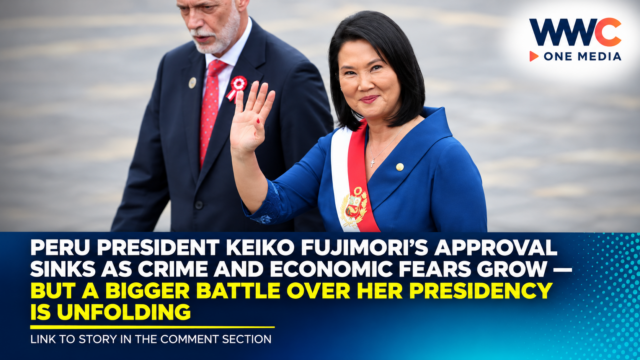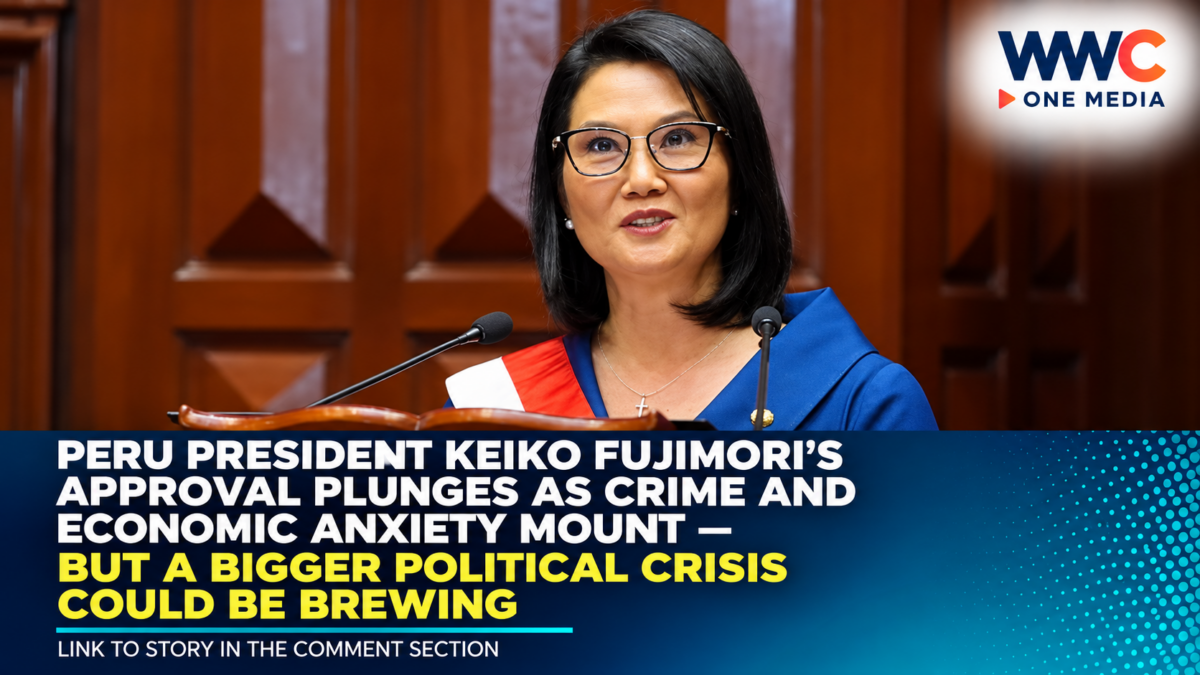
LIMA, PERU — October 14, 2026 — Peruvian President Keiko Fujimori is losing public support just months after taking office, with new regional polling showing her approval slipping to 46.3% as mounting concerns about organized crime, economic conditions and government performance put her administration under growing pressure.
The October survey by CB Global Data found that Fujimori’s positive rating declined from 52.4% in September to 46.3%, a drop of 6.1 percentage points.
Her disapproval increased to 50.8%, meaning more respondents expressed an unfavorable view of her presidency than a favorable one.
The decline was the largest monthly fall among the Latin American leaders assessed in the firm’s latest regional ranking, according to reporting by Infobae and Caretas.
Fujimori also dropped from fourth to seventh place in the survey’s regional standings.
The results add to concerns already raised by national polls in September, which showed that the conservative leader was losing much of the initial goodwill she enjoyed after assuming office on July 28.
But her biggest challenge may not simply be declining approval.
It is whether her government can deliver on promises to fight crime and improve the economy while facing resistance from a Congress in which her party does not hold a majority.
October Poll Shows Fujimori’s Approval Falling Below 50%
CB Global Data’s October survey found that 46.3% of respondents had a positive view of Fujimori, compared with 50.8% who viewed her negatively.
In the previous month’s survey, her approval stood at 52.4% and disapproval at 45.1%.
That represents a 6.1-percentage-point fall in approval and a 5.7-point increase in disapproval.
The research was conducted from October 5 to October 8 across 18 Latin American countries.
According to Caretas, national samples ranged from 1,959 to 3,911 respondents, with reported margins of error varying by country.
Fujimori’s seventh-place ranking placed her below several regional leaders, including Mexico’s Claudia Sheinbaum and El Salvador’s Nayib Bukele.
These figures are measures of public opinion, not election results.
They indicate a difficult political environment but do not determine how Peruvians will assess the president over the remainder of her term.
Earlier National Polls Reveal a Steeper Loss of Support
The October numbers follow an unusually rapid deterioration in Fujimori’s approval during the first weeks of her presidency.
A Datum Internacional survey reported in September found that approval had dropped from 60% in August to 42% in September.
That represented an 18-percentage-point decline.
Disapproval rose from 24% to 44% during the same period.
A separate Ipsos survey for Perú21 also reported 42% approval in September, compared with 57% in August.
Ipsos found disapproval rising from 25% to 48%.
A third survey conducted by the Institute of Peruvian Studies found 37% approval and 49% disapproval in early September.
The different polls should not be directly combined because they were conducted at different times using different samples and methodologies.
However, their overall direction points to the same political problem: Fujimori’s early support has weakened considerably.
Crime Is Becoming the Biggest Test of Her Presidency
Peru’s growing problems with extortion, organized crime and violent attacks were central issues during the 2026 election.
Fujimori campaigned on restoring public order and strengthening the government’s response to criminal groups.
Her administration has sought additional powers to address insecurity, including tougher rules against extortion and organized crime, changes to prison management and stronger security operations.
But public confidence in the government’s ability to deliver results remains fragile.
In September, an Institute of Peruvian Studies survey found that 59% of respondents considered public insecurity a top priority requiring urgent government attention.
Criminal activity affects transportation workers, business owners and communities where extortion demands can threaten livelihoods.
For the government, the challenge goes beyond announcing tougher penalties.
Effective crime reduction also requires capable police investigations, functioning courts, prison management and protection for victims and witnesses.
Without visible improvements, the issue that helped Fujimori win the presidency could become one of the greatest threats to her popularity.
Congress Cuts Fujimori’s Security Powers
Fujimori’s efforts to respond to crime have encountered significant political resistance.
According to an October 10 report by El País, the government requested authority to legislate by decree on 66 measures for 120 days.
The Chamber of Deputies reduced the request to just 20 measures and shortened the proposed period to 90 days.
The approved scope included measures addressing public security and the coastal El Niño phenomenon.
However, lawmakers rejected several proposals, including a greater role for the armed forces in overseeing prisons.
Some legislators expressed concern about the possible implications for civil liberties and human rights.
Fujimori’s party, Fuerza Popular, holds 41 of the 130 seats in the Chamber of Deputies.
Although it is the largest individual political force, it does not have the votes to govern without alliances.
The setback illustrates a major difference between Fujimori’s previous political influence and her current role as president.
Her party once exercised considerable power from Congress.
Now, her administration must negotiate with lawmakers to implement its own program.
The government argues that stronger measures are necessary to confront organized crime.
Opponents say emergency powers should be subject to appropriate democratic safeguards.
Economic Expectations Add to the Political Pressure
Alongside insecurity, economic concerns are contributing to doubts about the government’s performance.
Fujimori entered office promising greater investment, business confidence and employment opportunities.
Peru has significant economic strengths, including major copper production and extensive mineral resources.
The country is an important supplier of metals used in construction, electricity systems and manufacturing.
However, favorable investment conditions do not automatically produce immediate improvements in household living standards.
Jobs, purchasing power, public services and regional inequality remain important concerns.
Businesses also face the economic consequences of crime, particularly when extortion or insecurity raises costs.
For the administration, success will depend on whether its economic policies produce measurable improvements that reach ordinary Peruvians.
The October approval survey establishes that public support has weakened, but it does not by itself prove how much of the decline was caused by the economy versus crime or other political issues.
Those different factors require separate survey questions and analysis.
A Narrow Election Victory Leaves Peru Deeply Divided
Fujimori won the June 7 presidential runoff against left-wing candidate Roberto Sánchez after one of Peru’s closest elections.
The country’s National Jury of Elections formally declared her the winner on July 3.
The official count gave Fujimori 9,223,396 votes, compared with 9,173,755 for Sánchez.
The margin was just 49,641 votes.
The result illustrated the country’s deep political divisions, with contrasting electoral preferences among urban and rural communities.
Fujimori assumed office on July 28 for the 2026–2031 presidential term.
Her narrow victory meant she entered the presidency with substantial opposition as well as committed supporters.
That makes coalition-building particularly important.
A president can win a closely contested election and still face difficulties securing legislative support for ambitious reforms.
Fujimori’s early battles with Congress demonstrate how quickly those difficulties can affect the government’s agenda.
A Planned Meeting With Bukele Raises the Stakes
Fujimori is scheduled to visit El Salvador from October 28 to October 31, where she is expected to meet President Nayib Bukele and other officials.
Her planned program includes a visit to the country’s high-security Terrorism Confinement Center, widely known as Cecot.
Bukele’s security policies have attracted international attention for their aggressive response to criminal gangs.
Supporters credit his government with sharply reducing gang violence.
Human rights organizations, however, have raised concerns about mass detention, due process and the treatment of prisoners.
Fujimori has expressed interest in elements of El Salvador’s security approach.
But Peru’s legal framework, institutions and criminal environment differ from those of El Salvador.
Any effort to adapt particular policies would require careful consideration of their effectiveness, costs and compatibility with constitutional protections.
The proposed visit could strengthen Fujimori’s tough-on-crime political message.
Whether it produces meaningful policy changes or improved security remains to be seen.
Strong Political Influence Has Not Protected Public Approval
Fujimori’s declining popularity contrasts with her substantial influence inside Peru’s political system.
An October survey of political and business leaders conducted by Ipsos for Semana Económica ranked her as the country’s most powerful political figure.
She received a 97% score in the survey’s assessment of political influence.
But that result should not be confused with a 97% public approval rating.
The study measured the views of a specialist group about who holds power in Peru, not how ordinary voters evaluate the president’s performance.
The distinction illustrates an important challenge facing her government.
Political influence may help a president shape national debates and negotiate institutional decisions.
But it does not necessarily produce popular support.
Voters tend to judge governments on results that affect their daily lives.
Fujimori’s Legacy Creates Additional Scrutiny
Keiko Fujimori remains closely associated with the political legacy of her father, former President Alberto Fujimori.
Supporters of the former president credit his government with combating insurgent groups and introducing economic reforms.
Critics point to serious human rights abuses, authoritarian practices and corruption.
Alberto Fujimori was convicted of crimes involving human rights violations.
That history continues to shape debates about policing, military involvement in domestic security and executive authority.
For the current administration, public safety reforms must balance effective enforcement with the protection of democratic rights.
The government’s ability to demonstrate both could become an important factor in its political credibility.
What Happens Next?
The coming months will be critical for Fujimori’s administration.
Future opinion surveys will show whether the decline in approval continues or begins to stabilize.
The government will face pressure to demonstrate progress against organized crime while improving economic confidence.
Its relationship with Congress will also be central to the success of its legislative program.
The planned visit to El Salvador may offer Fujimori an opportunity to present additional security proposals, but the effectiveness of any new approach will depend on implementation in Peru.
For businesses, investors and ordinary citizens, the core questions remain practical.
Will insecurity decline?
Will employment and living standards improve?
Can political institutions cooperate to deliver reforms?
And can a government elected by such a narrow margin rebuild confidence across the country’s divided electorate?
Keiko Fujimori’s approval has fallen to 46.3% in a new October regional survey, with crime and economic anxiety creating mounting pressure. But her biggest political test may be whether she can turn promises into visible results while navigating a divided Congress that has already limited her powers.