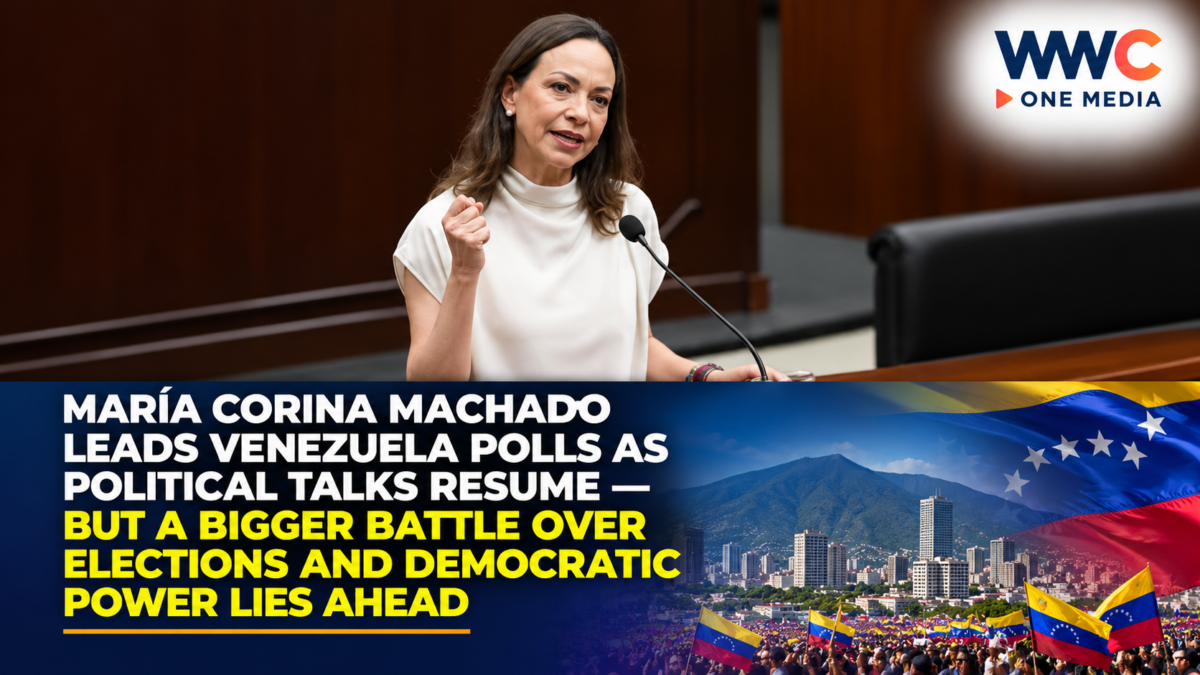
CARACAS, VENEZUELA — October 14, 2026 — Venezuelan opposition leader María Corina Machado remains one of the country’s strongest political figures in public opinion surveys as government and opposition representatives resume negotiations aimed at restoring democratic institutions and establishing a path toward national elections.
But the renewed dialogue has exposed a major contradiction in Venezuela’s political transition: Machado enjoys substantial support among voters, yet her movement has not been directly represented in the U.S.-backed talks with interim President Delcy Rodríguez’s government.
The negotiations have gained urgency following the capture of former President Nicolás Maduro by U.S. forces in January and the installation of an interim administration under Rodríguez.
Washington has backed the transition process, while opposition groups are pushing for guarantees that a future election will be free, competitive and internationally credible.
For Machado, the immediate challenge is turning public support into meaningful participation in Venezuela’s political future.
And for Venezuelans, the bigger question is whether the negotiations will deliver a genuine democratic transition—or become another prolonged process without a firm election date.
Machado Remains Ahead in Venezuelan Polling
Machado continues to command significant support, according to opinion polling cited in recent Bloomberg and Reuters reporting.
An AtlasIntel survey previously reported by Bloomberg found that 53% of respondents approved of Machado, making her one of the country’s best-rated political figures.
A separate Meganálisis survey placed Machado at 76% in a hypothetical presidential contest against interim President Delcy Rodríguez, who received 4%.
These figures should not be treated as interchangeable.
The AtlasIntel number measures approval, while the Meganálisis figures describe a hypothetical electoral matchup.
They also come from different surveys, with different methodologies.
Neither result constitutes an official election tally or guarantees that Machado would win a future presidential election.
Even so, the surveys help explain why her exclusion from the political negotiations has become controversial.
Her supporters argue that a transition cannot achieve lasting legitimacy if one of the country’s most influential opposition movements remains outside the main negotiating process.
Venezuela’s Political Dialogue Enters Another Critical Stage
The latest negotiations are focused on rebuilding democratic institutions and defining conditions for future elections.
Government and opposition representatives have discussed reforms affecting the Supreme Court of Justice, civil liberties, political participation and the administration of elections.
The opposition delegation has included representatives linked to Venezuela’s opposition-controlled National Assembly elected in 2015.
Dinorah Figuera has played a prominent role in the opposition negotiating effort.
The discussions follow earlier rounds of talks supported by the United States.
In September, Bloomberg Línea reported that a new phase would address political and civil guarantees as well as reforms to the country’s judicial institutions.
But progress has been uneven.
Venezuelan outlet Efecto Cocuyo reported that analysts viewed the second round of talks as producing limited institutional results, despite some developments involving political detainees, media access and judicial appointments.
The negotiations now face pressure to produce concrete agreements rather than broad commitments.
Why Machado Is Missing From the Talks
One of the biggest controversies is Machado’s absence from the negotiating table.
She has questioned aspects of the process while maintaining that genuine democratic advances would be welcome.
Her allies argue that excluding her movement creates doubts about whether the talks fully represent Venezuelan opposition voters.
Other opposition representatives have chosen to participate, saying negotiations offer a practical opportunity to secure political reforms.
The division reflects two competing concerns.
Some opposition leaders believe engagement with the interim government is necessary to obtain concessions and prepare for elections.
Others fear that negotiations without Machado could produce agreements that lack sufficient public legitimacy.
The issue is particularly sensitive because Machado was barred from running in the disputed 2024 presidential election.
Her political movement instead backed Edmundo González Urrutia, whom the opposition and several foreign governments recognized as the rightful winner of that contest.
The current talks therefore take place against years of disputes over electoral fairness and political participation.
Machado Wants Presidential Elections by July 2027
Machado has called for Venezuela to hold a new presidential election by July 2027.
In an interview with the Financial Times reported by Reuters on October 9, she argued that there was sufficient time to prepare for a credible vote by that date.
Her position places pressure on the interim government to establish a clear electoral timetable.
Rodríguez has promised that Venezuela will eventually hold elections as part of its transition toward what she describes as full democracy.
Addressing the United Nations General Assembly in September, Rodríguez said that all political forces would be able to participate.
However, she did not announce a date.
The difference is significant.
Machado wants a relatively near-term presidential election, while the interim government has emphasized institutional rebuilding and economic stability before voting takes place.
Until an official timetable is agreed, the future of Venezuela’s presidency remains uncertain.
Political Bans Could Determine Who Can Run
A central issue in the negotiations is whether previously imposed political disqualifications will be lifted.
Machado has faced restrictions on holding public office, and her allies are demanding guarantees that opposition candidates will be allowed to compete.
The debate goes beyond any single politician.
For a future election to be broadly credible, voters must be able to choose among candidates without arbitrary political exclusion.
The independence of electoral authorities and courts is therefore crucial.
Opposition representatives have sought reforms involving the Supreme Court and the National Electoral Council.
Political analysts argue that an election timetable alone will not guarantee democratic legitimacy if key opposition candidates remain barred or electoral institutions lack independence.
The practical test will be whether negotiations produce enforceable changes before voters are asked to return to the polls.
Machado’s Return to Venezuela Remains Unresolved
Machado has been outside Venezuela since late 2025.
She traveled abroad after winning the 2025 Nobel Peace Prize and has repeatedly expressed her desire to return home.
Her supporters say authorities have obstructed attempts to return, while U.S. officials have been cautious about the timing.
Reuters reported in September that Washington was concerned her return could complicate the U.S.-backed transition process.
Machado has nevertheless insisted that she intends to participate directly in Venezuela’s political future.
Her physical return could become a major political event.
Supporters would likely see it as a sign of greater political openness.
But it could also increase tensions between the interim government, the opposition and Washington.
As of October 14, no confirmed return date has been established.
Washington’s Role Raises Difficult Questions
The United States has become a central actor in Venezuela’s transition following the January operation that removed Maduro.
President Donald Trump’s administration has supported Rodríguez’s interim government while seeking economic stabilization and a longer-term political settlement.
Washington has also played a prominent role in Venezuela’s oil sector.
The arrangement has generated criticism from opposition figures who argue that economic agreements should not overshadow democratic reforms.
Machado has called for greater transparency in the management of Venezuela’s oil revenues.
The United States argues that economic recovery and political stability are necessary foundations for a successful transition.
But critics question whether supporting the interim administration while Machado remains excluded is consistent with Washington’s stated commitment to free elections.
The tension demonstrates how Venezuela’s political transition is linked to wider questions about sovereignty, international influence and control over natural resources.
Venezuela’s Oil Wealth Complicates the Transition
Venezuela possesses some of the world’s largest proven oil reserves.
Its energy industry could play a significant role in national reconstruction if production, investment and infrastructure improve.
However, years of economic crisis, institutional uncertainty and political conflict have created major obstacles.
Investors are watching for clearer rules governing oil operations, foreign investment and the country’s outstanding financial obligations.
On October 14, Reuters reported that Venezuelan economic adviser Calixto Ortega expected the government to publish a debt-sustainability analysis soon.
Such an assessment could be important for future debt negotiations and the country’s ability to attract financing.
Economic recovery could help stabilize living standards and public services.
But a stronger economy alone would not resolve disputes over political representation and democratic legitimacy.
The country’s future will depend on both economic reform and credible political institutions.
Why Polling Strength Does Not Guarantee Political Power
Machado’s polling advantage provides an indication of her political standing, but the path from popularity to office remains complicated.
First, Venezuela has not announced a firm date for its next presidential election.
Second, unresolved political restrictions could affect who is eligible to run.
Third, the country’s electoral institutions remain under scrutiny.
Fourth, opposition groups have not reached full agreement on the current negotiating process.
And finally, Washington’s influence over the transition adds another layer of uncertainty.
Even strong public support cannot substitute for a functioning and credible electoral system.
For Machado, the immediate priority is therefore not simply maintaining her popularity.
It is helping establish conditions under which voters can translate their preferences into an accepted political result.
What Happens Next?
The coming weeks will test whether Venezuela’s renewed dialogue can produce measurable political progress.
Key issues include reforms to the Supreme Court, restoration of political rights, guarantees for opposition participation and the establishment of an election timetable.
Machado’s possible return will also remain closely watched.
International observers will assess whether the interim government and opposition negotiators can move beyond preliminary agreements.
Meanwhile, Venezuelans continue to face uncertainty over political representation, economic recovery and the country’s long-term direction.
Polling suggests Machado retains substantial public support.
But it is the rules governing the eventual election—not opinion surveys alone—that will determine whether Venezuelans can freely choose their next president.
María Corina Machado may lead Venezuela’s political opinion polls as negotiations resume, but the country’s bigger democratic test is whether its leaders can agree on free elections, restore political rights and allow voters—not negotiating factions or foreign governments—to decide who holds power.