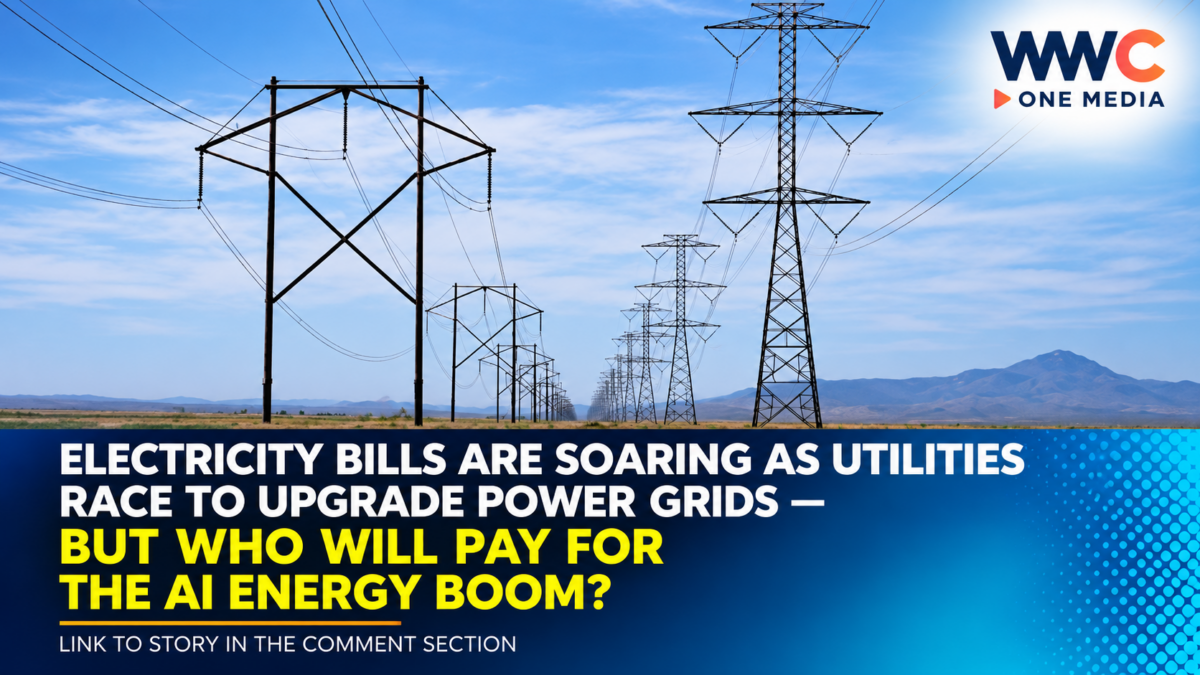
WASHINGTON, UNITED STATES — October 14, 2026 — America’s electricity affordability crisis is entering a new phase as utilities seek billions of dollars to expand and modernize power networks, raising a difficult question for regulators and consumers: Who should pay for the infrastructure needed to support artificial intelligence, industrial expansion and the country’s growing demand for electricity?
Across the United States, households are facing higher power bills while electricity companies plan major investments in transmission lines, substations, generating capacity and aging distribution networks.
The expansion of artificial intelligence has intensified the challenge.
Technology companies are building massive data centers that can require as much electricity as entire communities, forcing utilities to reconsider infrastructure plans developed when power demand was growing much more slowly.
But the emerging debate extends beyond whether enough electricity can be generated.
It concerns how the costs of building a larger power system are distributed between ordinary households, technology companies, industrial customers and utility shareholders.
If those costs are allocated poorly, residential customers could face higher electricity bills even when their own consumption barely changes.
Electricity Bills Are Becoming a Bigger Financial Burden
Electricity has become an increasingly important part of America’s cost-of-living debate.
According to TIME’s February 2026 analysis, average U.S. monthly residential electricity bills increased from approximately $121 in 2021 to $156 in 2025.
That represents an increase of nearly 30% over four years.
The rise has occurred alongside higher housing costs, insurance premiums and other household expenses.
For families living on fixed incomes, even relatively modest increases in monthly utility bills can create financial difficulties.
Energy affordability is particularly important because households cannot easily eliminate electricity consumption.
Refrigeration, lighting, heating, cooling and essential electronic equipment all require reliable power.
Some households can reduce usage through efficiency improvements, but the savings may be limited when electricity rates themselves continue increasing.
The problem is therefore not simply how much electricity consumers use.
It is also how much they must pay for each unit of energy and for access to the network that delivers it.
Why Utilities Are Spending Billions on Infrastructure
Electricity companies are being asked to modernize networks while accommodating rising demand.
Large parts of the U.S. grid were designed decades ago.
Utilities must replace aging equipment, strengthen protection against severe weather and connect new electricity generation facilities.
At the same time, additional demand from industrial development and data centers requires new substations, transformers and transmission capacity.
These investments are expensive.
Utility companies often recover approved infrastructure costs through regulated electricity rates.
That means investments made today can influence household bills for many years.
However, not every increase in utility spending automatically translates into the same increase for every customer.
Regulators determine which costs are considered reasonable, how they are recovered and which customer groups should bear them.
These decisions are central to the current electricity affordability debate.
The AI Boom Is Changing Electricity Demand
Artificial intelligence is becoming one of the most important new sources of electricity demand.
AI data centers require substantial power to operate computing servers, networking systems and cooling equipment.
Unlike many traditional commercial buildings, large data centers can operate continuously and require highly reliable electricity supplies.
As technology companies expand AI services, their electricity requirements can increase sharply.
In September 2025, Bloomberg investigated how growing data center activity was affecting wholesale power markets.
Its analysis found that some wholesale electricity prices near major data center concentrations were as much as 267% higher in a single comparable month than five years earlier.
The finding illustrated the potential pressure created when electricity demand expands faster than generation and transmission infrastructure.
However, it did not mean every household near a data center experienced a 267% increase in its electricity bill.
Wholesale prices are only one component of retail electricity charges, and the relationship between data center development and consumer costs varies by location.
The broader concern is that rapid demand growth can increase the cost of supplying electricity, particularly where the grid is already constrained.
Utilities Face a New Problem: Data Centers That May Never Be Built
An additional complication is emerging from speculative data center development.
According to The Wall Street Journal’s October 13 reporting, utilities are receiving enormous volumes of electricity connection requests from proposed AI facilities.
Some developers are seeking access to the grid from multiple utilities before deciding where to build.
This can create the impression that future electricity demand will be much greater than what eventually materializes.
Such proposals have been described as phantom data centers.
They present a difficult planning problem.
If utilities build infrastructure for facilities that never open, the costs may not be supported by the expected customer demand.
If they underestimate demand, they risk insufficient capacity and delays in connecting genuine projects.
Utilities are responding by requiring larger financial deposits, stronger contractual commitments and additional evidence that developments are likely to proceed.
The goal is to distinguish serious electricity customers from speculative requests.
This matters because inaccurate forecasts can lead to unnecessary infrastructure spending or insufficient investment, either of which can ultimately affect electricity costs.
Texas Shows the Scale of the Challenge
Texas has emerged as one of America’s most active markets for planned data center construction.
The state offers a large electricity market, extensive industrial infrastructure and growing renewable-energy capacity.
But demand projections have become difficult to interpret.
The Wall Street Journal reported that requests for new electricity connections in Texas had reached approximately 400,000 megawatts.
That figure represents proposed requests, not the amount of electricity that data centers are actually consuming.
Expected actual demand from the relevant projects is substantially smaller.
To address speculative applications, Texas regulators have introduced financial requirements intended to encourage developers to submit credible proposals.
The distinction is critical.
If electricity planners treat every requested megawatt as guaranteed future demand, they could overestimate how much infrastructure is needed.
For consumers, the consequences could include unnecessary expenditures incorporated into future utility rates.
Exelon Tightens Rules as Grid Requests Surge
Other utilities are adopting similar safeguards.
The Wall Street Journal reported that Exelon reduced its potential project demand pipeline from approximately 18,000 megawatts to 11,000 megawatts after requiring financial commitments.
The company reportedly accumulated around $1 billion in collateral.
This demonstrates how stronger application requirements can help utilities distinguish projects with serious financing and development plans from speculative proposals.
For data center developers, deposits and contractual obligations increase the cost of reserving electricity capacity.
But for existing customers, such measures may reduce the risk of paying for infrastructure built around unrealistic forecasts.
The challenge is designing requirements that discourage speculation without preventing viable technology projects from moving forward.
A $12.2-Billion Grid Upgrade Plan Highlights the Stakes
The need for better transmission infrastructure is also becoming more urgent.
Reuters reported on October 13 that PJM Interconnection, the largest U.S. regional electricity grid operator, had proposed approximately $12.2 billion in network improvements.
PJM coordinates wholesale electricity markets across 13 states and Washington, D.C.
The region includes major data center markets and densely populated areas with substantial electricity demand.
The proposed upgrades are largely designed to strengthen reliability rather than directly eliminate all transmission congestion.
Congestion occurs when power lines cannot efficiently deliver electricity from where it is generated to where it is needed.
This can force grid operators to rely on more expensive electricity sources.
It can also delay the connection of new generating projects.
According to research cited by Reuters, approximately 37.7 gigawatts of generating capacity faced delays associated with required transmission upgrades.
The figures demonstrate why electricity affordability is no longer simply a question of building more power plants.
The country also needs sufficient infrastructure to move electricity efficiently.
Better Transmission Could Deliver Long-Term Savings
Although power-grid expansion requires substantial upfront investment, inadequate transmission capacity can also be expensive.
Research cited by Reuters from S&P Global Energy suggests that improved interregional transmission could produce approximately $2.30 in benefits for every dollar invested.
Those benefits can include lower congestion costs, more efficient electricity generation and greater access to power from different regions.
A stronger transmission network may also improve reliability during severe weather or unexpected equipment failures.
However, the expected savings depend on project selection, construction costs, regulatory decisions and the actual performance of the new infrastructure.
Not every proposed transmission line will necessarily generate the same return.
The policy challenge is identifying investments whose long-term economic benefits justify their costs.
Should Technology Giants Pay More?
One of the most contentious questions involves the distribution of costs between large industrial electricity users and households.
AI data centers can require new transmission connections, substations and other dedicated infrastructure.
If these facilities create additional demand that requires systemwide investment, regulators must decide which expenses should be assigned directly to developers.
Technology companies may argue that their facilities create jobs, attract investment and contribute significant revenue to local utilities.
They may also emphasize that large customers can help spread existing infrastructure costs over a broader electricity sales base.
Consumer advocates counter that households should not be required to subsidize infrastructure primarily needed by exceptionally large new users.
Both arguments depend on the details of particular utility contracts and regulatory frameworks.
Large data centers can potentially benefit other customers when they pay enough to cover the additional costs they create and contribute toward existing network expenses.
But they can increase costs when utilities make investments that are not adequately recovered from the new customers benefiting from them.
The issue is therefore not whether data centers always raise electricity bills.
It is whether rates, contracts and investment decisions properly reflect the costs and benefits of serving them.
Electricity Affordability Is Not Just an AI Problem
AI development is receiving substantial attention, but it is not the only reason electricity costs are increasing.
A June 2026 white paper from Columbia University’s Center on Global Energy Policy identified multiple contributing factors.
These include inefficient infrastructure planning, utility incentives, slow permitting processes, supply-chain inflation and climate-related investment requirements.
Utilities are also facing higher costs for equipment, construction and maintenance.
Severe storms, wildfires and extreme temperatures can damage infrastructure and increase the need for investment in resilience.
Meanwhile, shortages of electrical equipment and skilled labor can delay construction and increase costs.
These factors can affect regions with relatively little data center development.
That is why attributing every electricity price increase to artificial intelligence would be inaccurate.
Power rates reflect a complex combination of generation expenses, grid investment, fuel prices, regulations and local market conditions.
Why Utility Regulation Matters
Electricity utilities operate under different regulatory arrangements across the United States.
In many areas, investor-owned utilities must obtain regulatory approval before recovering certain costs through consumer rates.
Regulators examine proposed investments and determine which expenses are reasonable.
The decisions can involve balancing several competing goals.
Utilities need enough revenue to maintain reliable networks and finance necessary improvements.
Consumers need protection against excessive charges and inefficient spending.
Businesses need predictable electricity costs to make investment decisions.
Regulators must also consider whether proposed investments will be useful over their expected lifetimes.
This becomes especially important when utilities are planning infrastructure around uncertain forecasts of AI demand.
If a proposed facility is canceled, regulators may need to determine who bears the cost of any infrastructure built specifically for it.
What the Crisis Means for Ordinary Households
For households, the most important issue is whether electricity remains affordable.
Higher rates can disproportionately affect low-income families because essential power consumption represents a larger share of their budgets.
Seniors and people who depend on electrically powered medical equipment may have limited ability to reduce consumption.
Households living in poorly insulated properties may also face higher heating and cooling expenses.
Energy assistance programs can provide relief, but their budgets do not always keep pace with rising electricity costs.
Long-term affordability may require a combination of stronger consumer protections, more efficient power systems and carefully designed investments.
The challenge is ensuring that the transition to a more electricity-intensive economy does not impose unreasonable costs on households least able to pay.
A Warning for the Philippines and Southeast Asia
The American electricity debate also carries lessons for Southeast Asia.
Countries including the Philippines, Malaysia, Singapore, Thailand and Indonesia are attracting new data center investments while working to expand power infrastructure.
For the Philippines, electricity affordability is already a major issue.
According to the Philippine Department of Energy, the country’s average residential electricity rate reached approximately ₱12.43 per kilowatt-hour in June 2026.
GMA News reported that the figure was higher than Singapore’s comparable average at the time.
Philippine electricity bills are influenced by generation charges, transmission costs, distribution expenses and taxes.
Fuel-price volatility and regional supply constraints can also create sharp changes in wholesale prices.
In September, the Department of Energy supported regional electricity price caps for the Visayas and Mindanao to address unusually high spot-market prices.
The policy was intended to protect consumers during periods of tight supply.
The broader lesson from the United States is that adding large new electricity customers requires careful planning and transparent cost allocation.
Southeast Asian regulators must ensure that investments supporting data centers and industrial expansion provide lasting value without unfairly shifting costs onto existing households.
The Philippine figures are separate national data and should not be interpreted as findings from Bloomberg’s U.S. investigation.
What Happens Next?
The electricity affordability debate will intensify as utilities request approval for additional infrastructure spending and technology companies announce new AI developments.
Regulators will face pressure to examine whether projected electricity demand is realistic.
Large power users may be asked to provide stronger financial commitments before new infrastructure is constructed.
Meanwhile, grid operators will need to accelerate investment where reliable demand justifies expansion.
The outcome could determine not only electricity prices but also the pace of America’s artificial intelligence and industrial development.
Affordable, reliable power is essential for households and businesses.
Yet building enough of it requires enormous investment.
The critical question is how to finance that expansion without creating unnecessary costs or unfairly distributing financial risks.
America’s AI boom is forcing utilities to rethink the future of electricity infrastructure — but the bigger test is whether regulators can protect ordinary households from paying for expensive power projects that primarily benefit technology giants or never materialize at all.