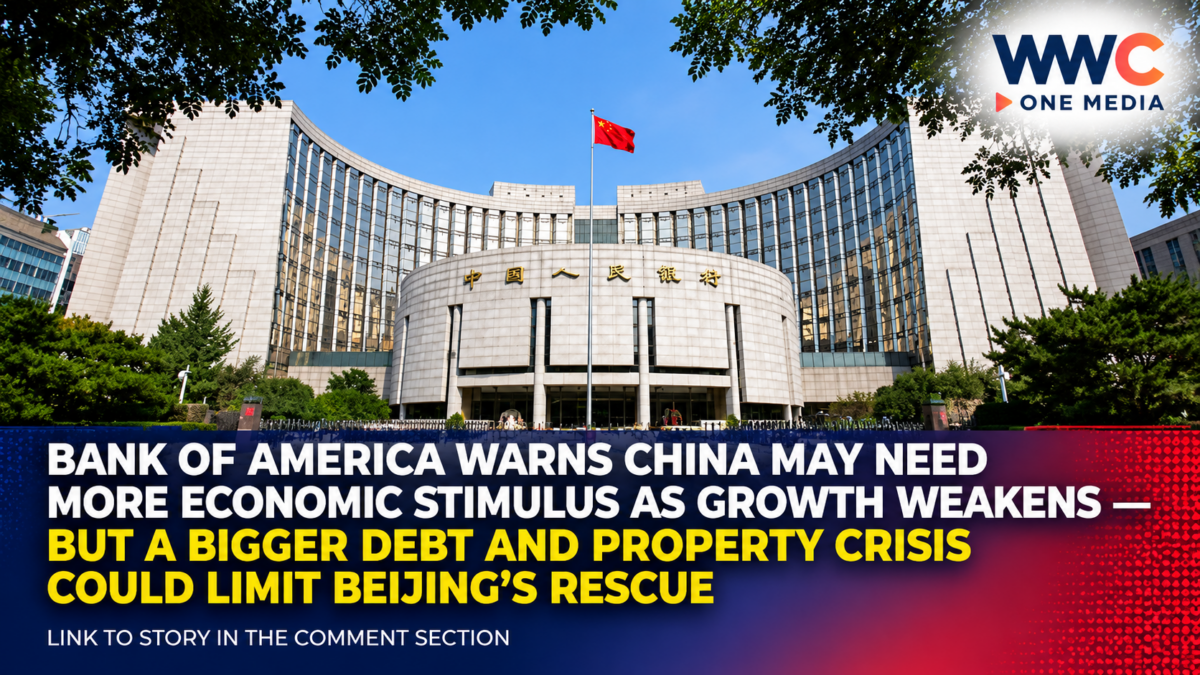
BEIJING, CHINA — October 14, 2026 — China could face mounting pressure to launch another round of economic stimulus if upcoming growth figures reveal that the world’s second-largest economy is struggling to recover, according to Bank of America, raising fresh questions about Beijing’s ability to revive spending, investment and its troubled property market.
Bank of America economist Helen Qiao believes the government’s next move may depend heavily on China’s third-quarter economic performance, with official data scheduled for release on Monday, October 19.
The upcoming figures will provide a crucial assessment of gross domestic product, industrial production, consumer spending and investment activity.
If economic growth falls below levels policymakers consider acceptable, the government could have stronger reasons to expand support beyond the targeted measures introduced in September.
But the decision comes at a difficult moment.
China’s export machine is generating record trade surpluses, while domestic consumption remains weak, property investment continues to struggle and local government debt limits the country’s fiscal flexibility.
For President Xi Jinping’s government, the challenge is no longer simply finding ways to increase economic activity.
It is determining how much additional borrowing and public spending can be justified without worsening the structural problems already weighing on the economy.
Bank of America Sees October 19 Data as a Possible Turning Point
According to Bloomberg’s October 14 report, Bank of America is closely watching China’s upcoming economic data for signs that authorities may need to strengthen their stimulus response.
The analysis comes after growth slowed to 4.3% in the second quarter, falling below Beijing’s official annual growth target range of approximately 4.5% to 5%.
The October 19 data release will offer the clearest view yet of whether the economy regained momentum during the third quarter.
Among the indicators being monitored are factory output, retail sales, fixed-asset investment and overall economic growth.
Bank of America’s assessment suggests weaker-than-acceptable results could increase the likelihood of fresh government intervention.
However, the bank has not established that another stimulus package is inevitable, nor has Beijing announced a new nationwide rescue program in response to the forthcoming figures.
The strength of China’s exports, as well as the performance of measures already introduced, could influence how urgently policymakers believe additional action is needed.
China’s Economy Is Growing Below Beijing’s Target
China’s second-quarter economic growth of 4.3% underscored the challenges confronting its policymakers.
The result was below the official 2026 target range, despite continued strength in export-oriented industries.
The slowdown followed weakness in household spending, property development and broader investment activity.
Authorities responded by pledging faster implementation of existing spending programs and additional targeted support.
However, the government has generally avoided a sweeping stimulus package comparable with the large-scale credit and infrastructure expansions introduced during earlier economic downturns.
Instead, Beijing has emphasized targeted assistance and the more effective use of previously approved funding.
The strategy reflects concerns about the country’s growing debt burden and the limited effectiveness of additional borrowing in industries suffering from structural weakness.
The upcoming third-quarter report will help determine whether this cautious approach has been sufficient.
September Stimulus Package Failed to Convince Some Investors
At the end of September, China’s government introduced a new package of measures designed to stabilize economic growth.
The program included mortgage subsidies for eligible first-time homebuyers and expanded central bank support for selected industries and investment projects.
Bloomberg described the measures as the country’s most substantial stimulus effort since September 2024.
However, financial markets were not uniformly impressed.
Some economists argued that the package focused on limiting further economic weakness rather than delivering the broad support needed to revive consumer confidence.
Bank of America Global Research was among the institutions questioning the scale of the intervention.
In analysis published at the beginning of October, its economists argued that the mortgage subsidies would have limited reach because of restrictive eligibility requirements.
The bank estimated that only around 20% to 25% of annual housing transactions would qualify.
It also estimated that the maximum first-year fiscal cost of the program would be approximately 27 billion yuan.
Those figures suggest the direct financial impact could be relatively modest compared with the scale of China’s property and household-demand problems.
The distinction is important because stabilizing the economy is not the same as restoring strong and self-sustaining growth.
Property Market Weakness Remains a Major Obstacle
China’s prolonged property downturn remains one of the central reasons its economic recovery has struggled to gain momentum.
For years, real estate development was an important source of economic activity, local government revenue and household wealth.
But the sector has suffered from declining confidence, financial pressure on developers and concerns about unsold or unfinished properties.
Falling home prices and reduced construction activity have affected related industries, including building materials, household appliances and local services.
The weakness has also made consumers more cautious about spending.
When households become uncertain about property values and their financial future, they may increase savings rather than make major purchases.
Mortgage subsidies can reduce borrowing costs for selected buyers.
However, lower financing costs alone may not persuade households to purchase property if they remain worried about employment, income growth and future home values.
This is why economists are increasingly questioning whether targeted support can resolve the deeper problems in China’s housing market.
China’s Debt Burden Is Limiting Its Stimulus Options
One of the most significant obstacles to another large rescue program is China’s expanding government debt.
According to Financial Times reporting published October 11, interest payments are expected to consume approximately 19.2% of the central government’s general public budget in 2026, compared with around 12% in 2014.
The growing burden is particularly difficult for local governments.
Many depend on economic activity, land-related revenue and borrowing to finance infrastructure and public services.
The prolonged property downturn has reduced important sources of local revenue, while existing debt obligations continue to accumulate.
The Financial Times reported that combined interest payments by central and local governments are projected at approximately 1.4 trillion yuan this year.
High debt-servicing costs reduce the amount of fiscal resources available for new development, public services and stimulus initiatives.
They also create pressure to use existing budget allocations more efficiently.
For Beijing, a massive new debt-funded program could provide short-term economic support while creating additional financial risks.
This helps explain why policymakers have preferred targeted interventions over an unrestricted spending expansion.
New Bank Loans Recover, but Credit Demand Remains Weak
China’s latest credit figures present another complicated picture.
According to Reuters, new bank loans rose to approximately 1.08 trillion yuan in September, compared with only 60 billion yuan in August.
The result exceeded economists’ expectations of approximately 975 billion yuan.
At first glance, the increase suggests an improvement in financial activity.
However, the rebound was partly influenced by seasonal factors and government efforts to expand targeted financing.
Corporate lending increased, while household borrowing remained broadly flat after previously declining.
The distinction matters because strong lending to businesses does not necessarily indicate that consumers are ready to spend more or purchase homes.
Reuters also reported that broader credit growth remained subdued and that money-supply indicators showed slower growth.
These developments suggest China’s problem is not simply a shortage of available bank financing.
It also involves weak demand for borrowing.
Even when banks are willing to provide credit, businesses and households may hesitate to take on additional debt if economic prospects remain uncertain.
This limits the effectiveness of policies that primarily work by making borrowing easier or cheaper.
Record Exports Are Keeping China’s Economy Afloat
While domestic demand remains fragile, China’s export sector is performing exceptionally well.
Official customs figures released October 14 showed that the country’s goods trade surplus reached approximately US$938 billion during the first nine months of 2026.
Exports surged 36.3% in September compared with a year earlier, supported by strong international demand for technology products, semiconductors, computing equipment and automobiles.
September’s monthly trade surplus reached approximately US$133.5 billion.
The export boom has helped support manufacturing activity and overall economic growth despite domestic weakness.
However, this success creates an economic imbalance.
China’s factories continue to sell increasing quantities of goods overseas, while household consumption at home has not recovered at the same pace.
International trading partners are also growing concerned about the size of China’s trade surplus.
Governments in the United States and European Union have raised questions about industrial competition, subsidies and the impact of Chinese imports on domestic industries.
This creates another vulnerability for Beijing.
If trade tensions escalate or global demand weakens, export growth may no longer provide the same support to China’s economy.
Stronger domestic consumption would therefore reduce the country’s dependence on overseas buyers.
Beijing Faces Pressure to Strengthen Consumer Spending
Economists have increasingly emphasized the importance of rebuilding household confidence.
For Chinese consumers, financial uncertainty has been driven partly by the housing downturn, employment concerns and uneven wage growth.
Government measures supporting mortgages and consumer purchases may help, but their effectiveness depends on whether households feel secure enough to spend.
Possible additional measures include broader consumption subsidies, support for households, faster public investment spending and further targeted credit assistance.
These are policy options being discussed by economists, not confirmed announcements of a new stimulus package.
China’s finance ministry has indicated that authorities are examining ways to expand interest subsidies and make more effective use of available fiscal resources.
Finance Minister Lan Foan said earlier this month that the government would continue implementing existing policies while studying highly targeted additional measures.
The remarks indicate Beijing remains open to further action.
However, they also suggest policymakers are seeking to avoid an indiscriminate increase in spending.
The central question is whether targeted stimulus can generate enough private-sector confidence to sustain recovery without continuous government intervention.
Could China’s Central Bank Cut Interest Rates Again?
China’s central bank remains another potential source of economic support.
The People’s Bank of China has used targeted financing tools and other measures to encourage lending and stabilize investment.
Some analysts expect further monetary easing could become necessary if economic growth weakens.
Potential options include additional policy-rate reductions, lower bank reserve requirements and support for selected credit markets.
However, none of these measures should be treated as guaranteed.
The central bank must balance the need to support growth against concerns about financial stability, currency movements and the effectiveness of additional lending.
Lower interest rates may reduce financing costs for borrowers.
But if consumer and business confidence remains weak, cheaper credit may not produce a substantial increase in investment or spending.
This is one reason the effectiveness of future stimulus will depend on more than monetary policy alone.
What More Stimulus Could Mean for Asian Markets
China’s economic policy decisions are closely watched across Asia.
A stronger Chinese economy could support demand for imported raw materials, manufacturing equipment, consumer goods and regional services.
Countries such as the Philippines, Singapore, Malaysia, Indonesia, Thailand and Vietnam have substantial economic links with China through trade, tourism and investment.
A recovery in Chinese domestic demand could provide opportunities for exporters and businesses serving Chinese customers.
Commodity markets may also respond to changes in construction and industrial activity.
However, the effects of stimulus depend on its design.
A program directed mainly toward infrastructure and advanced manufacturing may benefit different sectors from one focused on households and consumption.
Additional financing for factories could also increase competition faced by other Asian manufacturers.
Investors therefore need to examine which industries receive support rather than assuming all stimulus measures will benefit regional markets equally.
Why More Stimulus Might Not Solve China’s Deeper Problems
China’s economic challenges extend beyond short-term fluctuations in growth.
The property-sector downturn, demographic pressures, local government debt and weak household confidence are structural issues that cannot necessarily be resolved through a single round of stimulus.
Government support can cushion an economic slowdown and encourage selected types of spending.
But sustainable recovery requires businesses and consumers to become confident enough to invest and spend without depending continuously on additional policy intervention.
Economists also warn that excessive financing directed toward already well-supplied industries could worsen industrial overcapacity.
That could increase pressure on producer prices and intensify international trade disputes.
For Beijing, the challenge is ensuring that any additional stimulus improves economic productivity and household welfare rather than simply adding more debt.
This may require reforms alongside short-term financial support.
October 19 Data Could Determine Beijing’s Next Move
The most important immediate development will be the release of China’s third-quarter GDP and September activity indicators on October 19.
Investors will be watching whether economic growth has stabilized or weakened further.
Retail sales will provide evidence of household demand.
Industrial production will show whether factories continue benefiting from strong overseas orders.
Fixed-asset investment will indicate whether government support is translating into more construction and business spending.
Weak results across several indicators would strengthen the argument for additional stimulus.
Stronger-than-expected data could encourage policymakers to continue relying on existing measures.
However, the Chinese government has not publicly committed to introducing a specific package based on a predetermined growth threshold.
The decision will depend on the broader economic outlook and policy priorities.
The Bigger Question for China’s Economy
Bank of America’s analysis highlights an increasingly important dilemma confronting Beijing.
China has the manufacturing capacity and export strength to remain a major driver of international trade.
But its domestic economy has struggled to generate equally strong spending and investment momentum.
The latest credit figures suggest targeted support is helping parts of the financial system, but private demand remains uneven.
Meanwhile, the growing government debt burden constrains the scale of any new rescue measures.
For investors, the prospect of further stimulus may create opportunities in selected sectors.
For policymakers, however, the real test is whether additional intervention can deliver lasting improvements without increasing financial vulnerabilities.
Bank of America sees China’s next economic report as a potential turning point for stimulus policy — but the bigger challenge is whether Beijing can revive domestic demand and rescue its weakening property market without making the country’s already heavy debt burden even harder to manage.