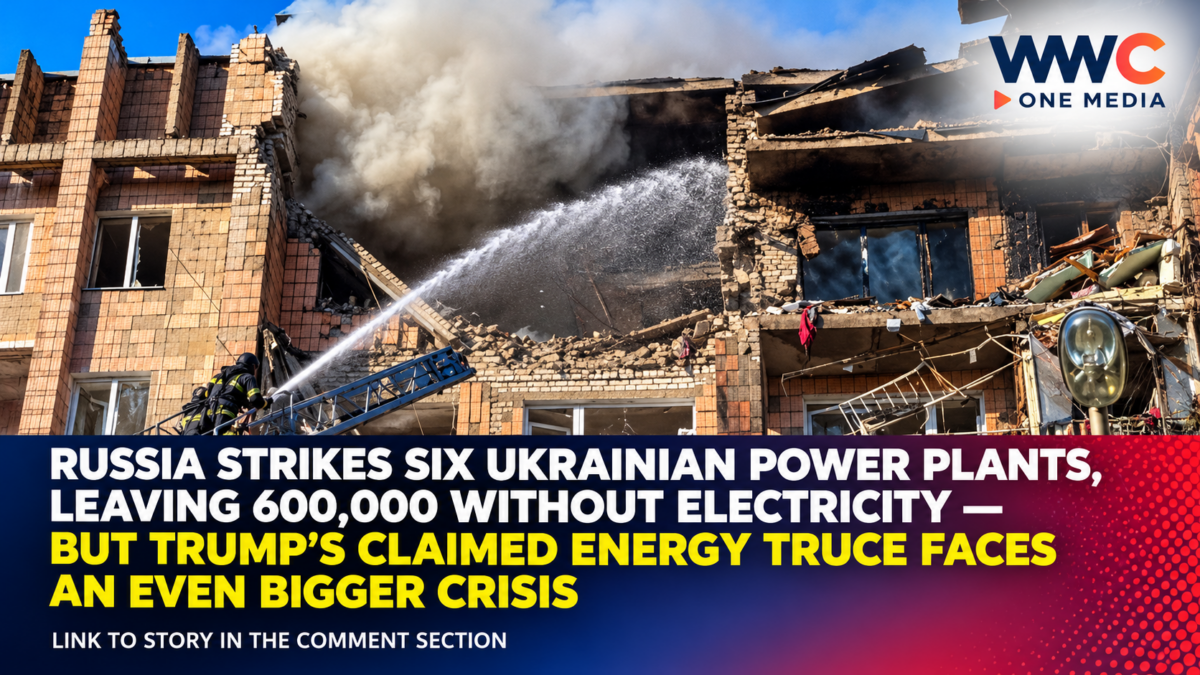
KYIV, UKRAINE — October 14, 2026 — Russia has unleashed another major wave of missile and drone strikes against Ukraine’s energy infrastructure, hitting power plants, damaging dozens of facilities and leaving at least 600,000 people without electricity in a direct challenge to U.S. President Donald Trump’s claim that Moscow and Kyiv had agreed to stop attacking each other’s energy facilities.
The latest bombardment targeted Ukraine’s capital, Kyiv, and the northeastern city of Kharkiv, as the country prepares for another potentially devastating winter of war.
According to Reuters, Ukrainian President Volodymyr Zelenskyy said 30 energy facilities were damaged during the overnight assault.
Russia’s Defense Ministry separately acknowledged striking six power plants, including four in and around Kyiv and two in Kharkiv.
The attacks also caused civilian casualties and damaged residential areas, raising fresh concerns over Ukraine’s ability to protect essential infrastructure.
But the political consequences could extend far beyond the battlefield.
Just days earlier, Trump publicly announced what he described as an immediate energy ceasefire between Russia and Ukraine.
Neither government formally confirmed the agreement.
Now, with Russian strikes continuing, Washington faces renewed questions about whether its latest peace initiative can produce meaningful commitments from Moscow.
Russia Hits Six Power Plants as Ukraine Faces Widespread Blackouts
Russian missiles and drones struck multiple locations overnight into October 14, concentrating on energy infrastructure supplying electricity and heating to major Ukrainian cities.
Zelenskyy reported that at least 600,000 people were without electricity following the attacks.
The Ukrainian president said the strikes damaged 30 energy facilities.
According to the Associated Press, Ukrainian Prime Minister Serhii Koretskyi reported that all three of Kyiv’s combined heat and power plants had been struck.
Combined heat and power plants are particularly important because they can supply electricity while also producing heat for nearby homes and businesses.
Damage to these facilities threatens not only electricity supplies but also district heating systems as colder weather approaches.
Russia’s Defense Ministry confirmed that its forces attacked six Ukrainian power plants.
However, the Russian government’s acknowledgment of the strikes does not independently establish the full extent of physical damage or civilian disruption.
Ukrainian authorities and energy operators continue assessing the consequences.
Three Killed in Kyiv as Residential Areas Come Under Fire
The latest strikes caused casualties beyond the damaged energy facilities.
Reuters reported that three people were killed in Kyiv during the overnight attack.
The Associated Press subsequently cited Kyiv police reporting five deaths and 36 injuries across the wider attack period.
The figures reflect reporting from different stages of the emergency response and may be revised as rescue operations continue.
Residential buildings were also damaged.
Emergency workers responded to fires, collapsed structures and areas hit by missile or drone debris.
The attacks underline the danger to civilians living near critical infrastructure.
Even when strikes are directed at energy facilities, nearby homes and businesses can suffer serious damage.
Ukraine has repeatedly accused Russia of deliberately targeting essential civilian services as part of its military campaign.
Moscow has defended its strikes as military operations.
Under international humanitarian law, civilian infrastructure is protected from attack unless it qualifies as a military objective under the applicable rules. Even then, attacks remain subject to distinction, proportionality and precaution requirements.
Whether particular strikes constitute war crimes requires a detailed legal and factual assessment.
Trump’s Energy Ceasefire Claim Comes Under Scrutiny
The renewed bombardment has placed Trump’s peace initiative under intense scrutiny.
On October 11, Trump announced on his Truth Social platform that Russia and Ukraine had agreed to stop attacking each other’s energy infrastructure.
He presented the arrangement as effective immediately.
However, Ukrainian officials said they had not been informed that a final agreement had been reached.
Zelenskyy expressed surprise at the announcement and indicated that Ukraine was prepared to consider reciprocal restraint if Russia genuinely stopped attacking Ukrainian energy facilities.
The Kremlin did not publicly confirm a completed ceasefire.
Russian officials subsequently referred to continuing contacts without providing evidence that a binding arrangement had taken effect.
That distinction is crucial.
Trump’s announcement indicated his administration believed an agreement had been secured, but the statements from Moscow and Kyiv did not establish a mutually confirmed ceasefire.
The subsequent Russian attacks have therefore exposed a major credibility problem for the initiative.
A ceasefire can only provide meaningful protection if the parties clearly agree to its terms and demonstrate compliance.
Zelenskyy Accuses Moscow of Disrespecting Washington
Zelenskyy sharply criticized the latest Russian strikes, describing them as a deliberate challenge to American diplomatic efforts.
The Ukrainian president argued that Moscow’s actions demonstrated a lack of respect for Trump’s attempts to stop attacks on energy infrastructure.
He called on Washington and the international community to respond to Russia’s continued bombardment.
For Kyiv, the issue goes beyond diplomatic embarrassment.
Ukraine has repeatedly sought stronger guarantees that any agreement with Moscow would be enforceable and supported by meaningful international monitoring.
Previous efforts to secure limited pauses in attacks have faced difficulties over implementation, verification and the absence of mutual trust.
The October strikes reinforce Ukraine’s argument that public declarations alone are insufficient.
A sustainable agreement would need clear obligations, credible monitoring and consequences for noncompliance.
Ukraine Intercepts Only Four of 39 Russian Missiles
One of the most alarming developments is the reported performance of Ukraine’s air defenses.
According to Reuters, Ukrainian authorities said only four of 39 incoming missiles were intercepted during the latest assault.
The Associated Press reported that Russia launched more than 120 drones alongside the missile barrage.
The low missile interception figure illustrates the danger posed by Russian ballistic missiles and other fast-moving weapons.
Ukraine depends on sophisticated air-defense systems to protect cities, industrial facilities and electricity infrastructure.
But these systems require a continuing supply of interceptors, spare parts, radar equipment and technical support.
Prolonged attacks can also overwhelm defenses by forcing operators to respond to multiple incoming threats simultaneously.
A single night’s interception rate does not establish the overall effectiveness of Ukraine’s entire air-defense network.
Nevertheless, the latest figures reinforce Kyiv’s repeated appeals for additional Western military assistance.
U.S. Intelligence Support Becomes Another Flashpoint
The energy strikes come amid increasing uncertainty over American military and intelligence support for Ukraine.
Reuters reported that U.S. officials had threatened to restrict certain intelligence support unless Kyiv stopped attacking Russian oil refineries.
The reporting was based on sources familiar with the discussions.
Trump, however, said Washington was still sharing intelligence with Ukraine.
Zelenskyy previously complained that Ukraine had received no advance warning from Western partners about an incoming Russian missile attack on Kyiv.
That raised concerns about whether changes in intelligence cooperation could weaken Ukraine’s ability to prepare for attacks.
However, the lack of advance warning does not by itself prove that Washington suspended intelligence sharing.
The distinction remains important because no verified public evidence establishes a complete termination of U.S. intelligence assistance.
For Ukraine, reliable early-warning information can save lives by giving civilians and emergency services time to prepare.
Russian Oil Refineries Become a Major Issue in Peace Talks
The dispute over energy infrastructure has become increasingly connected to global oil markets.
Ukraine has used drones to attack Russian oil refineries, fuel depots and logistics facilities in an effort to disrupt resources supporting Moscow’s war effort.
Russia, meanwhile, has repeatedly attacked Ukrainian power stations and other infrastructure.
These competing campaigns have become a major obstacle to Trump’s proposed energy ceasefire.
The U.S. administration has also sought to ease pressure on global diesel supplies amid elevated fuel prices.
Trump recently moved to relax restrictions affecting Russian diesel exports, drawing criticism from those concerned that additional energy revenues could benefit Moscow.
Ukraine considers attacks on Russian petroleum infrastructure a means of placing economic pressure on Russia.
Washington is attempting to reduce energy-market disruption while pursuing a diplomatic settlement.
The competing priorities create tension between Ukraine’s military strategy and the Trump administration’s energy and foreign-policy objectives.
Why Ukraine’s Energy Infrastructure Is Critical Before Winter
The timing of the strikes is especially dangerous.
Ukraine is entering the colder months, when electricity and heating demand typically increase.
Power plants, substations and transmission networks are essential for operating hospitals, public transport, communications systems, water supplies and residential heating.
Damage to critical facilities can create cascading disruptions across multiple sectors.
Energy workers have spent years repairing infrastructure following repeated Russian attacks.
However, restoration becomes increasingly difficult when newly repaired facilities are struck again.
Specialized electrical equipment can also be expensive and difficult to replace quickly.
A sustained campaign against power infrastructure could force authorities to impose scheduled blackouts or emergency electricity restrictions.
For civilians, prolonged outages during freezing conditions can create serious health and safety risks.
The exact severity of the coming winter’s power situation remains uncertain and will depend on repair progress, electricity imports, weather conditions and any further attacks.
Europe Faces Renewed Pressure to Support Kyiv
Russia’s latest attacks are also increasing pressure on European governments to strengthen assistance to Ukraine.
European leaders have supported efforts to end attacks on civilian energy infrastructure, but many remain skeptical about Russia’s willingness to honor an agreement without credible safeguards.
According to the Associated Press, Zelenskyy was expected to hold talks in London with British Prime Minister Andy Burnham as Ukraine seeks additional support.
Britain and European Union members are also considering further measures against Russia.
For European governments, Ukraine’s energy security is a humanitarian concern as well as a strategic issue.
A major deterioration in winter living conditions could create new displacement pressures and increase demand for emergency assistance.
Europe must also consider the implications of uncertainty surrounding Washington’s long-term support for Kyiv.
A weakening of U.S. assistance could require European countries to assume greater responsibility for financing, air defense and reconstruction.
Could the Energy Truce Still Be Revived?
Despite the attacks, a limited ceasefire focused on energy infrastructure remains a possible diplomatic objective.
Such an arrangement could reduce civilian suffering while broader peace negotiations continue.
However, successful implementation would require both Russia and Ukraine to confirm the terms of the agreement.
It would also require clarity about which facilities are protected, how violations would be verified and what would happen if either side resumed attacks.
Without those safeguards, even a short-term reduction in strikes may be difficult to sustain.
The experience of recent days demonstrates the limitations of announcing an agreement before its conditions are publicly established and accepted.
For Washington, the challenge is translating diplomatic statements into verifiable changes on the ground.
For Kyiv, the priority is ensuring that any halt to Ukrainian strikes is matched by meaningful restraint from Moscow.
For Russia, the issue is whether it is willing to commit to and observe limits on military operations affecting energy infrastructure.
What Happens Next?
The immediate priority for Ukraine is restoring electricity, repairing damaged facilities and strengthening defenses against additional Russian strikes.
Energy operators will continue assessing the damage while authorities monitor the risk of further outages.
Diplomatically, attention will turn to whether Trump can obtain clear commitments from Moscow and Kyiv.
Western governments will also face renewed decisions about air-defense supplies, intelligence cooperation and economic pressure on Russia.
The longer the attacks continue, the more difficult it may become to establish confidence in even a narrowly focused ceasefire.
The latest strikes have exposed the gap between diplomatic announcements and conditions on the battlefield.
Russia’s attacks on six Ukrainian power plants have left hundreds of thousands without electricity — but the bigger question is whether Trump’s claimed energy ceasefire can survive without a verified agreement, enforceable commitments and a genuine willingness by both sides to halt attacks on critical infrastructure.