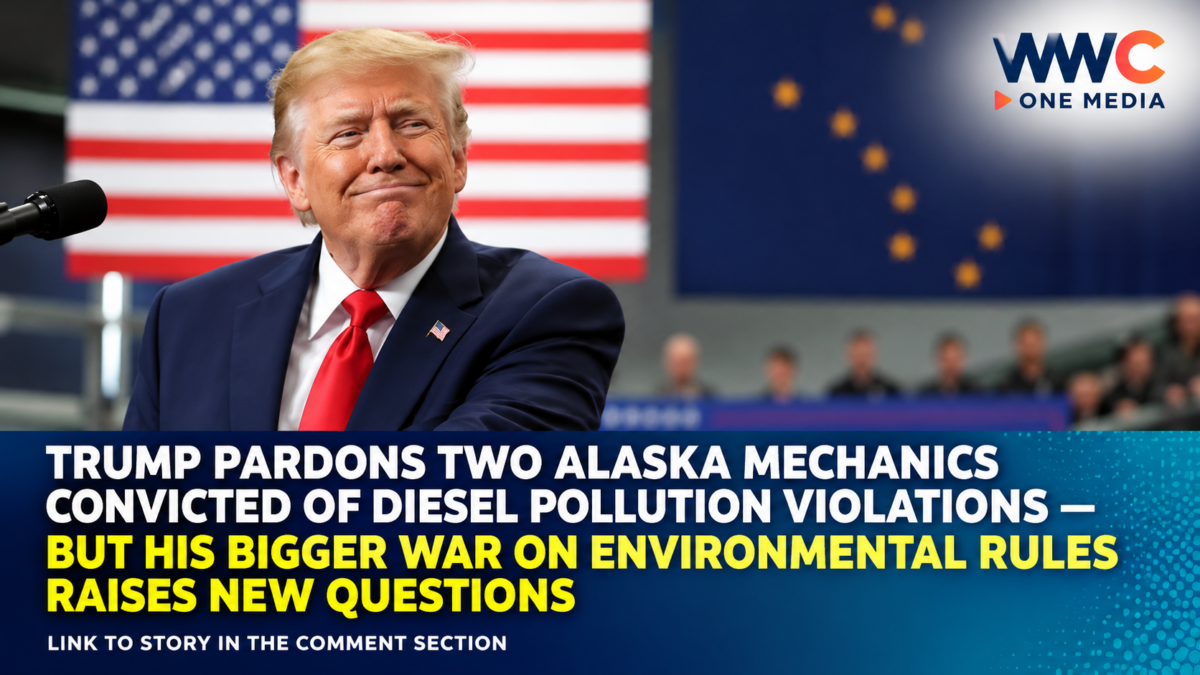
WASILLA, ALASKA — October 14, 2026 — U.S. President Donald Trump has pardoned two Alaska diesel mechanics convicted of violating federal environmental laws, turning an unusual act of presidential clemency into a political statement against pollution regulations just weeks before America’s crucial midterm elections.
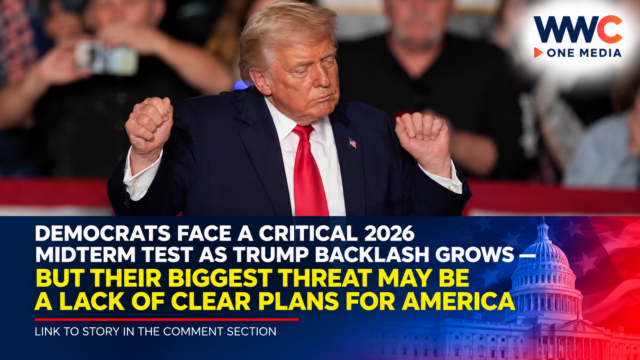
During a campaign rally in Wasilla on Tuesday, October 13, Trump invited Zachary Czubak and Patrick Fleming onto the stage and signed presidential pardon documents in front of cheering supporters.
The two men, who operated an Anchorage-based diesel repair business, previously pleaded guilty to federal charges stemming from the removal and disabling of pollution-control systems on diesel vehicles.
Trump portrayed the pair as hardworking mechanics unfairly targeted by the federal government for helping customers repair their trucks.
But federal court records tell a more complicated story.
Prosecutors established that the business had illegally modified emissions-control equipment on dozens of diesel vehicles, generating approximately $100,000 from the work.
The pardons now highlight a wider confrontation between the Trump administration’s deregulatory agenda and longstanding federal efforts to control air pollution.
Trump Signs Pardons During Alaska Campaign Rally
Trump issued the pardons during a high-profile political event aimed at strengthening Republican support ahead of the November 3, 2026, midterm elections.
The president called the two mechanics onto the stage before signing the clemency documents.
He argued that previous federal prosecutors had treated ordinary engine repairs as serious criminal offenses.
Trump claimed the men had been unfairly prosecuted under the Biden administration and portrayed their cases as examples of excessive government intervention in the lives of working Americans.
Fleming expressed gratitude after receiving his pardon, saying the men had intended to help Alaskans and diesel vehicle owners rather than harm anyone.
The public ceremony reflected Trump’s broader effort to cast federal environmental enforcement as an unnecessary burden on small businesses, particularly in communities where trucks and diesel-powered equipment are essential to daily life.
However, the underlying criminal cases involved more than routine vehicle maintenance.
What Did the Alaska Mechanics Actually Do?
Czubak and Fleming were co-owners of Arm Rippin Toys Inc., a repair business in Anchorage specializing in diesel vehicle maintenance and modifications.
A third co-owner, Michael Wayne Hanzuk II, was also involved in the same criminal case.
According to a November 9, 2022, announcement by the U.S. Attorney’s Office for the District of Alaska, the three men pleaded guilty to conspiracy to violate the Clean Air Act.
Federal investigators found that the business had removed or disabled federally required pollution-control equipment on at least 37 private and commercial diesel vehicles between July 2019 and September 2020.
The modifications included altering onboard diagnostic systems that normally identify emissions-control malfunctions.
By manipulating those monitoring systems, the mechanics allowed vehicles to operate after pollution-control equipment had been removed or disabled.
Prosecutors said the business collected approximately $100,000 for the unlawful modifications, commonly known as diesel deletes or tuning.
Unlike legitimate mechanical repairs, these modifications were intended to defeat pollution-control systems required under federal law.
Mechanics Faced Fines and Probation
The original prosecution resulted in substantial penalties.
Federal Justice Department records show that Czubak received five years of probation, a $66,000 fine and 180 hours of community service.
Fleming was sentenced in February 2023 and ordered to pay a $66,000 fine.
Hanzuk also received a $66,000 fine, five years of probation and 180 hours of community service. His sentence included six months of home confinement and a requirement to make a public acknowledgment of wrongdoing.
Trump told the rally crowd that the two mechanics had faced the possibility of lengthy imprisonment simply for repairing engines.
However, the actual sentences imposed in the case were fines, probation and community-service requirements rather than prison terms.
That distinction is important when assessing the president’s criticism of the original prosecution.
Why Diesel Pollution Controls Became a Federal Criminal Case
Diesel vehicles are widely used across Alaska, where trucks, heavy equipment and commercial vehicles are essential to transportation and economic activity.
Modern diesel engines are equipped with emissions-control systems intended to reduce harmful pollutants.
These systems can include diesel particulate filters, exhaust-gas recirculation equipment and selective catalytic reduction technology.
Some vehicle owners argue that emissions systems can be costly to repair and difficult to maintain, particularly in harsh operating environments.
As a result, a market developed for modifications that disable or remove these systems.
But federal law prohibits tampering with required emissions equipment.
The U.S. Environmental Protection Agency has warned that disabling such equipment can dramatically increase pollutants associated with respiratory illness, environmental damage and other public health risks.
In its 2022 statement about the Alaska case, federal prosecutors cited EPA estimates showing that removing diesel emissions controls can significantly increase particulate matter, nitrogen oxides and other harmful emissions.
The dispute therefore involves two competing concerns: the cost and reliability of vehicle maintenance, and the public health consequences of allowing pollution controls to be disabled.
Trump Administration Moves Away From Criminal Diesel-Tampering Prosecutions
The Alaska pardons are not isolated.
They form part of a broader policy shift under the Trump administration concerning federal enforcement of vehicle pollution rules.
The Justice Department announced earlier in 2026 that it would stop pursuing certain criminal prosecutions involving diesel emissions defeat devices, leaving relevant violations subject to civil enforcement instead.
Trump has also granted clemency to other individuals convicted of similar environmental offenses.
In September, he pardoned Michael Hanzuk, the third co-owner involved in the Anchorage repair shop case.
That means all three men connected to the original Arm Rippin Toys prosecution have now received presidential pardons.
Supporters of the administration’s approach argue that criminal penalties for emissions modifications can be disproportionate and place unnecessary pressure on mechanics and small repair businesses.
Critics, however, warn that weakening criminal enforcement may reduce deterrence against deliberate violations of environmental laws.
The broader debate concerns how aggressively the federal government should punish businesses that knowingly disable pollution-control systems.
Importantly, presidential pardons do not automatically repeal the Clean Air Act or legalize future emissions tampering.
Existing statutory requirements remain in place unless changed through the relevant legal or regulatory processes.
A Political Message Ahead of the November Elections
The timing of the pardons added another political dimension.
Trump traveled to Alaska to support Republican candidates ahead of the November 3 midterm elections, including Senator Dan Sullivan, who faces a competitive challenge from Democrat Mary Peltola.
Alaska has traditionally leaned Republican in presidential elections, but local economic concerns and competitive statewide races have increased its importance in the battle for control of Congress.
Energy prices have become a major campaign issue, especially in remote communities where heating fuel and transportation costs can be substantially higher than in other parts of the United States.
During his Alaska appearance, Trump emphasized energy policy, economic conditions and his administration’s opposition to regulations he considers harmful to businesses.
Pardoning the two mechanics reinforced his message that federal authorities had gone too far in policing diesel vehicle owners and repair shops.
The ceremony also provided a highly visible example of how presidential clemency can become part of an election campaign.
The Bigger Debate Over Trump’s Presidential Pardons
Trump’s latest pardons come amid wider scrutiny of his use of executive clemency.
A Reuters investigation published on October 13 examined his pardons of public officials and found a pattern heavily benefiting Republican politicians, appointees and supporters.
The Alaska mechanics’ cases are different because they concern environmental offenses rather than public corruption.
Nevertheless, their highly publicized pardons contribute to the broader debate over how presidential clemency should be exercised.
The U.S. Constitution gives the president broad authority to grant pardons for federal offenses.
Supporters view this power as an important safeguard against excessive punishment and injustice.
Critics argue that using clemency to advance political messages can weaken accountability, particularly when recipients have admitted committing the underlying offenses.
The central question is not whether the president has the authority to issue these pardons. His constitutional power is well established.
The controversy concerns whether the decision reflects appropriate mercy, a change in enforcement philosophy or political intervention in criminal accountability.
What Does This Mean for U.S. Environmental Enforcement?
The pardons could carry implications beyond Alaska.
Federal efforts to reduce vehicle emissions have historically relied on a combination of regulation, inspections, civil penalties and criminal enforcement for serious violations.
Restricting criminal prosecutions may change how the government deters deliberate tampering, even if civil penalties remain available.
Environmental advocates are concerned that removing the threat of criminal punishment could encourage some businesses to disregard emissions requirements.
Supporters of the policy change counter that civil enforcement provides a more proportionate response to violations involving vehicle modifications.
The longer-term consequences will depend on how federal agencies apply the law, whether Congress changes relevant statutes and how courts interpret future enforcement disputes.
For now, the Clean Air Act remains federal law, and the pardons do not provide blanket protection to other businesses performing unlawful diesel modifications.
What Happens Next?
For Zachary Czubak and Patrick Fleming, Trump’s decision delivers presidential clemency years after their convictions and sentences.
For the administration, the ceremony reinforces its opposition to what it describes as excessive environmental enforcement.
But for regulators, repair businesses and communities affected by diesel emissions, the larger questions remain unresolved.
How should the government balance affordable vehicle maintenance against pollution controls designed to protect public health?
When should violations result in civil penalties, and when is criminal enforcement justified?
And could presidential pardons influence whether future environmental regulations are taken seriously?
Trump’s decision may have closed the criminal chapter for two Alaska mechanics, but it has reopened a much bigger national debate over environmental protection, federal enforcement and the limits of presidential mercy.