
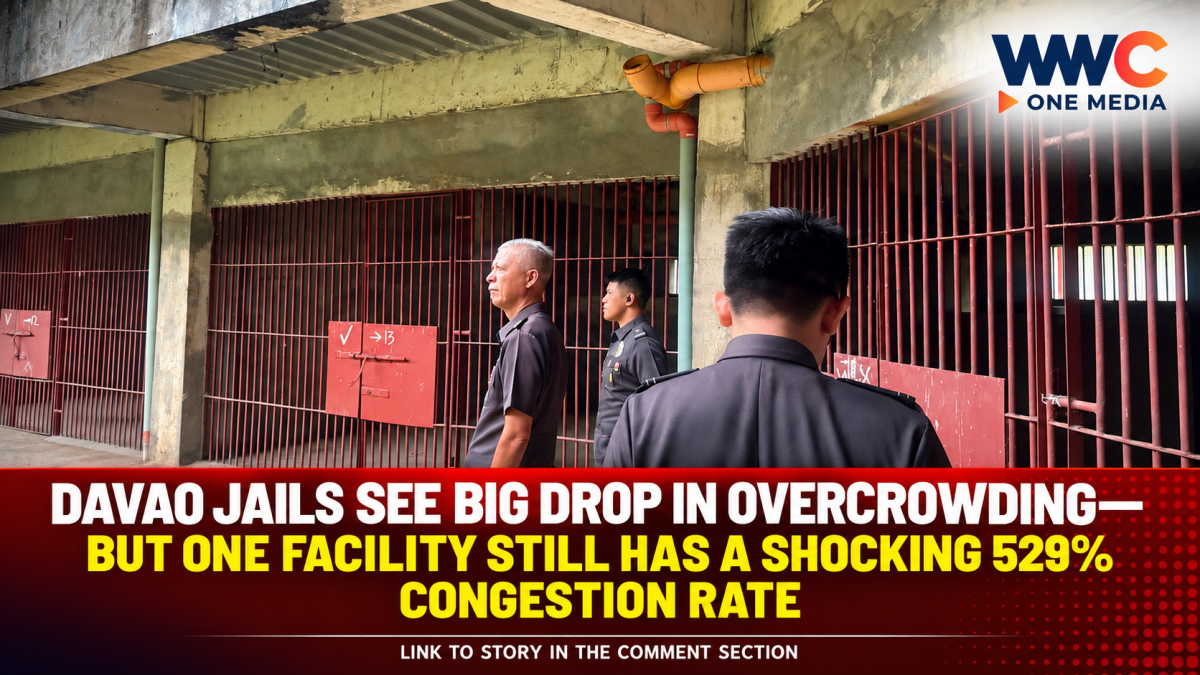
DAVAO CITY — Jail overcrowding in the Davao Region has eased significantly this year, with the Bureau of Jail Management and Penology in Region XI (BJMP-XI) reporting a 162 percent average congestion rate from January to August 2026, down sharply from 208 percent during the same period in 2025.
The decline represents a 46-percentage-point reduction, or roughly a 22 percent decrease relative to last year’s rate. Despite the improvement, BJMP officials stressed that the region’s jails remain seriously overcrowded.
Jail Chief Inspector Eliezer Sayson, chief of the BJMP-XI Program Development Division, attributed much of the reduction to the use of legal mechanisms that allow qualified Persons Deprived of Liberty (PDLs) to leave detention earlier when they meet the requirements.
Among the measures cited were probation, bail, service of sentence with or without Good Conduct Time Allowance (GCTA), acquittal, provisional dismissal, transfers to other facilities, and transfers to drug rehabilitation centers.
Legal processing becomes key to decongestion
Sayson said probation played a significant role in reducing the number of people being held in BJMP facilities.
Under Philippine law, eligible offenders may apply for probation subject to the requirements and limitations provided by law. The BJMP’s paralegal program helps PDLs understand available legal remedies and assists in following up cases with the courts.
The agency has indicated that strengthening these paralegal services will remain an important part of its strategy to prevent people from remaining in jail longer than legally necessary.
This approach is consistent with the broader national effort to reduce jail congestion. In January 2026, the Supreme Court-led Justice Sector Coordinating Council held its Second National Decongestion Summit, where officials pushed for stronger diversion programs, noncustodial measures, improved access to legal assistance, faster releases, and long-term legislative reforms.
Some Davao jails remain severely overcrowded
While the regional average has improved, the figures at individual facilities show that overcrowding remains a major challenge.
The Davao City Jail-Male Dormitory recorded the highest congestion rate in the region at 529 percent, followed by Panabo City Jail at 211 percent.
The Digos City District Jail-Male Dormitory recorded a 161 percent congestion rate, while the Davao City Jail-Annex registered 148 percent.
The continued overcrowding is partly linked to the steady arrival of newly committed PDLs from Philippine National Police detention centers and other detention facilities following commitment orders issued by trial courts.
This creates a difficult cycle: while some detainees are released through legal processes, new commitments continue entering the BJMP system.
New Wangan jail seen as potential game changer
BJMP-XI is also looking toward infrastructure as another long-term solution.
The New Davao City Jail-Male Dormitory in Wangan, Calinan is being developed to accommodate more than 2,000 PDLs.
According to BJMP-XI, the four-storey structure, consisting of 224 cells, has already been completed structurally. However, the facility still requires about P600 million to make it fully operational.
The proposed funding would cover essential finishing and support requirements, including painting, roofing and hallway works, insulation, tiling, bed bunks, water infrastructure, tanks and deep-well sources, CCTV systems, and additional structures such as administrative, visitation, kitchen and barracks buildings.
The facility is expected to eventually provide substantial additional capacity for Davao City.
The problem is bigger than Davao
The Davao Region’s improvement comes amid a nationwide effort to address one of the Philippine correctional system’s longest-running problems.
In May 2026, the Philippine News Agency reported that 351 of 488 BJMP jail facilities nationwide remained overcrowded, with an average congestion rate of 279 percent, according to BJMP data cited by the Department of the Interior and Local Government. DILG Secretary Jonvic Remulla said jail overcrowding requires a broader government response, including facility improvements and stronger coordination among agencies.
BJMP itself reported in July that its nationwide congestion rate had declined from 292 percent in 2025 to 281 percent in 2026, following paralegal interventions and facility improvements. The agency said its paralegal efforts had contributed to the release of 92,084 PDLs during the period it reviewed.
Earlier Philippine Statistics Authority data also illustrate how deeply rooted the overcrowding problem is. The PSA’s BJMP-sourced statistics showed that, as of June 30, 2025, the average congestion rate among 337 congested BJMP jails nationwide was 290 percent, meaning roughly four to five PDLs were sharing a 4.7-square-meter space intended for one person.
Decongestion requires more than new buildings
The figures indicate that constructing additional facilities alone will not permanently solve jail overcrowding.
The BJMP’s own programs identify paralegal services as a key component of decongestion, including informing PDLs about their rights, available modes of early release, legal remedies, and case follow-ups.
The Supreme Court’s national decongestion initiative similarly emphasizes reducing unnecessary admissions, expanding alternatives to incarceration, speeding up legitimate releases, strengthening legal assistance, and pursuing structural reforms.
For Davao, the challenge is therefore twofold: make additional jail capacity available while ensuring that qualified PDLs are able to access the legal processes that can lawfully shorten or end their detention.
The 162 percent regional congestion rate shows that progress is being made—but the 529 percent figure at Davao City Jail-Male Dormitory underscores how much work remains before the region can claim that its overcrowding problem has truly been solved.
For now, BJMP-XI’s message is clear: the numbers are moving in the right direction, but Davao’s jail system is still operating far beyond intended capacity.

Leave a Reply