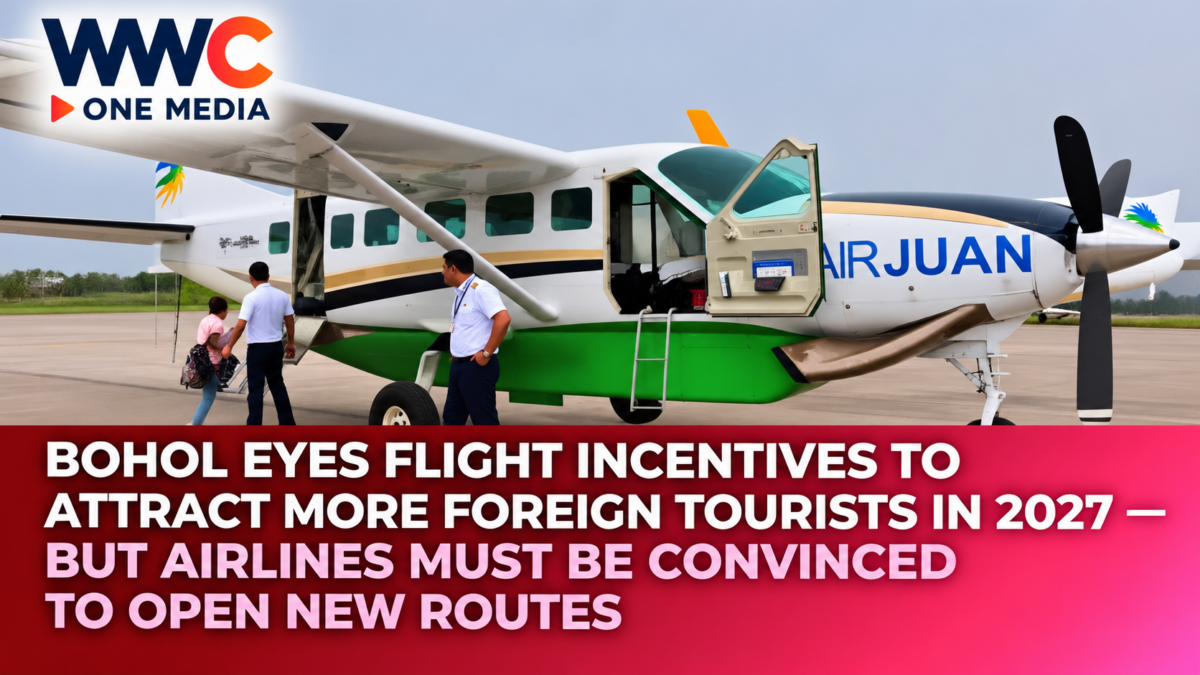
BOHOL, Philippines — October 12, 2026 — Bohol is preparing an ambitious international tourism expansion as the provincial government and Aboitiz InfraCapital explore charter flight incentives, stronger airline partnerships and targeted promotions to attract more foreign visitors in 2027.
The initiative aims to strengthen Bohol’s position as one of the Philippines’ leading island destinations while increasing international connectivity through Bohol-Panglao International Airport.
According to Bilyonaryo, Governor Erico Aristotle “Aris” Aumentado and Aboitiz InfraCapital Bohol Airport Corporation are coordinating with airlines, tourism businesses and government agencies to develop the Visit Bohol 2027 campaign.
South Korea and China have been identified as priority international markets, while Japan and Taiwan are being targeted for further growth.
Australia, New Zealand, Europe and North America are also included in the province’s wider marketing strategy.
The provincial government has pledged financial support for the campaign and is considering incentives to attract charter flights.
However, the proposed airline incentives remain subject to approval, and no funding amount has been announced.
The bigger question is whether Bohol can translate its international marketing ambitions into more direct flights, affordable travel packages and sustainable tourism revenue for local businesses.
Bohol Launches Major Tourism Strategy for 2027
The province gathered government and private-sector tourism stakeholders on October 7 for the Bohol Tourism Marketing Workshop in Tagbilaran City.
The meeting brought together officials, airport representatives, airlines, transport operators and tourism businesses to develop a coordinated marketing direction.
Rather than relying on individual promotional efforts, the province wants stakeholders to agree on priority markets and practical measures to attract visitors.
Governor Aumentado emphasized that tourism development requires cooperation across the entire industry.
The strategy includes improving travel packages, strengthening air connectivity and ensuring that tourism businesses are prepared to serve more international customers.
The campaign’s principal branding will be Visit Bohol 2027.
A secondary campaign, Step Into Wonder, will provide marketing messages tailored to different tourism markets.
Initial planning activities are expected to take place during October and November 2026.
South Korea and China Lead Bohol’s International Tourism Targets
Bohol has identified South Korea and China as its core overseas markets.
South Korea is already an important source of travelers for Panglao because the airport has international connections with Incheon and Busan.
These services provide direct access to Bohol without requiring travelers to transfer through Manila or Cebu.
The province hopes to strengthen relationships with airlines, tour operators and travel agencies to encourage additional bookings.
China is also considered a strategic market because of its large outbound tourism industry.
However, turning marketing interest into actual arrivals will depend on airline capacity, travel demand, flight permissions and commercial decisions by operators.
The province’s strategy does not mean that new China-Bohol flights have already been approved.
Officials will need to work with airlines and tourism partners before any new route becomes operational.
Japan and Taiwan Emerge as Growth Markets
Bohol is also looking to Japan and Taiwan for additional tourism opportunities.
The province has already demonstrated its potential to attract Japanese visitors through charter services.
On May 2, 2026, Bohol welcomed its first direct charter flight from Japan.
The flight, operated by Cebu Pacific from Narita International Airport, brought 164 Japanese visitors to Bohol-Panglao International Airport.
The provincial government said the service resulted from cooperation among local tourism stakeholders and engagement with Japanese travel partners.
Governor Aumentado expressed interest in eventually establishing regular direct flights from Japan.
The charter operation is significant because it shows that targeted cooperation can produce actual visitor arrivals.
However, one successful charter flight does not guarantee that a permanent scheduled route will be commercially viable.
Airlines must consider passenger demand, aircraft availability and operating costs before launching regular services.
Taiwan has also been identified as a market where additional airline and tour operator partnerships could support growth.
Australia, New Zealand and Europe Offer Different Opportunities
The Visit Bohol 2027 strategy extends beyond Northeast Asia.
Australia and New Zealand are considered emerging source markets.
Europe is being targeted particularly for long-stay travelers.
North America is being approached as a market for balikbayan tourism, including Filipinos living overseas who may visit family while also traveling to Philippine destinations.
Each market requires a different approach.
Short-haul Asian visitors may be attracted by direct flights and convenient holiday packages.
Long-haul travelers may prioritize extended stays, island experiences and itineraries combining multiple Philippine destinations.
Balikbayan visitors may have additional travel needs involving family connections and domestic transportation.
Bohol’s challenge is to develop tourism products appropriate for each customer segment instead of using identical promotions across every market.
Charter Flight Incentives Could Help Open New Routes
One of the most important proposals under discussion is providing incentives for charter flights.
Charter services can help destinations test travel demand before airlines commit to regular scheduled flights.
Travel agencies or tour operators may organize flights linked to packaged holidays, promotional campaigns or seasonal travel demand.
Incentives could potentially make such arrangements more commercially attractive.
However, Bohol has not yet disclosed the design or value of its proposed charter support.
It is therefore premature to claim that airlines will receive a specific subsidy, guaranteed payment or discount.
Any such program would require approval and clear implementation rules.
Authorities would also need to evaluate whether the potential tourism benefits justify the public expenditure.
For Bohol, the objective is to make new international connections more viable while encouraging visitors to spend money at local tourism businesses.
Trip.com Offers ₱500 and ₱1,000 Flight Discounts
Separately from the proposed charter flight incentives, Bohol-Panglao International Airport has partnered with online travel platform Trip.com on a passenger discount promotion.
The campaign offers vouchers worth ₱500 for eligible domestic flights and ₱1,000 for eligible international flights to or from Bohol-Panglao International Airport.
The vouchers became available beginning October 1, 2026.
The promotion is intended partly to encourage travel around the special non-working days in Metro Manila from November 16 to 18 during the 49th ASEAN Summit and related meetings.
Travelers should review the terms, eligibility conditions, booking periods and voucher availability through the official booking platform.
The discounts are not automatically available on every flight or to every passenger.
The promotion is also distinct from the proposed incentives for airlines operating charter services.
The first is an existing consumer-facing voucher program; the second remains under consideration.
Aboitiz InfraCapital Invests ₱4.53 Billion in Airport Modernization
The tourism campaign is supported by a wider modernization program at Bohol-Panglao International Airport.
Aboitiz InfraCapital Bohol Airport Corporation is responsible for operating the facility under a 30-year public-private partnership arrangement.
The company has committed approximately ₱4.53 billion in investment over the concession period to expand and modernize airport facilities.
The planned work includes improvements to passenger areas, operational systems and airside infrastructure.
Reported upgrades include baggage-handling equipment, elevators, passenger boarding bridges and other terminal facilities.
Airfield maintenance and testing are also intended to support safe operations and prepare the airport for larger aircraft where technically and commercially feasible.
The modernization program is important because attracting more flights requires more than marketing.
Airport facilities must be capable of handling increased passengers, aircraft movements and baggage volumes efficiently.
However, the ₱4.53-billion commitment covers investments over the concession period and should not be described as money already fully spent.
Airport Has Served More Than 2.16 Million Passengers Under Aboitiz
Bilyonaryo reported in September that Bohol-Panglao International Airport had handled more than 2.16 million passengers since Aboitiz InfraCapital took over airport operations.
The figure reflects cumulative passenger traffic over that period.
It is not a count of international tourists, nor does it represent annual tourism arrivals.
The operator has also expanded retail and dining options within the terminal.
New businesses include food outlets, souvenir stores and travel-related retailers.
The improvements are intended to strengthen the passenger experience and create commercial opportunities.
Local businesses also have opportunities to showcase Boholano products through government-supported programs.
For the airport operator, these developments can support passenger satisfaction while generating additional non-aeronautical commercial activity.
For the province, they provide another way to connect tourism growth with local enterprises.
Panglao Wants Better Tourism Experiences Beyond the Airport
Aboitiz InfraCapital is also coordinating with the Municipality of Panglao to improve visitors’ experiences.
In early October, company representatives met Panglao Mayor Edgardo “Boy” Arcay to explore better coordination among the airport, local government, businesses and tourism stakeholders.
The discussions focused on the complete visitor journey, from arriving at the airport to reaching hotels and attractions.
This approach recognizes that tourism growth depends on more than air transportation.
Travelers also consider road access, transportation reliability, accommodation, cleanliness, safety and service quality.
An airport may successfully attract passengers, but visitors’ experiences after leaving the terminal can influence whether they recommend the destination or return.
Panglao’s beaches, diving areas and resort facilities are among Bohol’s best-known attractions.
Improving connectivity between the airport and these destinations could support the wider tourism campaign.
Community-Based Tourism Becomes Part of Bohol’s Growth Strategy
Bohol is also seeking to distribute tourism benefits beyond established resort areas.
Earlier in 2026, the Tourism Promotions Board worked with Aboitiz InfraCapital Airports on a community-based tourism immersion.
The initiative highlighted opportunities involving local food, heritage, nature and cultural experiences.
Bohol’s attractions extend beyond Panglao’s beaches to include the Chocolate Hills, Loboc River, diving destinations and community-managed tourism sites.
For local businesses, a more diversified visitor itinerary can create opportunities for guides, transport providers, food producers and small accommodations.
That could help spread tourism spending to more communities.
However, sustainable development also requires environmental safeguards.
More visitors can increase pressure on roads, waste-management systems, water supplies and sensitive natural areas.
The province will need to balance growing arrivals with protecting the destinations that make Bohol attractive.
Airlines Must Be Convinced That Demand Will Last
One of the biggest obstacles to opening new international routes is airline economics.
Airlines need sufficient passenger demand to cover fuel, aircraft, staffing, airport and operating costs.
A destination may attract strong interest during holidays yet struggle to sustain flights during quieter months.
Officials discussed these problems during an October 5 meeting with airline and tourism representatives.
The Bohol Times reported that Governor Aumentado met representatives of Philippine Airlines, Cebu Pacific, One Aviation and local travel industry groups.
Participants discussed schedules, reduced flight frequencies during lean seasons, airfares and opportunities to add services.
These issues help explain why the province is considering charter incentives and stronger promotional partnerships.
Attracting a new route is one challenge.
Keeping that route commercially viable throughout the year is another.
What More Flights Could Mean for Bohol’s Economy
Successful route expansion could create opportunities across Bohol’s tourism economy.
Hotels and resorts could benefit from stronger room demand.
Restaurants, transport operators, dive centers and tour companies could serve additional visitors.
Local producers could benefit from spending on food, souvenirs and other products.
Additional flight connections could also improve accessibility for Bohol residents and businesses.
But the economic effects would depend on actual passenger arrivals, average visitor spending and how much revenue remains within the local economy.
More flights do not automatically guarantee higher profits for every tourism business.
If accommodation supply grows faster than demand, competition could pressure room rates.
Public spending on incentives would also need to be evaluated against measurable benefits.
The province’s proposed program should therefore be assessed through passenger growth, visitor spending and the sustainability of new airline services.
The Bigger Question: Can Bohol Become a Stronger International Gateway?
Bohol has already established itself as one of the Philippines’ recognized tourism destinations.
Its attractions include beaches, diving, heritage sites and nature-based experiences.
The next challenge is improving international access and turning traveler interest into consistent arrivals.
Aboitiz InfraCapital’s airport modernization program provides part of the necessary infrastructure.
The Visit Bohol 2027 campaign aims to improve marketing and commercial coordination.
Trip.com’s voucher promotion provides an immediate incentive for some travelers.
And the proposed charter flight support could help airlines and travel agencies test new international connections.
However, these efforts remain at different stages of implementation.
Some promotions are already active.
Airport investment is being deployed over time.
Charter incentives remain subject to approval.
The success of the strategy will depend on whether government and private-sector partners can convert their plans into reliable flights and competitive travel experiences.
For Bohol, the opportunity is significant: stronger tourism could support investment, employment and local businesses.
But the province must also make sure its infrastructure and communities can handle any increase in visitor numbers.
Bohol and Aboitiz InfraCapital are exploring new flight incentives to attract more international tourists — but the bigger test is whether the province can convince airlines to launch and sustain routes that turn Visit Bohol 2027 into lasting economic growth.