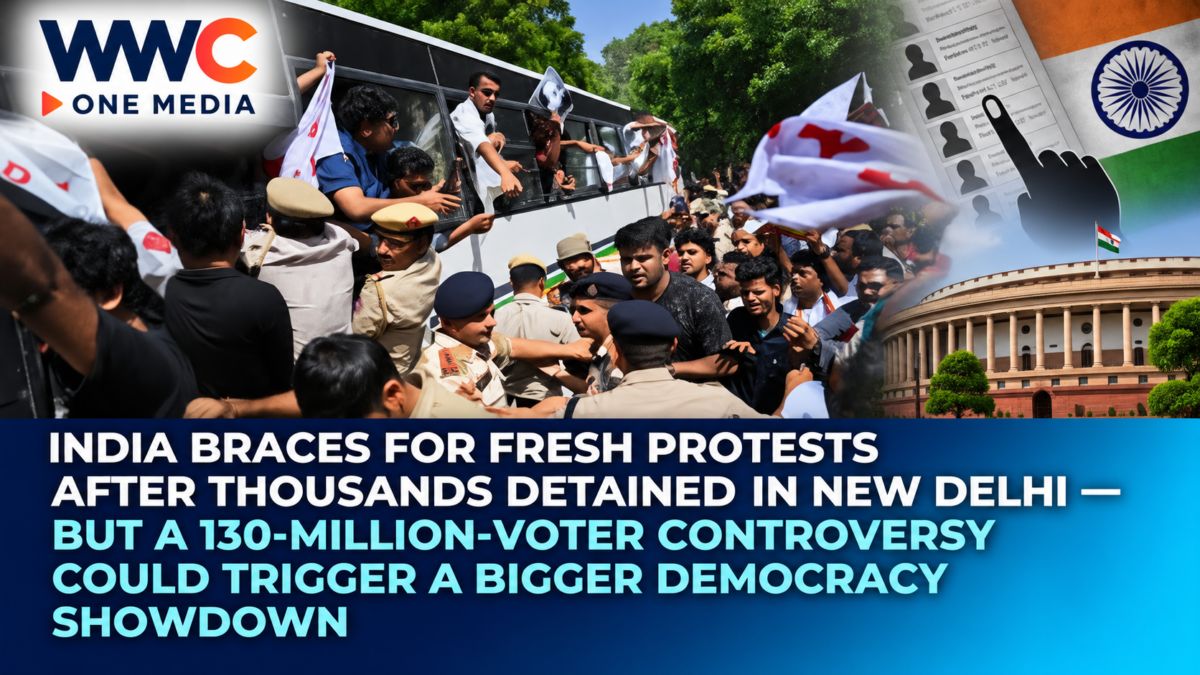
NEW DELHI, India — October 12, 2026 — India’s capital is preparing for another wave of demonstrations after police detained thousands of protesters over the weekend during a growing confrontation over the removal of more than 130 million names from electoral rolls.
Authorities closed six metro stations and imposed traffic restrictions across central Delhi on Monday as opposition parties planned a march toward the Supreme Court.
The protests have brought together youth activists, student organizations and opposition politicians demanding the resignation of Chief Election Commissioner Gyanesh Kumar.
At the center of the dispute is India’s Special Intensive Revision, or SIR, a sweeping effort to update voter lists.
The Election Commission maintains that the process is intended to eliminate invalid, duplicate and outdated entries.
Critics, however, accuse officials of removing legitimate voters and undermining public confidence in the country’s electoral system.
The allegations have not been established as proven election manipulation, and the government strongly denies wrongdoing.
But as protests continue and the country’s highest court intervenes over the treatment of demonstrators, India faces a growing test of electoral transparency, civil liberties and trust in its democratic institutions.
Delhi Shuts Metro Stations as Opposition Plans New March
New Delhi entered October 12 under heightened security.
Reuters reported that six metro stations were closed for security reasons, while police introduced restrictions and diversions along more than 20 road stretches.
The measures followed a weekend of large-scale demonstrations and detentions.
Opposition leader Rahul Gandhi urged supporters of the Congress party, civil society organizations and other political groups to participate in a march to the Supreme Court.
The opposition planned to submit a memorandum to Chief Justice Surya Kant demanding an end to alleged electoral manipulation, a halt to disputed voter-roll revisions and Kumar’s resignation.
Authorities said security measures were necessary to maintain public order and manage the risk of further confrontations.
But opposition leaders criticized the restrictions, arguing that they interfered with peaceful democratic participation.
Thousands Detained During Weekend Crackdown
The scale of the police response has become a major controversy.
Associated Press reported that more than 2,000 demonstrators were detained during Saturday’s crackdown.
Other Indian news organizations reported substantially higher figures, with some citing approximately 7,000 detentions.
Many people were taken into custody before reaching the planned demonstration at Jantar Mantar.
Police deployed buses and temporary holding facilities as protesters attempted to gather in different parts of the capital.
Most of those detained Saturday were later released, according to police accounts reported by AP.
Additional detentions followed on Sunday.
The Hindustan Times reported that roughly 700 people were detained during the second day of unrest, while other outlets cited lower preliminary estimates.
These differences reflect reporting at different times and potentially different definitions of detention.
The precise cumulative total remains disputed and should not be presented as a single verified figure.
Why 130 Million Names Have Become the Center of the Crisis
The protests are fueled by a nationwide controversy over electoral-roll revisions.
Reuters reported that more than 130 million names had been removed from voter lists since the revision process began last year.
The removed records included deceased voters, people who had relocated and individuals whom authorities could not trace.
The Election Commission argues that reviewing such entries is essential to maintaining accurate voter lists.
However, critics contend that the process may also have removed eligible citizens who should have retained their voting rights.
Opposition parties claim the revisions disproportionately affect vulnerable communities and could benefit Prime Minister Narendra Modi’s Bharatiya Janata Party.
The government and Election Commission deny those accusations.
The key distinction is that 130 million deleted entries do not automatically equal 130 million eligible people unlawfully denied the vote.
Establishing wrongful disenfranchisement would require examining eligibility, individual removal decisions, notification procedures and opportunities for correction.
The Election Commission says people removed incorrectly can apply to be restored to the rolls.
Critics question whether those remedies are sufficiently accessible and effective.
Who Is Gyanesh Kumar, and Why Do Protesters Want Him Removed?
Chief Election Commissioner Gyanesh Kumar has become the central target of the demonstrations.
As the head of India’s election administration, Kumar oversees an institution responsible for managing the electoral process.
Protesters accuse the Election Commission of failing to adequately protect legitimate voters during the revision exercise.
Their demands include greater transparency, safeguards against wrongful deletion and Kumar’s resignation.
The commission maintains that the process is impartial.
The BJP has accused opposition parties of undermining public confidence in legitimate electoral procedures by making unsupported allegations.
This disagreement illustrates the challenge facing election administrators.
Accurate voter lists are essential to prevent fraud and administrative errors.
But the process of correcting those lists must also protect eligible citizens against wrongful exclusion.
Public confidence depends on both objectives being achieved.
‘Cockroach’ Youth Movement Becomes a Major Political Force
Much of the momentum behind the demonstrations comes from the Cockroach Janta Party, or CJP, a youth-led protest movement.
Despite its name, the group is primarily a protest movement rather than an established electoral party.
Associated Press reported that it emerged from an online campaign in which young Indians adopted the cockroach as a symbol of resilience after a controversial comparison involving unemployed young people.
Its founders include Abhijeet Dipke, Saurav Das and Ashutosh Ranka.
The movement has attracted supporters concerned about unemployment, public accountability and electoral rights.
Its demonstrations have increasingly intersected with broader opposition criticism of the Modi administration.
Organizers say they will continue protesting until authorities address their demands.
The movement’s growth reflects the potential for dissatisfaction over separate political and economic issues to converge around a single controversy.
Protest Leaders Detained and Later Released
The detention of CJP leaders intensified tensions.
AP reported that Dipke, Das and Ranka were taken into custody after arriving in New Delhi on Saturday.
The three were later released under a condition requiring them to maintain public peace for one year, according to the movement’s legal representatives.
It was not immediately clear how the condition would affect their ability to organize or participate in future demonstrations.
Following their release, the leaders pledged to continue mobilizing supporters.
They criticized the police response and accused the government of suppressing dissent.
Authorities maintain that public-order restrictions must be observed.
The dispute now concerns the boundary between lawful preventive policing and interference with peaceful assembly.
India’s Supreme Court Intervenes Over Detentions
The growing unrest prompted an unusual intervention by India’s Supreme Court.
During an urgent Sunday hearing, the court emphasized that peaceful, unarmed protesters must not be detained except through procedures established by law.
The court also directed authorities to protect access to public transport, maintain internet connectivity and allow people to move freely.
It called for the removal of restrictions affecting access to court premises.
The intervention is significant because it places legal limits on how authorities manage public demonstrations.
However, the court’s directions should not be interpreted as a final ruling that every detention was unlawful.
Individual allegations would still require appropriate legal examination.
The court’s involvement also does not resolve the separate dispute over the voter-roll revision itself.
Journalists and Opposition Lawmakers Raise Police-Abuse Allegations
The police response has attracted criticism beyond the youth movement.
Indian news organizations reported that journalists were among those detained during Sunday’s demonstrations.
Some media workers said police apprehended them despite their efforts to identify themselves as journalists.
Opposition lawmakers and student activists also alleged excessive force.
The Indian Express documented complaints from people who said they were detained even when they were not participating in an active protest.
Police and government authorities, meanwhile, have cited public-order concerns and alleged violations of restrictions governing gatherings.
These competing accounts require independent examination.
Journalists must be able to document events without arbitrary interference, while authorities have a responsibility to protect the public and respond lawfully to any violence.
A credible review of the weekend’s events would need to distinguish peaceful participants, bystanders and individuals accused of specific offenses.
Rahul Gandhi Turns the Dispute Into a National Political Confrontation
Rahul Gandhi’s decision to support Monday’s march has increased the political significance of the protests.
The opposition Congress party is seeking to turn concerns over voter lists into a broader campaign for electoral accountability.
Its demands go beyond individual reinstatement of voters.
The party wants the revision process halted and greater scrutiny of the Election Commission’s leadership and decisions.
For the Modi government, the dispute represents a test of its ability to defend the legitimacy of an administrative process while managing large demonstrations.
For Congress, the challenge is substantiating its allegations and persuading voters that the controversy reflects systematic problems rather than administrative corrections.
The debate is therefore likely to continue in courts, political institutions and public demonstrations.
Why the Election Commission’s Response Matters
The Election Commission’s defense rests on the importance of maintaining accurate electoral records.
Removing deceased voters, duplicate entries and outdated addresses is a legitimate administrative objective.
But the process must also include safeguards.
Voters need understandable information about why their names were removed.
Eligible citizens should have accessible opportunities to challenge mistakes.
Clear documentation, transparent statistics and meaningful independent scrutiny can help establish whether the process is being conducted fairly.
Without those safeguards, even legitimate voter-list maintenance can undermine confidence.
The number of deleted records alone cannot determine whether the process was fair or unfair.
The crucial issue is whether eligible citizens were improperly excluded and whether errors can be corrected in time for elections.
Why the Protests Matter Beyond India
India is the world’s most populous country and one of Asia’s largest economies.
The credibility of its elections matters domestically and to its international relationships.
Large demonstrations, transport closures and political uncertainty can disrupt businesses and daily life.
However, there is no verified basis to claim that the October 12 protests have already caused a nationwide economic crisis or a broad collapse in Indian financial markets.
For Southeast Asia and the Philippines, the developments are relevant mainly as an example of how electoral administration, political trust and civil liberties interact in a major democracy.
The larger international question is how governments balance public order with citizens’ right to question state institutions.
The Bigger Question: Can India Restore Trust Before the Protests Grow?
New Delhi’s latest unrest reflects a dispute that cannot be resolved solely through police deployments and temporary road closures.
The underlying concerns involve voter eligibility, institutional independence and the right to peaceful protest.
The government argues that accurate electoral lists strengthen democracy.
Opposition parties and youth activists argue that the process risks excluding legitimate voters.
Both claims must be assessed against evidence rather than political rhetoric.
For the Election Commission, the priority is demonstrating that the revision is transparent, lawful and correctable.
For police authorities, the challenge is enforcing public-order rules without violating constitutional protections.
For opposition leaders, it is proving allegations through verifiable records and legal processes.
And for millions of ordinary voters, the central concern is whether their right to participate in elections is secure.
India’s capital is bracing for another day of protests after thousands were detained — but the bigger question is whether the government can restore confidence in the country’s electoral system before the dispute grows into a wider political confrontation.