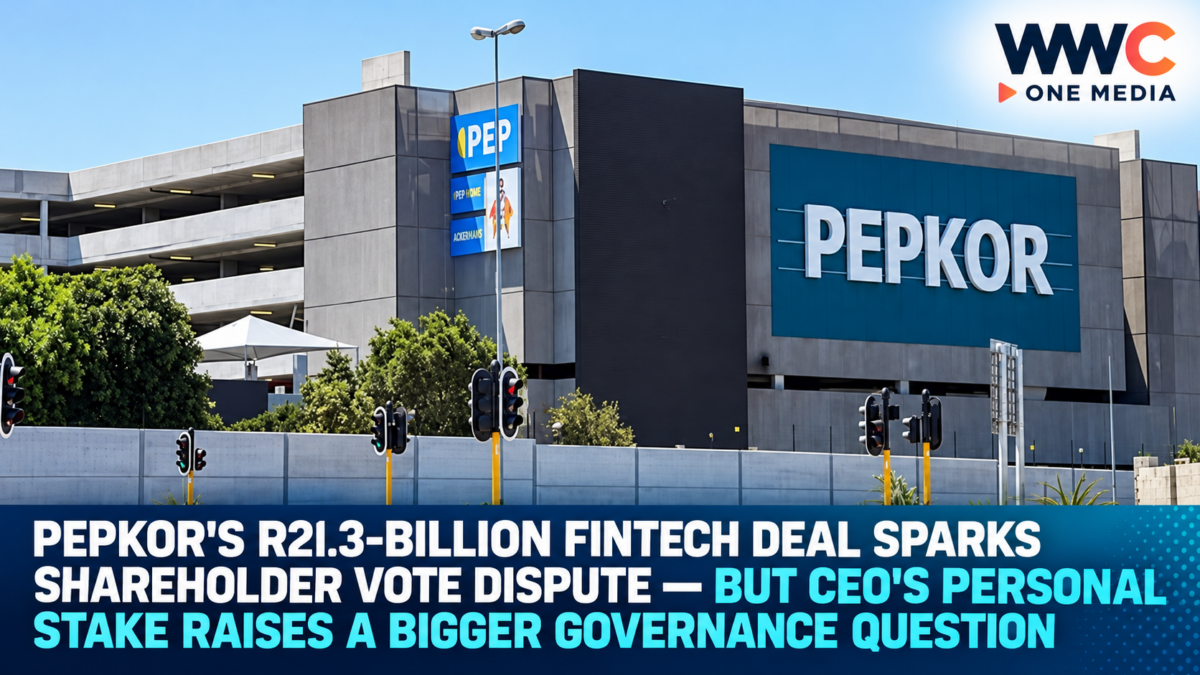
CAPE TOWN, South Africa — October 12, 2026 — South African retail giant Pepkor Holdings is facing growing shareholder scrutiny over its proposed R21.3-billion ($1.3-billion) fintech transaction, after an investment management firm argued that investors should have been allowed to vote on a deal involving a substantial indirect financial interest held by the company’s chief executive.
The controversy centers on Pepkor’s plan to combine its Flash financial technology business with Shop2Shop, creating a major digital payments and merchant-services platform serving South Africa’s informal economy.
Under the proposed agreement, Pepkor will control 57.1% of the combined company, known as FintechCo.
But CEO Pieter Erasmus, who already held an indirect minority stake in Shop2Shop, is expected to own approximately 13.2% of the enlarged business.
Based on the transaction’s implied valuation, that holding would be worth approximately R2.8 billion, although its eventual value could change before the deal closes.
The arrangement is now raising questions about corporate governance, board oversight and whether shareholders should have been given a greater say in a transaction that could reshape Pepkor’s long-term business strategy.
The deal may satisfy the Johannesburg Stock Exchange’s formal requirements, but the bigger question is whether meeting the minimum legal standard is enough when a company’s chief executive has a substantial personal interest in the outcome.
Aeon Investment Management Challenges Pepkor’s Decision
Aeon Investment Management, one of Pepkor’s 30 largest investors, believes shareholders should have been consulted before the fintech transaction received approval.
Aeon CEO Asief Mohammed told Bloomberg that a shareholder vote would have demonstrated stronger corporate governance, even if the Johannesburg Stock Exchange did not formally require one.
Aeon holds approximately 0.4% of Pepkor.
Mohammed suggested that the company could have arranged a voluntary, non-binding shareholder resolution, allowing investors to express their views while leaving the final transaction decision with the board.
Such a vote would not necessarily have prevented the agreement from proceeding.
However, it could have provided an additional measure of transparency and helped management assess shareholder confidence.
The criticism reflects a distinction increasingly debated in corporate governance: whether companies should limit themselves to satisfying regulatory requirements or adopt higher standards when important conflicts of interest arise.
Some Pepkor Directors Reportedly Opposed the Deal
The governance controversy extends beyond outside investors.
According to Bloomberg’s October 12 reporting, some Pepkor directors voted against the proposed transaction because they believed shareholders should have been allowed to decide whether to support it.
The information was attributed to a person familiar with the situation who was not identified because board voting records are confidential.
Pepkor declined to disclose how many directors supported or opposed the agreement, citing the confidentiality of board proceedings.
The reported dissent is important because it suggests concerns were raised within the company’s own governance structure.
However, the exact number of dissenting directors remains unconfirmed, and the report does not establish that the board’s approval process breached applicable law or listing rules.
How Pepkor’s R21.3-Billion Fintech Deal Works
Pepkor announced the transaction on July 22, 2026.
The proposed combination brings together two financial technology businesses that already have an established commercial relationship.
Flash operates a platform that enables merchants to distribute digital products and services, including prepaid electricity, mobile airtime and data.
Shop2Shop provides payments, merchant acquiring, cash management and other financial tools, particularly for smaller businesses operating in South Africa’s informal economy.
Together, the companies are expected to create a financial technology platform with annual transaction throughput exceeding R200 billion.
Under the agreement, Pepkor will contribute its entire Flash business, valued at approximately R10.6 billion, and subscribe for R1.57 billion in newly issued Shop2Shop shares.
That investment will help settle Shop2Shop debt and other obligations.
In return, Pepkor will hold a controlling 57.1% interest in FintechCo, with existing Shop2Shop shareholders holding the remaining 42.9%.
The overall transaction implies an equity valuation of approximately R21.3 billion.
This figure represents the implied valuation of the combined business, not the cash price Pepkor is paying to acquire Shop2Shop.
CEO Pieter Erasmus’s R2.8-Billion Stake Becomes the Flashpoint
The most controversial feature of the transaction is the financial interest held by Pepkor’s CEO.
Erasmus has an indirect stake in Shop2Shop through an associated company.
According to Pepkor’s financial disclosures, the related company originally acquired a 30% shareholding before Erasmus became Pepkor’s CEO in October 2022.
That interest subsequently increased to approximately 31.2%.
Following completion of the proposed Flash-Shop2Shop combination, entities associated with Erasmus would hold approximately 13.2% of FintechCo.
Based on the R21.3-billion implied equity valuation, the interest would have an estimated value of approximately R2.8 billion.
The figure is a valuation estimate, not a confirmed cash payment or realized personal profit.
It also reflects an indirect ownership interest rather than shares necessarily held in Erasmus’s personal name.
Nevertheless, the substantial financial exposure creates an important corporate governance question.
Can shareholders be fully confident that a transaction has been structured in their best interests when the chief executive of one participating company also has a substantial financial interest in the other?
Pepkor Says CEO Was Excluded From Deal Decisions
Pepkor has defended its governance procedures.
The company said Erasmus recused himself from all deliberations and decisions relating to the transaction.
It also obtained independent valuations for both Flash and Shop2Shop.
Independent directors concluded that the transaction was fair and reasonable and in the interests of Pepkor shareholders.
The company additionally commissioned a voluntary independent fairness opinion to support the board’s assessment.
These measures are intended to manage potential conflicts of interest and provide safeguards around the transaction.
However, critics argue that independent valuations and executive recusals do not necessarily replace the benefits of shareholder consultation.
For Aeon Investment Management, the concern is not simply whether formal legal procedures were followed.
It is whether investors had an adequate opportunity to express their views on a major strategic transaction.
Why the Deal Did Not Require a Shareholder Vote
Pepkor classified the proposed transaction as a Category 2 transaction under the Johannesburg Stock Exchange’s listing requirements.
According to the company’s July announcement, this classification does not require shareholder approval.
Pepkor also concluded that the transaction did not qualify as a related-party transaction under the relevant JSE rules.
The company explained that Erasmus’s indirect interest was below the applicable 35% associate-classification threshold.
It also noted that another Shop2Shop shareholder controlled more than half of the business.
These provisions are central to the legal distinction between a transaction that must be approved by shareholders and one that can be authorized through the board’s established procedures.
But the absence of a mandatory vote does not prevent investors from calling for greater transparency.
The debate is therefore primarily about governance standards and shareholder participation rather than a confirmed breach of stock-exchange regulations.
No regulatory ruling establishing that Pepkor unlawfully avoided a shareholder vote was identified in the reporting available as of October 12.
Flash and Shop2Shop Could Transform South Africa’s Informal Economy
Beyond the governance dispute, the transaction has significant commercial ambitions.
South Africa’s informal economy includes thousands of small shops, township retailers and independent merchants.
Many of these businesses depend heavily on cash transactions and face limited access to conventional banking and financing services.
Fintech companies have increasingly developed tools that allow these merchants to accept digital payments, manage cash and purchase products through electronic platforms.
Flash already serves approximately 170,000 informal traders.
Shop2Shop has more than 210,000 users.
Combining their networks could create opportunities to distribute additional products, expand payment acceptance and improve access to business services.
However, these figures describe the reported scale of the individual platforms and should not automatically be added together to calculate unique customers, since some merchants may use both systems.
The proposed FintechCo platform is intended to connect digital financial services with Pepkor’s extensive retail network.
Pepkor Wants to Move Beyond Discount Clothing
Pepkor is best known for retail chains including PEP and Ackermans.
The group has built a major business serving value-conscious consumers across Southern Africa.
But the company’s long-term growth strategy increasingly includes financial services, digital payments and connectivity.
Management believes these businesses could become important drivers of future revenue and profitability.
Through Flash and Shop2Shop, Pepkor aims to expand its participation in merchant payments, digital products and services for smaller businesses.
The combination could also strengthen distribution for the group’s planned digital banking activities.
This diversification may reduce reliance on traditional clothing and merchandise sales.
However, expanding into financial technology introduces different operating risks, including regulation, cybersecurity, competition, credit exposure and technology investment.
For shareholders, the strategic opportunity must therefore be weighed against the financial and governance risks associated with the transaction.
Pepkor Plans a Separate Listing of FintechCo
One of the company’s longer-term goals is to list the combined financial technology business separately.
A public listing could allow investors to value FintechCo independently from Pepkor’s traditional retail operations.
It might also provide additional financing options for expansion.
Pepkor has indicated that it intends to retain majority ownership over the longer term.
The planned listing is a strategic ambition rather than a completed transaction.
Its timing and ultimate valuation will depend on market conditions, business performance, regulatory approvals and shareholder arrangements.
The existing agreement includes provisions designed to protect minority shareholders of FintechCo and provide potential exit mechanisms if a listing does not occur.
These include put-and-call arrangements that may become exercisable several years after completion, subject to agreed conditions.
Such provisions will be important in evaluating the company’s future financial obligations and the alignment of interests between Pepkor and other shareholders.
Pepkor Shares Fall 31% as Investors Assess the Risks
The governance controversy comes during a difficult period for Pepkor’s shares.
Bloomberg reported that the stock had declined approximately 31% in 2026 as of October 12.
That compared with a roughly 25% decline in the eight-member FTSE/JSE Retailers Index.
The underperformance demonstrates the pressure facing the retailer in a challenging market environment.
However, the decline should not be attributed entirely to the Flash-Shop2Shop agreement.
Pepkor’s share price is also influenced by consumer spending, earnings expectations, retail competition, financing costs and broader financial-market conditions.
For investors, the latest controversy adds another issue to consider when assessing the company’s future.
The key question is whether the proposed FintechCo transaction can produce enough commercial value to justify its complexity and associated governance concerns.
Regulatory Approval and Completion Remain Outstanding
Pepkor’s September 14 business update said the proposed transaction remained subject to conditions precedent, including regulatory and competition approvals.
At that point, management expected the transaction to take approximately nine months from its July announcement to complete.
The agreement therefore should not be described as fully completed as of October 12.
Until the relevant conditions are fulfilled, the final ownership structure and implementation timetable could still change.
The company will also need to demonstrate that the combined operations can deliver the expected efficiencies.
Potential benefits include a larger merchant network, additional products and stronger payment-processing capabilities.
But these outcomes will depend on successful integration and continuing demand from small businesses.
South Africa’s Corporate Governance Standards Face a Bigger Test
The Pepkor dispute highlights a broader challenge for publicly traded companies.
Investors rely on corporate boards to approve transactions that serve the interests of all shareholders.
When an executive has a substantial financial interest in another party to a transaction, questions about independence become particularly important.
Formal safeguards such as recusals, independent valuations and fairness opinions can help manage those concerns.
But some institutional investors believe the most sensitive transactions should also be subjected to shareholder consultation, even when the law does not make it compulsory.
The disagreement does not necessarily mean either side has violated the rules.
Instead, it raises a question about how boards can preserve trust when corporate strategy, personal financial interests and investor rights intersect.
For other companies pursuing acquisitions or financial technology partnerships, the case could become a useful reference point in debates over disclosure and voluntary shareholder involvement.
The Bigger Question: Can Pepkor Deliver Fintech Growth Without Losing Investor Trust?
The proposed Flash-Shop2Shop merger could reshape Pepkor’s future.
The company sees opportunities to build a major merchant-commerce platform serving hundreds of thousands of traders and handling more than R200 billion in annual transaction throughput.
If successful, FintechCo could become a significant contributor to the group’s growth beyond conventional retail.
But the transaction has also exposed tensions over how strategic decisions should be made.
Aeon Investment Management believes shareholders deserved the opportunity to express their views.
Some directors reportedly raised similar concerns.
Pepkor maintains that it followed the applicable listing rules and implemented independent governance safeguards.
Both perspectives matter.
The company may have complied with the formal approval requirements, but the controversy shows that legal compliance and investor confidence are not always the same thing.
For Pepkor, the commercial challenge is to create a competitive financial technology business.
The governance challenge is to convince shareholders that the transaction’s benefits will be shared fairly.
And for CEO Pieter Erasmus, the existence of a substantial indirect interest in the combined company means scrutiny of the transaction’s fairness is likely to remain intense.
Pepkor’s R21.3-billion fintech deal could unlock a new growth engine for one of Africa’s biggest retailers — but the larger question is whether the company can deliver that transformation without allowing concerns over shareholder rights and executive interests to overshadow its ambitions.