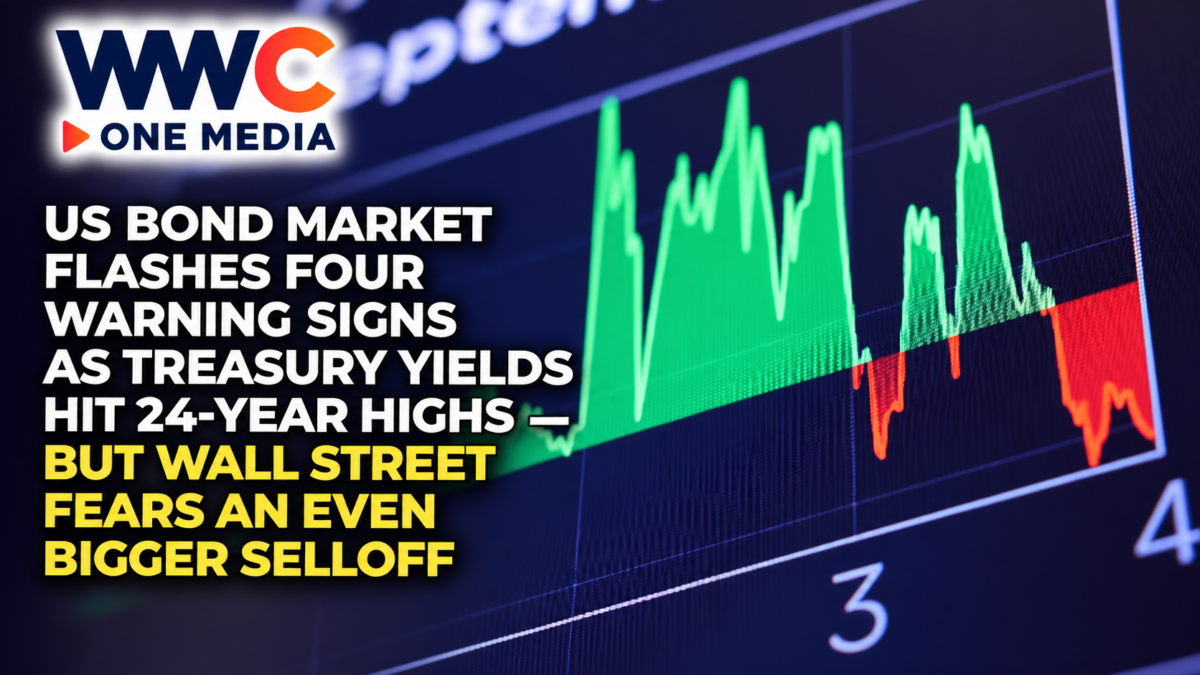
NEW YORK, United States — October 10, 2026 — A powerful selloff in US government bonds is raising alarms across global financial markets, with investors identifying four technical warning signs that could push Treasury yields even higher and increase borrowing costs for governments, businesses and households.
The benchmark 10-year US Treasury yield has risen approximately 135 basis points since the conflict involving Iran began in February, reaching around 5.23%, according to Reuters.
The 30-year yield has climbed approximately 110 basis points from its March low to about 5.614%.
Both have traded at levels last seen more than two decades ago.
While rising yields can attract investors searching for better returns, they can also expose weaknesses in the financial system.
That is because bond prices fall when yields rise.
Investors holding existing longer-duration securities can experience substantial market-value losses.
More importantly, some institutional investors may have to sell additional bonds or futures contracts to manage their risks, potentially amplifying the original market move.
An October 9 Reuters report, republished by Bilyonaryo, identified four developments that suggest the bond market could face further turbulence.
The bigger question is whether the latest rise in yields will eventually attract enough buyers to stabilize the market — or whether a chain reaction of hedging and forced selling will make the downturn worse.
Warning Sign 1: Investors Are Paying More to Protect Against Higher Rates
The first signal comes from the interest-rate options market.
Professional investors use derivatives to protect their portfolios against unexpected changes in yields.
One measure being closely watched is known as payer skew.
This reflects the relative demand for options that become valuable when interest rates rise sharply.
As investors become more concerned about a sudden jump in yields, they may be willing to pay more for that protection.
Reuters reported that the cost of protection against a 200-basis-point increase in 10-year US swap rates over three months reached 132 basis points on October 5.
That was the highest reading since the banking turmoil associated with Silicon Valley Bank’s collapse in March 2023.
Separately, implied volatility for one-month options on 10-year swap rates rose to 21.4 basis points, its highest level since late March.
These readings indicate greater demand for insurance against adverse interest-rate moves.
They do not prove that rates will actually rise by 200 basis points.
Instead, they suggest that investors are increasingly concerned about extreme outcomes.
Why Interest-Rate Options Matter
Treasury yields and interest-rate swap rates are not identical, but they generally move in related directions.
When demand for protection against higher swap rates intensifies, it can provide insight into broader market fears.
Rising option prices can also reflect greater uncertainty about the future direction of interest rates.
For institutional investors, that uncertainty affects decisions about leverage, portfolio duration and hedging.
For ordinary borrowers, sustained increases in Treasury yields can eventually affect loan pricing.
But derivatives-market volatility should not be confused with an immediate change in consumer interest rates.
The concern is that professional investors are preparing for a wider range of unfavorable outcomes.
Warning Sign 2: The AI Boom Is Flooding Credit Markets With New Debt
The second warning sign comes from an unexpected source: artificial intelligence.
Technology companies are borrowing enormous amounts of money to finance AI infrastructure.
Major projects require data centers, processors, electricity systems, cooling facilities and high-capacity networking equipment.
Some businesses are financing these investments through corporate bond issuance.
That creates new demand for investor capital.
It can also generate selling pressure in the Treasury market.
When an investor purchases a long-term corporate bond, that position introduces sensitivity to interest-rate movements.
Investors may hedge by selling Treasury futures.
Others may sell existing government securities to free up capital for higher-yielding corporate debt.
According to Reuters, investment-grade bond transactions have increasingly been accompanied by Treasury futures selling as investors adjust their exposure.
Goldman Sachs forecasts that major hyperscale technology companies could issue a record $420 billion of debt in 2027.
That is a prediction rather than a confirmed total.
But it demonstrates how financing the AI boom could influence markets far beyond technology stocks.
How AI Borrowing Can Push Treasury Yields Higher
Corporate bonds and government bonds compete for investor funds.
When large companies issue substantial amounts of debt, investors may rebalance their portfolios to accommodate the new securities.
Some may reduce Treasury holdings.
Others may use Treasury futures to hedge the interest-rate risk associated with corporate bonds.
If enough investors take similar actions, Treasury prices can come under pressure.
Because bond prices and yields move in opposite directions, that selling can push government borrowing costs higher.
This does not mean AI infrastructure spending is inherently harmful.
Investment in computing capacity can support economic activity and innovation.
But the financing required for that expansion can affect the broader bond market, particularly when investors are already worried about inflation and rising rates.
Warning Sign 3: Mortgage Investors Are Increasing Their Hedges
The third warning sign involves the US mortgage market.
Mortgage-backed securities are financial instruments supported by pools of mortgage loans.
Their interest-rate sensitivity can change as borrowers adjust their refinancing and repayment behavior.
When rates decline, homeowners may refinance, causing some mortgages to be repaid sooner.
When rates rise, refinancing usually becomes less attractive.
Existing mortgages may therefore remain outstanding longer than expected.
This can increase the duration of mortgage-backed securities, making them more sensitive to further interest-rate changes.
Institutional investors may respond by selling Treasury futures or using other instruments to reduce their exposure.
The practice is commonly called convexity hedging.
Reuters reported that recent trading activity suggests mortgage investors are increasing this type of protection.
Mike Riddle, chief executive of Eris Innovations, pointed to nine large transactions during October as evidence of heightened hedging activity.
Why Mortgage Hedging Can Amplify a Bond Selloff
The concern is that rising yields can create a feedback loop.
First, Treasury yields increase.
Then mortgage securities become more sensitive to interest rates as refinancing expectations change.
Investors respond by selling Treasury futures or increasing other hedges.
That activity can push Treasury prices lower and yields higher.
The process may then create a need for additional hedging.
This is different from investors simply deciding that the economic outlook has worsened.
The selling can be partly mechanical, driven by changes in portfolio risk.
Such activity becomes particularly important when many institutions are managing similar exposures.
However, convexity hedging does not guarantee a market crisis.
The impact depends on trade volumes, liquidity and whether other investors are willing to buy.
Warning Sign 4: Long-Term Bonds Are Being Punished More Severely
The fourth signal comes from the Treasury yield curve.
The yield curve compares interest rates on government bonds with different maturities.
Reuters reported that the gap between 10-year and 30-year US Treasury yields widened to approximately 37 basis points during the week.
The 30-year yield was rising faster than the 10-year yield.
That indicates investors were demanding greater additional compensation to hold the longest-dated government debt.
The difference had previously reached around 52 basis points in late July, so the latest reading was not an all-time record.
The concern is the combination of a widening spread and already exceptionally high yields.
Long-term bonds expose investors to decades of uncertainty over inflation, interest rates and fiscal policy.
When investors become more worried about those risks, they may demand higher yields.
That additional compensation is often described as the term premium.
America’s Growing Debt Is Part of the Problem
Rising long-term borrowing costs have renewed attention on US government finances.
Investors are evaluating the amount of debt Washington must refinance, the outlook for future deficits and the cost of servicing federal obligations.
These concerns are particularly relevant to 30-year Treasury bonds.
An investor purchasing very long-term debt faces greater uncertainty about inflation and fiscal policy over the coming decades.
That can increase the yield demanded.
The widening spread between 10-year and 30-year bonds may partly reflect those longer-term concerns.
However, term premiums cannot be observed directly with perfect precision.
Analysts estimate them using market models and other information.
The latest yield-curve movement is consistent with growing fiscal anxiety, but it does not establish that the United States is about to default on its obligations.
Could US Treasury Yields Reach 6%?
Some major investors believe yields could climb significantly further.
Pimco Group Chief Investment Officer Dan Ivascyn has warned that the benchmark 10-year Treasury yield could reach 6%.
A move to that level would represent an important increase in financing costs and would mark a return to yields not seen since around 2000.
Other strategists have also discussed the possibility of 6% yields if inflation remains persistent and bond-market pressures continue.
But 6% is a potential scenario, not a certain destination.
Market conditions could change if inflation eases, energy prices retreat or investors increase purchases of government debt.
Policy decisions by the Federal Reserve and Treasury Department may also influence expectations.
The warning is that risks remain elevated, not that a particular yield level is inevitable.
Rising Yields Are Already Hurting Smaller Companies
The bond-market selloff has implications for equities as well.
The Wall Street Journal reported that smaller US companies have been especially vulnerable to rising yields.
Smaller businesses often rely more heavily on bank financing, floating-rate debt or refinancing arrangements than larger corporations with extensive access to capital markets.
As borrowing costs rise, interest expenses can increase.
That may reduce profitability and discourage investment.
The Russell 2000 index of smaller US-listed companies has experienced sustained weakness, reflecting concerns about borrowing costs and financial conditions.
However, rising Treasury yields do not affect every company equally.
Businesses with strong cash reserves, modest debt and stable earnings may be better positioned than heavily indebted competitors.
Higher Bond Yields Can Pressure Stock Valuations
Treasury yields are an important benchmark for financial asset pricing.
When government bonds offer higher returns, investors may demand greater expected returns from riskier assets.
That can pressure equity valuations.
Long-duration growth stocks may be particularly sensitive because much of their expected value depends on profits projected far into the future.
Higher discount rates reduce the present value of those future earnings.
This can affect technology stocks even when their underlying businesses continue growing.
Real estate, utilities and other interest-rate-sensitive sectors may also experience pressure.
But the effect is not uniform.
Strong corporate earnings and economic growth can sometimes help equity markets withstand higher rates.
Investors must consider both financing conditions and business fundamentals.
The Iran Conflict Is Adding Inflation Pressure
The Middle East conflict has contributed to concerns about energy costs and inflation.
Higher oil prices can affect transportation, manufacturing and household expenses.
If inflation remains elevated, central banks may need to maintain restrictive interest-rate policies for longer or consider additional tightening.
Markets respond not only to actual policy decisions but also to expectations about future rates.
This uncertainty contributes to pressure on government bonds.
However, oil prices and geopolitical developments are only part of the story.
Government borrowing, investment demand, corporate debt issuance and trading mechanics are also influencing yields.
That is why the current selloff cannot be explained by one factor alone.
Are There Signs the Bond Market Could Stabilize?
Despite the four warning signals, there is also evidence that selling pressure may be easing.
The Wall Street Journal reported on October 9 that some of the technical forces behind the bond selloff were beginning to moderate.
Mortgage-related hedging pressures appeared to be stabilizing in some areas.
Investors also showed healthy demand at a recent 10-year Treasury auction.
Higher yields may themselves attract buyers looking to lock in returns.
This could help establish a level of support for bond prices.
However, a temporary stabilization does not guarantee that the broader selloff has ended.
Inflation reports, government borrowing announcements and changes in investor positioning could produce renewed volatility.
The outlook remains uncertain.
What Bond Investors Should Understand
Higher yields can create both risks and opportunities.
Investors purchasing newly issued bonds may receive more attractive income than was available when yields were lower.
But holders of existing fixed-rate bonds can experience market-value losses when yields rise.
Longer-duration securities generally react more strongly to interest-rate changes.
Investors who plan to hold individual bonds until maturity face different considerations from those who may need to sell earlier.
Credit quality also matters.
US Treasury securities carry different credit characteristics from corporate bonds or lower-rated debt.
A higher advertised yield should not be treated as the only factor in an investment decision.
Portfolio diversification, liquidity needs and investment horizons remain important.
Why the Philippines and Asian Markets Should Pay Attention
US Treasury yields influence financial conditions across the world.
They serve as a major reference point for dollar-denominated borrowing and international bond pricing.
When US yields rise sharply, investors may reassess the returns they require from bonds issued by emerging-market governments and companies.
This can affect financing costs in Asia.
For the Philippines, higher global interest rates may influence demand for sovereign bonds, corporate debt and other financial assets.
Currency markets may also react as investors compare yields across countries.
However, a rise in US Treasury yields does not automatically translate into an identical increase in Philippine interest rates.
Domestic inflation, Bangko Sentral ng Pilipinas policy and local investor demand remain important.
The broader significance is that volatility in the US bond market can transmit financial pressure internationally.
The Bigger Picture: Wall Street Is Facing a Dangerous Feedback Loop
The four warning signs identified by Reuters reveal how different corners of financial markets are connected.
Options traders are paying more for protection against rising rates.
AI companies are issuing large amounts of debt, creating more demand for hedging and investor capital.
Mortgage investors are adjusting positions as higher rates change the expected duration of their securities.
Long-term Treasury investors are demanding greater compensation for fiscal and inflation risks.
These forces can reinforce one another.
But they can also weaken if market conditions stabilize.
The next phase will depend on inflation, energy markets, bond supply, investor demand and the behavior of major institutional investors.
A bond-market crisis is not inevitable.
What matters is whether liquidity remains sufficient to absorb the selling.
THE BOTTOM LINE
The US Treasury market is facing four warning signs that could intensify its recent selloff.
The first is rising demand for protection against higher interest rates.
The second is unprecedented borrowing to finance artificial intelligence infrastructure, which is increasing hedging activity.
The third is stronger mortgage-related convexity hedging.
The fourth is a steepening yield curve, reflecting greater compensation demanded for holding long-term government bonds.
The 10-year Treasury yield has climbed to around 5.23%, while the 30-year yield has reached approximately 5.614% in the Reuters report.
These developments raise concerns that additional selling could push yields higher and create new pressure on stocks, mortgages, corporate debt and international financial markets.
However, there are also indications that higher yields are beginning to attract buyers and that some technical selling pressures may be easing.
The biggest question is whether investors will regain confidence before the four warning signals reinforce one another — or whether another wave of selling will push US borrowing costs toward levels that could destabilize global markets.
Wall Street is no longer watching only inflation and the Federal Reserve. The hidden mechanics of the bond market itself may determine what happens next.