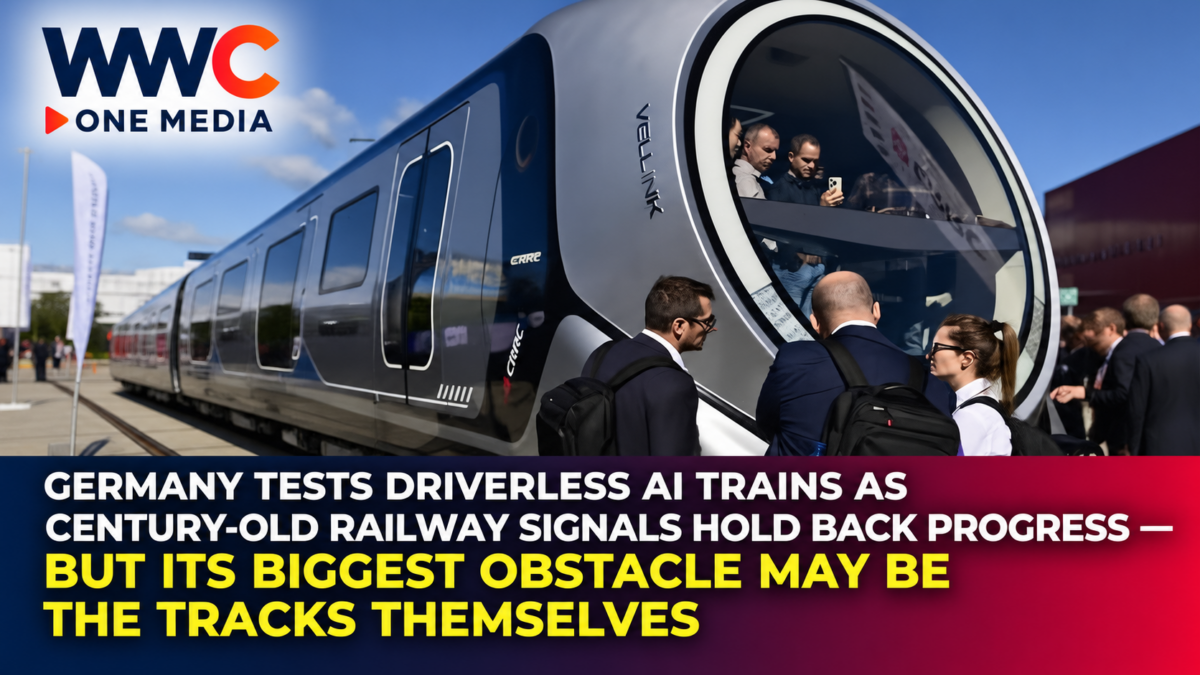
BERLIN, Germany — October 10, 2026 — Germany is making significant progress toward trains that can operate without drivers, but the country’s aging railway network is threatening to slow the arrival of a new generation of artificial intelligence-powered transportation.
A new Bloomberg report highlights the contradiction confronting Europe’s largest economy: engineers are developing trains capable of detecting obstacles and making automated operating decisions, while parts of the railway system still depend on signaling equipment and infrastructure built around technology from a much earlier era.
The challenge extends beyond replacing train drivers with computers.
Germany must modernize the tracks, signaling systems, communications networks and operational procedures that allow thousands of passenger and freight trains to move safely across a busy national network.
The urgency is growing as Deutsche Bahn struggles with delays, deteriorating infrastructure and construction-related disruptions.
Official figures show that only 58.7% of Deutsche Bahn’s long-distance services met its punctuality standard during the first half of 2026.
Yet Germany has also demonstrated that fully automated train movements are technically possible, supported by tens of millions of euros in government research funding.
The bigger question is whether Europe’s industrial powerhouse can modernize its aging railway infrastructure quickly enough to turn artificial intelligence from a promising experiment into a reliable everyday transportation system.
Germany Successfully Demonstrates Driverless Train Technology
On September 8, Germany’s Federal Ministry for Economic Affairs and Energy announced a major milestone in railway automation.
An industry consortium successfully demonstrated fully automated train movements under real-world conditions at facilities operated by Havelländische Eisenbahn.
The demonstration involved a modified Siemens Mobility Mireo train equipped with advanced automation technology.
The system can prepare the train for operation, carry out safety checks and move it without a driver from a stabling area toward its operating position.
The technology is also designed to identify unexpected obstacles and respond appropriately.
The government said the project demonstrated the technical feasibility of automated train preparation and positioning.
It represents progress toward a railway system that can perform certain tasks without continuous human control.
However, the successful trial does not mean Germany has already introduced nationwide driverless passenger trains.
The demonstrated capabilities involve specific operating scenarios, with broader deployment still requiring technical certification, infrastructure compatibility and regulatory approval.
Germany Invests €41.5 Million in the Future of Autonomous Trains
The German government provided approximately €41.5 million in funding for the AutomatedTrain research initiative.
The project brought together companies and research organizations with expertise in railway operations, engineering, artificial intelligence and digital infrastructure.
Participants included Siemens Mobility, Bosch Engineering, Deutsche Bahn subsidiaries, Codewerk, IAV, duagon, Red Hat and Dresden University of Technology.
The consortium worked for approximately three years to develop and test technologies for fully automated railway operations.
The goal is to demonstrate that trains can carry out selected activities autonomously while maintaining the strict safety standards required by rail transport.
For railway operators, the potential advantages include more flexible fleet deployment, improved efficiency and reduced dependence on staff for repetitive positioning and preparation tasks.
Automation could also help address workforce shortages.
However, commercial deployment would require additional investment beyond the research project’s initial funding.
Why Old Railway Signals Are Holding Back New Technology
One of the greatest obstacles to railway automation is the infrastructure that trains depend on.
Unlike self-driving vehicles operating primarily through onboard sensors and road-navigation technology, automated trains must function within a tightly controlled railway network.
Signaling systems determine when and where trains can safely move.
Points and switches direct trains between tracks, while train-protection equipment helps prevent unsafe movements.
Older signaling installations can remain in operation for decades.
Although they may continue to perform their original functions, connecting them with modern digital systems can be difficult.
Some legacy infrastructure was designed long before today’s requirements for continuous data exchange, advanced traffic optimization and automated train control.
This can create compatibility challenges for operators attempting to introduce more advanced systems.
Modern train automation therefore requires coordinated investment in trackside technology, communications networks and control systems.
Installing intelligent software on a locomotive does not automatically make the entire railway capable of supporting autonomous operation.
AI Cannot Repair Broken Tracks or Eliminate Bottlenecks
Germany’s railway challenges go well beyond its signaling equipment.
Deutsche Bahn’s interim report for 2026 identifies several major sources of operational disruption.
These include aging and failure-prone infrastructure, congested railway corridors, extensive construction activity and weather-related interruptions.
The company also reported that operational congestion reached a new high during the first half of the year.
When a railway operates close to its capacity limits, relatively small disruptions can spread quickly.
A delayed train may occupy a section of track needed by another service.
The resulting conflict can create additional delays across the network.
Artificial intelligence may help dispatchers find better solutions, but software cannot instantly create additional tracks, restore damaged infrastructure or remove physical capacity constraints.
Those problems require maintenance, modernization and, in some cases, construction of additional infrastructure.
This distinction is central to understanding why railway automation may progress more slowly than the underlying technology.
Only 58.7% of Long-Distance Trains Met Punctuality Standard
Deutsche Bahn’s performance figures illustrate the challenge.
During the first half of 2026, its long-distance train punctuality rate fell to 58.7%, compared with 63.4% during the same period in 2025.
For regional rail services, punctuality stood at 88.2%, down from 90.2%.
The company’s punctuality standard generally counts a train as punctual when it arrives less than six minutes late.
The figures reveal a substantial difference between regional and long-distance operations.
Long-distance services travel across multiple sections of the network, making them more exposed to infrastructure faults, congestion and knock-on delays.
The company identified severe winter weather, a June heat wave and extensive construction work as factors affecting performance.
A better dispatching system could help manage some disruptions.
But meaningful improvements will also depend on repairing infrastructure and reducing recurring failures.
Deutsche Bahn Plans 28,000 Construction Projects in 2026
Germany is already undertaking an extensive railway renewal program.
Deutsche Bahn reported that approximately 14,000 construction projects had been completed during the first half of 2026.
The full-year plan covers approximately 28,000 projects.
The work includes track repairs, station improvements, switches, signaling equipment and upgrades to heavily used railway corridors.
The scale of the program shows how much investment and operational coordination are required to modernize the network.
But construction itself creates short-term difficulties.
Closing sections of track or reducing capacity can force trains onto alternative routes.
These diversions may increase travel times and create new congestion.
For passengers, the result can be frustrating: the work necessary to improve long-term reliability can initially make services less dependable.
Germany must therefore balance the speed of modernization against the need to keep trains operating during construction.
Deutsche Bahn Is Already Using AI to Manage Delays
While fully autonomous passenger trains remain a developing technology, Deutsche Bahn is already applying artificial intelligence to day-to-day operations.
Its KI-Dispo system supports railway dispatchers by processing current traffic conditions and recommending adjustments.
The technology can analyze operational information in seconds.
It is intended to help control centers respond more efficiently when services experience delays or conflicts.
According to Deutsche Bahn’s 2026 interim report, the system has been piloted on the Stuttgart, Rhine-Main, Munich and Berlin S-Bahn networks.
The company is continuing to refine the system and improve connections with passenger-information services.
AI-based predictions can also use historic journey data and real-time signaling information to estimate arrival and departure times.
This can help railway staff and passengers anticipate disruptions.
However, these applications are distinct from fully driverless trains.
AI-assisted dispatching provides decision support, while autonomous train operation involves direct control of vehicle movements under strict safety requirements.
Digital Signaling Is Essential to the Next Generation of Rail
Modern railway automation depends heavily on digital train-control systems.
One important European technology is the European Train Control System, or ETCS.
It forms part of the broader European Rail Traffic Management System designed to improve interoperability and train protection.
Digital train-control equipment can provide more sophisticated information about train movements and permitted operating conditions.
This creates opportunities for automated train operation and improved capacity management.
However, railway operators must ensure that onboard equipment and trackside infrastructure work together.
Modernization is therefore a system-wide challenge.
Installing new software on a train is only one part of the process.
The tracks, signaling equipment, telecommunications systems and operational rules must also support the desired level of automation.
That makes deployment considerably more complicated than introducing a new consumer technology product.
Siemens, Bosch and Deutsche Bahn Are Developing Different Forms of Automation
Germany’s railway technology industry is exploring several applications.
The AutomatedTrain project is focused on demonstrating fully automated movements for train preparation and stabling operations.
Separate projects involve automated freight-yard locomotives.
Deutsche Bahn Cargo has worked with Bosch Engineering and ITK Engineering on a fully automated shunting locomotive intended for railway freight operations.
In earlier company announcements, the partners identified regulatory approval toward the end of 2027 and deployment from 2028 as their targets.
These are planned milestones rather than completed achievements.
Freight-yard automation is particularly attractive because some operations take place within relatively controlled environments.
That can make the operating challenges different from those faced by passenger trains traveling through busy national networks.
The distinction is important.
A successful autonomous freight-yard locomotive does not automatically demonstrate that all mainline passenger trains can operate without drivers.
Different railway environments require different technical safeguards and approvals.
Driverless Trains Could Help Address Workforce Shortages
Germany’s railway industry also faces demographic and labor challenges.
Experienced railway employees are retiring, while operators must recruit and train replacements.
Maintaining sufficient qualified personnel is particularly important in safety-critical roles.
Automation could help reduce the amount of staff time required for certain repetitive tasks.
For example, automatically moving trains between stabling areas and stations may allow trained personnel to focus on activities requiring greater human judgment.
The government has identified workforce shortages as one reason for supporting autonomous-train research.
However, automation does not necessarily eliminate the need for railway employees.
New systems require maintenance technicians, software engineers, cybersecurity specialists, controllers and safety professionals.
Human oversight may also remain necessary depending on the operating environment and approved level of automation.
The likely effect is a change in how railway work is organized, rather than an immediate replacement of the entire workforce.
Safety and Cybersecurity Will Determine How Quickly AI Trains Arrive
Introducing artificial intelligence into railway systems creates substantial safety responsibilities.
Rail networks must operate under strict procedures because failures can endanger passengers, workers and surrounding communities.
Autonomous systems must reliably recognize hazards, follow movement authorities and respond to unexpected conditions.
Their performance must be demonstrated under a wide range of operating circumstances.
Cybersecurity is another critical concern.
As more railway equipment becomes connected through digital networks, operators must protect systems against unauthorized access and disruption.
Communication failures and software errors also need appropriate fallback procedures.
These requirements explain why railway automation cannot simply be deployed at the same speed as many ordinary consumer software applications.
Before a new system enters commercial service, operators and regulators need evidence that it meets applicable safety standards.
Germany’s Experience Offers Lessons for Asia and the Philippines
Germany’s modernization difficulties have implications for countries developing new railway networks or upgrading existing systems.
Across Asia, governments are investing in urban rail, regional trains and higher-capacity transport corridors.
The technology selected during initial construction can influence maintenance costs and modernization options for decades.
For the Philippines, the lesson is especially relevant as railway development expands.
Projects must consider not only the trains themselves but also signaling, telecommunications, power systems, maintenance capabilities and long-term interoperability.
A modern train operating on unreliable infrastructure cannot consistently deliver reliable service.
Similarly, advanced artificial intelligence cannot compensate for insufficient maintenance or inadequate network capacity.
For countries building new rail infrastructure, designing systems with future digital upgrades in mind may reduce some of the difficulties currently confronting older networks.
However, the costs and technical requirements vary considerably by project.
There is no universal solution that can be transferred directly from Germany to every Asian railway.
The Bigger Picture: Artificial Intelligence Needs Modern Infrastructure
Germany’s autonomous-train experiments illustrate a broader challenge in the global adoption of artificial intelligence.
Software capabilities can advance faster than the physical systems needed to use them.
In railway transport, that includes tracks, signaling equipment, power networks and operational control centers.
A promising AI demonstration may show what is technically possible.
But large-scale commercial deployment requires reliability across an entire operating environment.
That means governments and companies must invest in physical infrastructure alongside digital technology.
The same principle applies to other sectors, including energy, manufacturing and logistics.
AI can improve forecasting, planning and decision-making, but its benefits are limited when the underlying infrastructure cannot support the changes it recommends.
THE BOTTOM LINE
Germany has demonstrated important progress in autonomous railway technology, including a September 2026 driverless-train trial supported by approximately €41.5 million in public research funding.
Companies such as Siemens Mobility, Bosch and Deutsche Bahn are developing systems capable of automating selected train movements and improving railway operations.
But aging signaling equipment, overloaded routes and extensive infrastructure repairs remain major obstacles to widespread deployment.
Deutsche Bahn’s long-distance punctuality fell to just 58.7% during the first half of 2026, underscoring the scale of its existing reliability challenges.
The biggest obstacle to Germany’s AI railway future may not be whether computers can control trains — but whether the country’s aging infrastructure can support the technology safely and reliably.
Germany may be developing trains that can operate without drivers. But before artificial intelligence can transform the railway, the country must first solve the problems already keeping conventional trains from arriving on time.