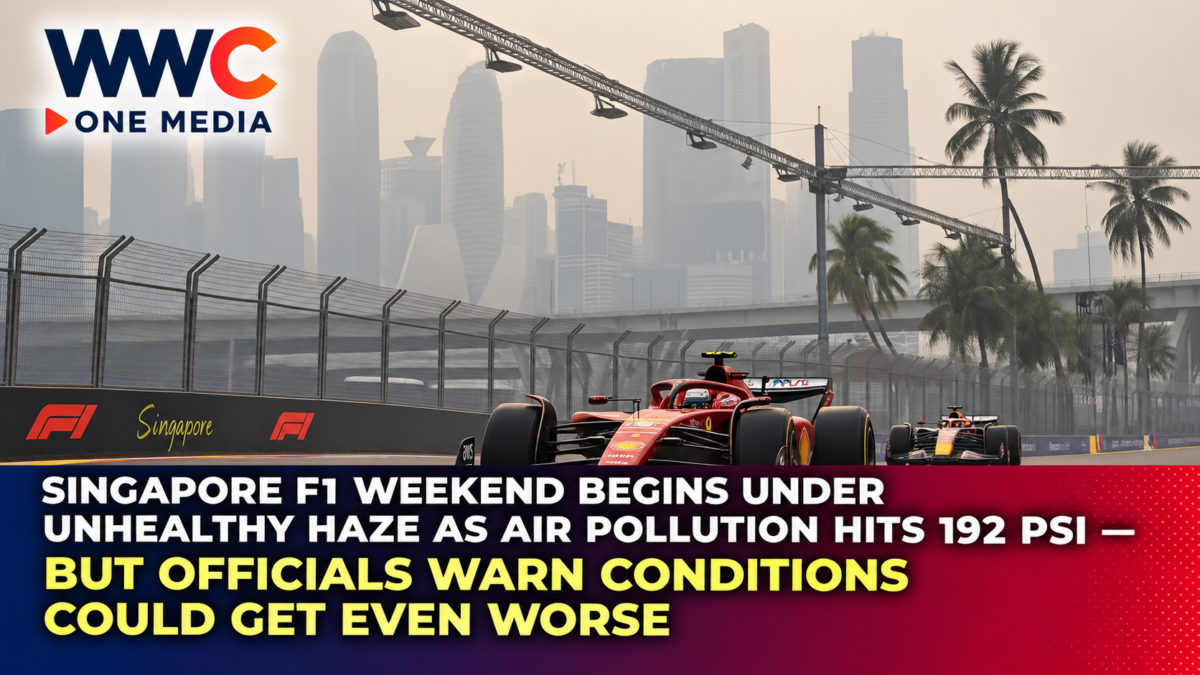
SINGAPORE — October 10, 2026 — Singapore’s highly anticipated Formula 1 Grand Prix weekend is unfolding under a cloud of unhealthy air pollution as smoke from widespread Indonesian forest and land fires continues to blanket the city-state, threatening outdoor activities and raising health concerns for hundreds of thousands of motorsport fans and residents.
The 24-hour Pollutant Standards Index (PSI) reached 192 in central Singapore on Friday, October 9, the highest level recorded during the country’s 2026 haze season.
Although air quality improved slightly overnight, readings remained unhealthy across all five regions on Saturday as the city prepared for Formula 1 action at the Marina Bay Street Circuit.
According to Channel NewsAsia, the 24-hour PSI at noon on October 10 stood at 171 in central Singapore, 161 in the west, 154 in the east, 134 in the south and 122 in the north.
The National Environment Agency (NEA) has warned that conditions could worsen further, potentially pushing the index above 200 into the Very Unhealthy range.
That possibility has prompted government agencies and Formula 1 organizers to prepare additional precautions.
But the Grand Prix remains scheduled to proceed.
The biggest question is whether Singapore can safely deliver its biggest motorsport weekend while smoke from regional wildfires continues to threaten air quality and public health.
Singapore’s Air Quality Remains Unhealthy as F1 Weekend Begins
Singapore experienced another difficult morning on October 10 as the haze persisted across the island.
Official air-quality readings showed that every region remained above 100 on the 24-hour PSI scale, placing the entire country in the Unhealthy category.
The central region continued to record the highest pollution levels.
The situation was worse on Friday, when the PSI reached 192 in the central region.
That was the highest recorded level of Singapore’s 2026 haze season.
The latest readings represent a substantial deterioration from the beginning of October.
On October 1, the NEA reported PSI readings of 60 to 73, within the Moderate range.
By October 7, the index had climbed to between 105 and 140.
Two days later, the readings reached between 136 and 192.
The progression shows how quickly conditions can deteriorate when regional fires, dry weather and prevailing winds combine.
Although pollution concentrations can change throughout the day, authorities have advised the public to monitor official readings rather than assume brief improvements mean the haze has ended.
Indonesia’s Forest and Land Fires Are Driving the Crisis
Singapore’s latest haze episode is largely linked to smoke from forest and land fires in Indonesia.
The NEA has identified growing numbers of hotspots in southern and central Sumatra, with additional smoke activity in Kalimantan.
Prevailing southeasterly to southwesterly winds have carried smoke toward Singapore.
Dry conditions associated with a particularly strong El Niño weather pattern have aggravated the regional fire situation.
Reduced rainfall allows vegetation and other combustible material to dry out, increasing the likelihood that fires will spread.
Once smoke enters the atmosphere, changes in wind direction can carry it across national borders.
That means Singapore can experience severe air pollution even when the principal fires are burning hundreds of kilometers away.
Regional haze has affected Singapore and neighboring countries repeatedly over several decades.
The latest episode demonstrates that transboundary air pollution remains a major environmental challenge in Southeast Asia.
Government Warns Pollution Could Enter ‘Very Unhealthy’ Territory
On October 9, Singapore’s government announced that it was prepared to strengthen its haze response.
The National Environment Agency warned that the 24-hour PSI could exceed 200 if unfavorable conditions persist.
Under Singapore’s air-quality classification system, readings between 101 and 200 are considered Unhealthy.
Readings between 201 and 300 are considered Very Unhealthy.
The distinction matters because more severe pollution requires stronger precautions, particularly for vulnerable groups.
In response to the deteriorating situation, the government convened its Haze Task Force, which brings together 28 public agencies.
The task force is preparing additional measures to protect residents, workers and visitors.
These include potential changes to outdoor activities and increased support for people who may be affected by respiratory symptoms.
However, a warning that the PSI could exceed 200 does not mean that it has already done so.
As of the official readings cited on October 10, the index remained within the Unhealthy category.
Formula 1 Says Singapore Grand Prix Will Continue
Despite the haze, Formula 1 organizers and the Fédération Internationale de l’Automobile (FIA) have indicated that the Singapore Grand Prix will proceed as scheduled.
Reuters reported on October 8 that race officials were monitoring pollution conditions and coordinating with local authorities.
The Marina Bay race is one of Formula 1’s most recognizable events, attracting international spectators, sponsors, broadcasters and corporate guests.
Canceling or significantly disrupting the event would create substantial logistical and commercial complications.
However, organizers have stressed the importance of health and safety.
Contingency measures are available if air quality deteriorates.
These may include adjustments to outdoor entertainment and other activities surrounding the main race.
The current position is that racing will continue, but officials retain the ability to respond to changing conditions.
There has been no confirmed cancellation of the Grand Prix.
Outdoor Concerts and Entertainment Could Face Restrictions
The Singapore Grand Prix is more than a motorsport competition.
The event has become a major entertainment festival featuring international music performances, hospitality events and corporate gatherings.
According to the Financial Times, the 2026 weekend includes concerts featuring international performers such as The Killers and Lana Del Rey.
These activities can require spectators to spend long periods outdoors.
That becomes a concern when pollution levels remain elevated.
Reuters reported that the FIA and local authorities are prepared to consider restrictions affecting entertainment and outdoor activities if conditions worsen.
Potential changes could include limiting certain outdoor programs or adjusting schedules.
However, specific cancellations should not be reported unless organizers announce them.
The main sporting event and its accompanying entertainment activities may be subject to different operational decisions.
Fans should therefore monitor official notices for individual performances and scheduled activities.
Drivers Face the Physical Demands of Racing in Hazy Conditions
Singapore’s Marina Bay Street Circuit is already considered one of the most physically demanding races on the Formula 1 calendar.
Drivers compete in high temperatures and humidity while maintaining intense concentration over a long race distance.
The circuit’s narrow corners and limited runoff areas require precise car control.
Adding unhealthy air quality creates another environmental concern.
Fine particulate pollution can irritate the respiratory system, especially during prolonged exposure or intense physical exertion.
The Guardian reported that specialists have raised concerns about the potential effects of haze on physical preparation and performance.
Some drivers have suggested that the current conditions remain manageable.
However, individual driver assessments do not replace official environmental and medical monitoring.
The FIA is coordinating with local authorities to evaluate conditions and determine whether additional safeguards are necessary.
Spectators Could Face Greater Exposure Than Drivers
While Formula 1 drivers are receiving considerable attention, spectators may face different exposure risks.
Fans often spend many hours walking between viewing areas, attending concerts and waiting outside.
Some may also be traveling with children or older relatives.
Prolonged exposure can increase the likelihood of irritation and other health effects, particularly among individuals with existing respiratory or cardiovascular conditions.
Authorities have emphasized that the appropriate precautions depend on pollution levels and personal health.
For spectators, this means checking current air-quality information and adjusting outdoor activity accordingly.
People experiencing significant symptoms should seek medical advice.
Race organizers and Singapore authorities have prepared medical support and access to protective masks if conditions worsen.
These measures are intended to reduce risk without unnecessarily disrupting essential activities.
What Singapore’s Health Authorities Are Advising
Singapore’s health guidance distinguishes between healthy individuals and groups more vulnerable to air pollution.
For healthy people, the NEA recommends reducing prolonged or strenuous outdoor physical exertion when the 24-hour PSI is in the Unhealthy range.
Children, pregnant women and older adults are advised to minimize prolonged or strenuous outdoor physical activity.
People with chronic heart or lung disease are advised to avoid prolonged or strenuous outdoor exertion.
Residents should use the 24-hour PSI to help plan activities over the day.
The one-hour PM2.5 readings provide additional information about more immediate pollution conditions.
The Ministry of Health notes that healthy individuals with short-term haze exposure may experience irritation of the eyes, nose and throat.
Anyone with persistent or worsening symptoms should obtain appropriate medical guidance.
Well-fitted N95 masks may help reduce exposure to airborne particles when outdoor exposure is unavoidable, particularly under more severe conditions.
However, masks are not a substitute for reducing exposure where possible.
Singapore’s Tourism Industry Has Billions Riding on Formula 1
The Singapore Grand Prix is also a major business event.
The city-state uses the race to attract tourists, international executives, investors and corporate partners.
Reuters reported that Singapore was hosting several major conferences around the Grand Prix period.
Events included the Forbes Global CEO Conference, Milken Asia Summit and TOKEN2049.
Together, the conferences and associated activities have attracted a large number of international visitors.
Hotel prices and demand for hospitality services have increased during the period.
Maybank analysts estimated that tourism receipts directly associated with the Formula 1 event could exceed S$160 million.
The Financial Times also reported that Singapore’s Formula 1 events have generated more than S$2.2 billion in tourism revenue over their history.
These figures explain why the race carries significance well beyond motorsport.
A successful event supports hospitality, transport, restaurants, entertainment and international business activity.
However, tourism revenue estimates should not be confused with net profits or the overall economic benefit after costs.
Hosting major events involves considerable spending on infrastructure, security and operations.
The Haze Exposes Southeast Asia’s Environmental Vulnerability
Singapore’s pollution crisis is not solely a domestic environmental issue.
It highlights the challenge of managing air pollution that crosses national borders.
Smoke generated by fires in one country can affect public health, transportation and commercial activities elsewhere in the region.
Southeast Asian governments have repeatedly discussed cooperation on fire prevention, land management and haze monitoring.
The ASEAN Specialised Meteorological Centre provides regional information on hotspots, smoke plumes and weather conditions.
However, detecting fires is only part of the response.
Long-term progress requires better fire prevention, land-management practices and enforcement.
Weather patterns can also influence the severity of particular haze episodes.
Periods of unusual dryness may increase the risk of fires and make smoke pollution harder to control.
The recurrence of these events underlines the importance of regional cooperation rather than relying exclusively on temporary domestic precautions.
Rain Could Bring Relief — But Wind Direction Remains Critical
Singapore’s weather forecast offers some possibility of improvement.
The NEA has said showers are expected across Singapore and surrounding areas during October 10 and 11.
Rain can help reduce airborne particle concentrations and improve local air quality.
But its effects can be temporary if smoke continues entering the region.
Wind conditions remain particularly important.
Prevailing winds may continue transporting haze from Sumatra and Kalimantan toward Singapore even if local rainfall provides short-term relief.
That means air-quality readings could fluctuate throughout the Grand Prix weekend.
Authorities are monitoring both fire activity and weather conditions before issuing updated guidance.
The possibility of rain should not be treated as a guarantee that the haze will clear before the race.
What the Singapore Haze Means for Travelers From the Philippines
Singapore is a major destination for Filipino tourists, business travelers and overseas workers.
The haze could affect travel plans involving outdoor sightseeing, concerts and sports events.
Visitors attending Formula 1 should pay close attention to official advisories and any changes to scheduled activities.
Travelers with asthma or other respiratory conditions should take additional care and carry prescribed medication.
For those planning outdoor activities, the official PSI and one-hour PM2.5 readings provide useful information.
However, the presence of unhealthy haze does not automatically mean airports are closed or flights are canceled.
Flight disruptions should be reported only when confirmed by airports or airlines.
For the Philippines and neighboring countries, the situation also serves as a reminder that transboundary haze can affect different parts of Southeast Asia depending on prevailing wind patterns.
The exact impact outside Singapore must be assessed using local air-quality data.
Could Haze Become a Bigger Challenge for Asia’s Outdoor Sporting Events?
Singapore’s experience raises a wider question about the vulnerability of international sporting events to environmental disruption.
Formula 1 races depend on complex schedules, international travel and large gatherings of people.
Extreme weather, poor air quality and other environmental conditions can complicate planning.
Organizers increasingly need contingency procedures for risks that may not directly affect the racing surface but can still threaten public health.
Singapore has dealt with haze during earlier Grand Prix periods, including in 2019.
The repeated nature of the problem shows why monitoring systems and flexible event management are important.
Other Asian sporting events face their own environmental challenges, including extreme heat, heavy rainfall and air pollution.
The issue is not limited to Formula 1.
It concerns the ability of major event organizers to protect participants and spectators while adapting to changing regional conditions.
THE BOTTOM LINE
Singapore’s Formula 1 Grand Prix weekend has begun with unhealthy air quality across the city-state as smoke from Indonesian forest and land fires continues to drift into the region.
The 24-hour PSI reached 192 in central Singapore on October 9 before easing slightly on Saturday.
At noon on October 10, readings remained between 122 and 171 across the country’s five regions.
Authorities have warned that pollution could worsen enough to enter the Very Unhealthy category.
The government has activated its Haze Task Force, while Formula 1 and the FIA continue monitoring conditions.
The race remains scheduled to proceed, although outdoor entertainment and other activities could face changes if pollution intensifies.
The biggest question is not simply whether the Singapore Grand Prix can go ahead — but whether organizers can protect spectators, workers and residents if air quality deteriorates during one of the city’s biggest international events.
Singapore’s Formula 1 weekend is still on track, but the continuing haze has turned a celebration of motorsport and tourism into a high-stakes test of public-health preparedness.