MUMBAI, India — October 10, 2026 — India’s central bank has raised interest rates for the first time in more than three years, confronting a growing economic dilemma as surging fuel prices and inflation threaten household purchasing power despite the country’s strong economic growth.
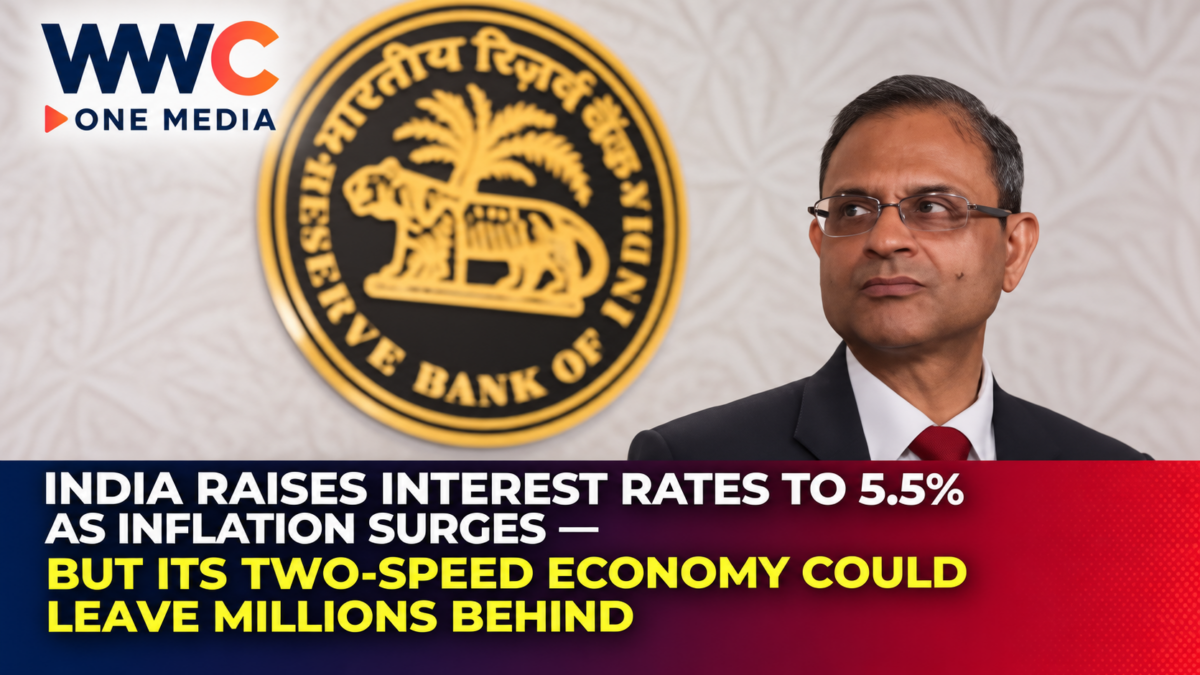
The Reserve Bank of India (RBI) increased its benchmark repo rate by 25 basis points to 5.50% on October 7, signaling a major shift toward tighter monetary policy.
But behind the decision lies a deeper concern: India’s economy is increasingly showing signs of moving at two different speeds.
While wealthier consumers continue spending on expensive vehicles and other discretionary purchases, many lower-income and rural households are feeling greater pressure from rising living costs.
According to the Financial Times, the rate increase is testing policymakers’ ability to manage an economy where financial conditions vary significantly across income groups and regions.
The biggest question is whether India’s central bank can control inflation without placing even greater pressure on households already struggling to keep up.
RBI Raises Rates for the First Time Since February 2023
The RBI’s six-member Monetary Policy Committee unanimously approved the 25-basis-point increase following meetings held from October 5 to 7.
The move raised the benchmark repo rate from 5.25% to 5.50%.
It was the first policy rate increase since February 2023, ending more than three and a half years without a hike.
The central bank also changed its monetary policy stance from “neutral” to “calibrated tightening.”
The revised stance suggests officials are increasingly focused on preventing inflation from becoming entrenched.
RBI Governor Sanjay Malhotra explained that inflation risks were becoming less favorable, requiring a more cautious approach to monetary policy.
The decision came amid higher global energy prices, financial market volatility and pressure on the Indian rupee.
Although the RBI has not committed to a specific sequence of future rate increases, its new policy stance indicates that further tightening remains possible.
Why India’s Strong Economy Is Becoming More Unequal
India remains one of the world’s fastest-growing major economies.
Gross domestic product expanded by 7.8% during the April–June 2026 quarter, exceeding the central bank’s earlier expectations.
Strong corporate investment, urban consumption and activity in parts of the services sector have helped support economic growth.
However, national GDP growth does not necessarily reflect the financial condition of every household.
The Financial Times describes an increasingly divided economy, with affluent consumers maintaining stronger demand while poorer households face pressure.
Automobile sales offer one illustration.
Higher-income consumers can continue purchasing premium vehicles even as other households reduce discretionary spending.
Meanwhile, weaker tractor sales have raised concerns about demand conditions in rural areas.
Tractor sales are influenced by several factors, including farm incomes, weather, financing conditions and replacement cycles.
They are therefore not a perfect measure of rural economic wellbeing.
Nevertheless, the contrast illustrates why headline growth figures may conceal important differences between regions and income groups.
For the RBI, the challenge is setting one national interest rate for an economy with widely varying financial circumstances.
Inflation Is Becoming a Bigger Threat
Inflation has returned to the center of India’s economic policy debate.
Consumer price inflation reached 4.82% in August 2026, exceeding the RBI’s 4% medium-term target for a third consecutive month.
The central bank aims to keep inflation near 4%, within a permitted band of 2% to 6%.
Although the August reading remained inside the official tolerance range, the broader increase in prices concerned policymakers.
According to Reuters, inflation had spread across a growing share of India’s consumer price basket.
Approximately half of the basket was experiencing price increases above 4%.
This suggests that inflation pressures are becoming broader rather than remaining concentrated in a few products.
For households, persistent inflation reduces the purchasing power of income.
Families may have to allocate more money to food, transportation and essential services, leaving less available for savings and discretionary spending.
The challenge becomes more difficult when wage growth fails to keep pace with living costs.
The Middle East Conflict Is Raising India’s Energy Costs
One of the main drivers of renewed inflation pressure is the increase in global energy prices associated with the conflict in the Middle East.
India is a major importer of crude oil.
Higher international oil prices can therefore increase the cost of energy imports and create pressure throughout the economy.
Transportation, manufacturing and agricultural production are among the sectors affected by changes in fuel costs.
Businesses facing higher expenses may attempt to pass some of those costs on to consumers.
For families, this can mean additional increases in transportation and everyday household spending.
Higher energy prices can also complicate India’s external financial position because importers need more foreign currency to purchase crude oil.
These developments create a difficult policy environment.
The central bank cannot directly control international oil prices, but it can influence domestic interest rates and financial conditions.
By raising borrowing costs, policymakers aim to limit the risk that temporary price shocks develop into persistent inflation.
However, higher interest rates cannot quickly increase global oil supplies or reverse geopolitical disruptions.
RBI Raises India’s Growth Forecast to 7.1%
Despite the inflation risks, the central bank remains optimistic about India’s overall economic performance.
The RBI increased its GDP growth forecast for fiscal year 2026–27 to 7.1%, up from 6.7%.
The upward revision reflects the strength of recent economic activity.
India’s 7.8% growth during the April–June quarter provided evidence of resilience despite global uncertainty.
Strong credit demand and business activity have also contributed to expectations that growth will remain relatively robust.
This creates room for the central bank to increase rates without assuming that the economy will immediately contract.
But growth projections remain subject to risks.
Higher oil prices, weaker rural demand and additional financial tightening could influence future performance.
The 7.1% figure is a forecast rather than a completed full-year growth result.
Inflation Forecast Climbs to 5.2%
The RBI also revised its inflation expectations upward.
Its forecast for consumer price inflation in fiscal year 2026–27 increased from 5.0% to 5.2%.
That suggests policymakers expect inflation to remain above the central bank’s preferred 4% midpoint.
Some forecasts indicate that inflation could approach 6% toward the end of 2026 before moderating.
The increase reflects concern about food and energy prices, weather-related disruptions and broader pricing pressures.
For households, the outlook means the cost of living could remain challenging even if economic growth stays strong.
For businesses, the higher inflation forecast adds uncertainty to planning, financing and investment decisions.
The RBI must therefore balance its objective of price stability with the potential economic costs of higher borrowing rates.
How Higher Interest Rates Could Affect Indian Families
The repo rate influences broader borrowing conditions throughout India’s financial system.
When the RBI raises its policy rate, banks may increase interest rates on certain loans.
Homeowners with floating-rate mortgages could face higher monthly payments, depending on the terms of their loans and the speed of bank repricing.
Consumers taking out new personal or automobile loans may also encounter higher borrowing costs.
Businesses could face more expensive financing for expansion and working capital.
However, the impact will not be identical for every borrower.
Some loans have fixed rates, while others are linked to benchmarks that respond more quickly to monetary policy changes.
Higher interest rates may also benefit certain savers if banks increase deposit rates.
For households with limited savings and substantial borrowing needs, however, the balance may be less favorable.
The effects depend on the structure of each household’s assets, debts and income.
Rural India Faces a Different Economic Reality
One of the most important elements of the two-speed economy is the contrast between urban and rural demand.
India’s urban economy includes affluent consumers, expanding technology industries and businesses serving relatively high-income households.
These groups may have greater financial flexibility when prices increase.
Rural communities, meanwhile, depend more heavily on agricultural income, local employment and the effects of weather conditions.
Weak monsoon rainfall associated with El Niño has created additional concerns for food production and rural purchasing power.
Changes in rainfall can affect agricultural output, farm incomes and the cost of food.
When household budgets are already tight, higher prices can force families to postpone major purchases.
The Financial Times points to weaker rural consumption indicators as evidence of this divergence.
However, rural India is not economically uniform.
Conditions vary widely across states, agricultural sectors and income groups.
The more important policy question is whether growth is sufficiently broad-based to support households outside the most prosperous urban markets.
India’s Rupee Faces Pressure From Global Markets
The RBI’s decision also comes amid pressure on India’s currency.
Before the October policy announcement, the rupee weakened as investors responded to rising U.S. Treasury yields, a stronger dollar and capital outflows.
Reuters reported that the currency closed at approximately 96.42 per U.S. dollar on October 6.
A weaker rupee can raise the local-currency cost of imported goods, particularly energy.
That creates another potential source of inflation.
Higher interest rates may help support the currency by increasing returns on rupee-denominated assets.
However, exchange rates depend on several factors beyond monetary policy.
Global investor sentiment, capital flows, trade balances and movements in the U.S. dollar can all influence currency markets.
The RBI has also used foreign-exchange and liquidity-management tools to address volatility.
Such measures can reduce market disruptions but do not remove all external economic risks.
RBI Introduces Special Dollar Window for Oil Companies
India’s currency pressures prompted an additional policy response.
On October 10, reports emerged that the RBI had arranged a special dollar-supply facility for major public-sector oil marketing companies, effective October 12.
The arrangement is intended to allow designated oil companies to obtain dollars through a dedicated channel rather than relying entirely on the regular foreign-exchange market.
The companies identified in reporting include Indian Oil Corporation, Bharat Petroleum Corporation and Hindustan Petroleum Corporation.
The measure could reduce concentrated dollar demand associated with energy imports.
It illustrates how the central bank is using measures beyond interest-rate increases to address financial pressures.
However, the RBI had not publicly disclosed every operational detail, including the total volume of dollars to be supplied.
The facility should therefore not be described as a guaranteed solution to rupee weakness.
Why the RBI’s Next Move Could Be More Difficult
The October interest-rate increase may be only the beginning of a more complicated policy period.
The central bank faces several competing risks.
If inflation continues rising, additional rate increases may become necessary to maintain price stability.
But if household consumption weakens sharply, tighter borrowing conditions could aggravate the slowdown.
The country’s strong headline growth provides some flexibility.
However, the distribution of that growth matters.
An economy supported by affluent consumers and large businesses may be less resilient if lower-income households face continued pressure.
The RBI will therefore need to monitor inflation, consumption, employment, credit growth and currency conditions.
Future decisions will depend on whether price pressures moderate and whether economic activity remains broadly supported.
What India’s Rate Hike Means for the Philippines and ASEAN
India’s monetary policy shift is also relevant to other Asian economies.
Central banks across the region are navigating the effects of global energy prices, currency volatility and changing U.S. interest rates.
Higher oil prices can create inflation pressure in countries that depend heavily on imported fuel.
A stronger dollar and rising U.S. bond yields can also influence investment flows across emerging markets.
For the Philippines, these developments provide important regional context.
The Bangko Sentral ng Pilipinas faces its own monetary policy considerations involving domestic inflation, economic growth and exchange-rate conditions.
However, India’s decision does not mean Philippine interest rates must automatically follow the same path.
Each central bank responds to domestic conditions, institutional mandates and financial risks.
The broader lesson is that emerging economies may face difficult trade-offs when external price shocks arrive at a time of uneven household demand.
The Bigger Picture: Growth Figures Are Not the Whole Economy
India’s latest interest-rate decision demonstrates a central challenge facing fast-growing emerging economies.
Strong GDP growth can coexist with financial stress among large sections of the population.
While expanding industries and affluent households support economic activity, inflation can weaken the purchasing power of people with limited financial resources.
Higher interest rates may be necessary to protect price stability.
But the burden of tighter financial conditions can fall differently across income groups.
For policymakers, monetary policy alone cannot resolve those differences.
Infrastructure investment, employment opportunities, agricultural productivity and targeted social policies also influence whether economic growth becomes more inclusive.
India’s challenge is therefore broader than setting the appropriate interest rate.
It involves ensuring that the benefits of economic expansion reach more households while inflation remains under control.
THE BOTTOM LINE
The Reserve Bank of India raised its benchmark policy rate by 25 basis points to 5.50% on October 7, 2026, marking its first increase since February 2023.
The central bank also shifted to a calibrated tightening stance as rising energy prices and broader inflation pressures threatened economic stability.
Despite the rate increase, the RBI upgraded its fiscal-year growth forecast to 7.1%, reflecting continued strength in the wider economy.
However, the Financial Times highlights an increasingly important divide between affluent consumers who continue spending and lower-income households facing financial pressure.
The biggest risk is not simply that India has begun raising interest rates again — but that the same policy could have very different consequences for a wealthy urban consumer and a struggling rural family.
India’s economy may still be growing rapidly, but the real test is whether policymakers can bring inflation under control without deepening the divide between those prospering and those being left behind.