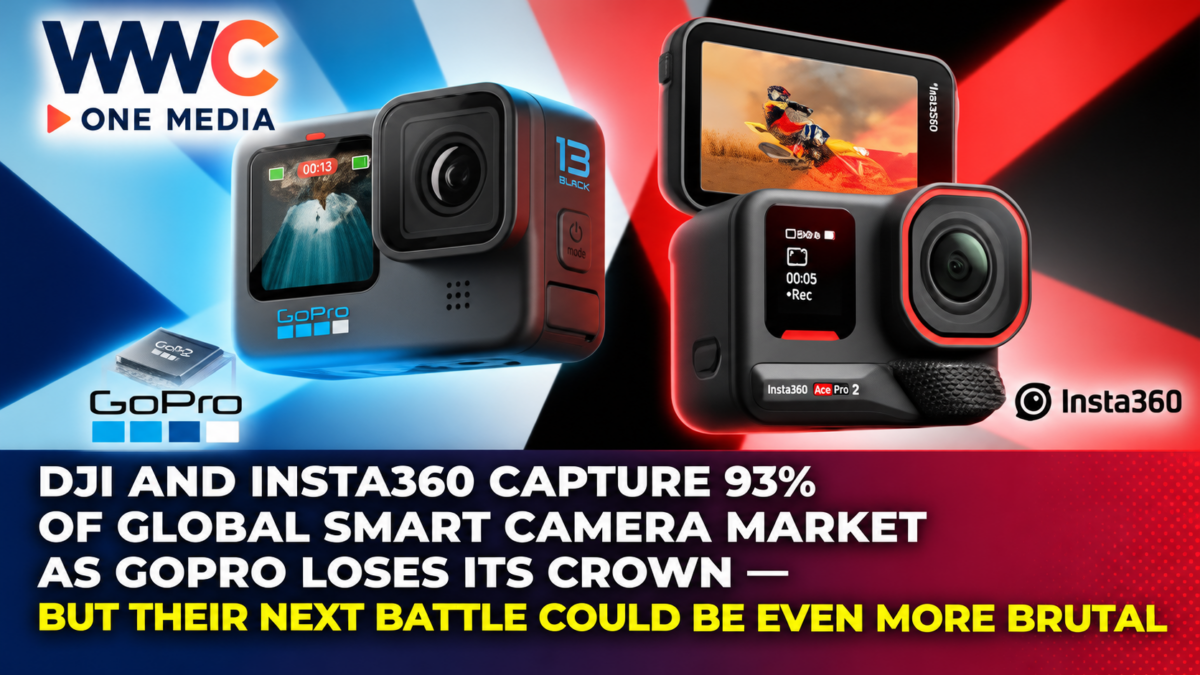
SHENZHEN, China — October 10, 2026 — The global smart-camera industry has undergone a dramatic transformation, with Chinese technology companies DJI and Insta360 capturing a combined 93% of worldwide handheld smart-camera shipments as American pioneer GoPro struggles to defend the business it helped create.
But the next chapter may be even more intense.
Having overtaken their American competitor, the two Shenzhen-based manufacturers are now increasingly challenging each other across action cameras, panoramic imaging, drones and other consumer technologies.
According to market research firm IDC, DJI commanded 73% of the global handheld smart-camera market in the second quarter of 2026, while Insta360 accounted for 20%.
GoPro, once virtually synonymous with action cameras, held approximately 3%.
The numbers illustrate an extraordinary shift in consumer electronics, where two Chinese companies have emerged as dominant competitors in a market that was once defined by an American innovator.
The biggest question is no longer whether DJI and Insta360 can defeat GoPro — but which of the two Chinese giants will emerge stronger from their increasingly aggressive battle for global dominance.
Chinese Camera Companies Dominate a Fast-Growing Global Market
IDC’s latest research shows that global handheld smart-camera shipments exceeded 5.88 million units during the second quarter of 2026.
That represented an increase of 57% compared with the same period a year earlier.
Industry revenue approached 15.7 billion yuan, highlighting strong demand for equipment used by vloggers, travelers, filmmakers, athletes and online content creators.
DJI shipped more than 4.28 million units during the quarter, securing a 73% share.
Insta360 followed with more than 1.15 million units and a 20% share.
Together, the companies accounted for 93% of worldwide shipments.
The figures cover multiple product categories, including stabilized gimbal cameras, action cameras and panoramic cameras.
They do not mean DJI and Insta360 control 93% of the entire global photography industry.
Nevertheless, their combined share demonstrates how decisively Chinese brands have expanded across portable imaging equipment.
GoPro Falls From Industry Pioneer to Just 3% Market Share
GoPro helped define the action-camera market after its founding in 2002.
Its compact, durable cameras became essential equipment for surfers, cyclists, skiers, divers and adventure travelers.
For years, the company enjoyed strong global recognition and built a loyal community around user-generated footage.
Its rise helped establish action cameras as a mainstream consumer electronics category.
However, the emergence of more technologically diverse rivals changed the competitive landscape.
DJI introduced increasingly sophisticated stabilization systems and compact handheld cameras.
Insta360 popularized immersive video, advanced reframing software and new approaches to capturing action footage.
GoPro continued developing products, but its rivals expanded faster across several emerging categories.
According to IDC-based reporting, GoPro’s conventional action-camera shipments declined 49% year over year in the second quarter of 2026.
Its panoramic-camera shipments fell by approximately 61%.
The company’s broader handheld smart-camera market share was estimated at just 3%.
The figures underline the commercial pressures facing a brand that once dominated its signature product category.
GoPro’s $285 Million Rescue Deal Marks a Turning Point
GoPro’s difficulties became even more apparent on September 1, 2026, when the company announced a definitive merger agreement with Starman Optical, a U.S.-based optical-photonics company.
Under the proposed transaction, GoPro shareholders will receive an aggregate cash payment of approximately $285 million, subject to adjustments, and retain roughly 10% ownership in the combined publicly listed company.
Starman’s owners would effectively hold the remaining majority interest.
According to Reuters, the transaction is intended to help strengthen GoPro’s finances and address challenges involving debt, component costs and Chinese competition.
The agreement also creates opportunities to expand beyond consumer cameras.
Starman specializes in optical transceivers used in communications and artificial intelligence infrastructure.
The combined company plans to explore applications involving AI data centers, government, defense and aerospace markets.
GoPro possesses more than 2,500 U.S. patents, including intellectual property associated with optics and imaging systems.
Those assets could provide opportunities in technologies beyond action cameras.
However, the transaction is expected to close before the end of 2026 and remains subject to applicable conditions.
The announcement should not be confused with confirmation that the merger has already been completed.
DJI’s Success Was Built on Drone Technology
DJI originally established its international reputation through consumer and professional drones.
The company became a leader in technologies involving stabilization, camera sensors, flight-control systems and compact electronic design.
It subsequently applied its expertise to handheld imaging products.
Its Osmo Pocket and Osmo Action families helped attract consumers who wanted smooth footage, portability and simplified video production.
The Osmo Pocket series became particularly attractive to vloggers and creators seeking stabilized footage without a separate camera rig.
DJI also benefited from its wider hardware ecosystem, which includes accessories, imaging software and professional filming equipment.
By expanding from drones into handheld cameras, the company was able to use capabilities developed in one industry to compete in another.
The strategy has helped DJI establish a powerful position in the broader smart-camera market.
But as its presence has grown, competition with Insta360 has become increasingly direct.
Insta360 Builds a Rival Camera Empire
Insta360 developed its brand around panoramic cameras and immersive video.
Its products allow users to capture footage in multiple directions and select the final viewing angle during editing.
This approach became popular among travelers, extreme-sports enthusiasts and social media creators.
Rather than requiring users to frame every shot perfectly during recording, panoramic footage gives them greater flexibility afterward.
Insta360 has also invested in software that simplifies editing, tracking subjects and creating visually dynamic content.
That combination of hardware and software helped the brand differentiate itself from traditional camera manufacturers.
The company has since expanded into conventional action cameras, compact wearable cameras and stabilized imaging devices.
According to IDC figures, Insta360 controlled approximately 73% of the global panoramic-camera segment in the second quarter of 2026.
Its strength in that category makes it an important competitor even though DJI remains considerably larger across the overall handheld smart-camera market.
The Next Camera War Is DJI Versus Insta360
The Financial Times reports that the rivalry between DJI and Insta360 is becoming more aggressive as both companies enter each other’s established markets.
DJI has moved into panoramic cameras, placing it in direct competition with Insta360’s core product range.
Insta360, meanwhile, is expanding into drones and other products associated with DJI.
The result is a growing struggle for consumers who use multiple types of cameras.
A traveler may want a stabilized pocket camera, a conventional action camera, a panoramic camera and a drone.
Companies that can supply several of those devices may gain advantages through accessories, software integration and brand loyalty.
But expanding into new markets is expensive.
Manufacturers must invest in development, manufacturing, distribution and customer support.
Competition also creates pressure to release products more frequently and improve performance.
For DJI and Insta360, the next challenge is maintaining growth without sacrificing profitability.
Patent Battles Add Another Layer of Competition
The Financial Times also reports that the companies have pursued patent-related litigation against one another in the United States.
Intellectual property is particularly valuable in a market built around stabilization, optics, imaging software and compact camera engineering.
Patent disputes can influence product design, licensing costs and commercial strategy.
They can also increase expenses and create uncertainty around specific technologies.
However, allegations made in legal proceedings do not establish that either company has committed infringement.
The outcomes depend on court findings and other legal developments.
The disputes nevertheless demonstrate how the competition has expanded beyond product specifications and retail pricing.
Both companies are working to protect the technology they consider essential to their competitive positions.
U.S. Restrictions Complicate DJI’s Global Ambitions
DJI’s leadership also comes with geopolitical challenges.
The company faces restrictions affecting access to certain U.S. regulatory approvals and government-related markets.
These restrictions can complicate the introduction of new products and expansion strategies.
However, they should not be described as a blanket ban on every DJI camera already available to American consumers.
The precise implications depend on the product and regulatory rules involved.
Insta360 has sought to expand its American presence through distribution, marketing and relationships with online creators.
This creates an opportunity for the smaller Chinese company to increase recognition in a market where GoPro has historically been strong.
At the same time, Insta360 must navigate its own international regulatory and commercial risks.
Competition in the United States is increasingly affected not only by product quality but also by the relationship between technology companies and government policy.
Why Shenzhen Gives Both Companies a Competitive Advantage
DJI and Insta360 are headquartered in Shenzhen, one of the world’s most important electronics manufacturing centers.
The city supports an extensive network of suppliers, engineers and specialized manufacturers.
For hardware companies, this concentration can reduce the distance between product development, component sourcing and manufacturing.
Engineers can test designs and coordinate with suppliers relatively quickly.
That can help accelerate product development, particularly in industries where features and specifications change frequently.
Shenzhen’s manufacturing ecosystem has supported the international growth of numerous Chinese electronics companies.
But proximity to suppliers does not guarantee success.
Companies must still differentiate their products, control costs and respond to changing consumer preferences.
GoPro’s difficulties demonstrate that an established brand cannot rely indefinitely on its early success.
Strong Sales Do Not Guarantee Strong Profits
The DJI–Insta360 rivalry raises an important financial question.
Expanding market share is not the same as generating higher profits.
Manufacturers may increase shipments while facing rising spending on research, new product development, marketing and customer acquisition.
Price competition can also reduce margins.
As DJI and Insta360 enter each other’s markets, both face incentives to improve specifications, introduce new features and expand retail distribution.
Consumers may benefit from more advanced cameras and greater competition.
For the companies, however, the battle could become increasingly expensive.
Investors will be watching whether higher shipment volumes translate into sustainable earnings.
The company with the largest market share may not necessarily produce the strongest investment returns.
What This Means for Camera Buyers in the Philippines and Asia
The rivalry could have important implications for consumers across Southeast Asia, including the Philippines.
DJI and Insta360 products appeal to vloggers, travelers, filmmakers, content creators and outdoor enthusiasts.
Their expanding product ranges provide more choices across stabilized cameras, action cameras and panoramic imaging.
Greater competition could encourage improvements in image quality, battery life, editing software and stabilization.
It may also increase the number of products available at different price points.
However, lower prices are not guaranteed.
Local pricing depends on distribution costs, taxes, product availability and commercial strategy.
Filipino consumers should also consider official warranty coverage, service centers, accessory availability and software support.
For professional users, long-term reliability may matter more than the newest advertised feature.
The growing competition offers opportunities, but purchasing decisions still depend on individual needs.
The Bigger Picture: Chinese Technology Companies Challenge Established Western Brands
The transformation of the handheld smart-camera market reflects a broader pattern in global consumer technology.
Chinese companies are increasingly competing through engineering, industrial design and software rather than relying primarily on lower production costs.
DJI’s growth in drones and stabilized cameras and Insta360’s success in panoramic imaging illustrate that shift.
Their rivalry also shows that competition is not simply between China and the United States.
Two Chinese manufacturers can become each other’s most formidable rivals after challenging an established Western competitor.
For GoPro, the transition represents a struggle to reinvent a once-dominant brand.
For DJI and Insta360, it presents a different challenge: defending their market positions against each other while managing technological, financial and geopolitical risks.
The competitive pressure could produce faster innovation, but it may also reduce profitability and force difficult strategic decisions.
THE BOTTOM LINE
DJI and Insta360 have captured a combined 93% of worldwide handheld smart-camera shipments, according to IDC data for the second quarter of 2026.
DJI led with 73%, followed by Insta360 with 20%, while former action-camera leader GoPro held approximately 3%.
GoPro’s financial difficulties have led to a proposed merger with Starman Optical involving approximately $285 million in cash for shareholders.
But the industry’s next major confrontation is increasingly between DJI and Insta360 themselves.
Both companies are expanding into each other’s strongest product categories while facing patent disputes, development costs and international regulatory pressures.
The biggest question is no longer whether Chinese camera manufacturers can dominate global portable imaging — but whether their rivalry will create a new technology champion or trigger a costly struggle that weakens both companies.
GoPro’s decline demonstrates that even an industry pioneer can lose its competitive advantage. Now DJI and Insta360 must prove they can avoid the same fate.