
Busan has long sold itself to the world through its beaches, seafood markets and spectacular coastline.
Now, the South Korean port city is betting that its mountains could become just as powerful a tourism draw.
At the center of that strategy is Geumjeongsan National Park, a new national park surrounding Mount Geumjeong that is already attracting hikers from across Korea and overseas.
The park became South Korea’s 24th national park in November 2025 and, according to The Korea Times, is the country’s first national park located inside a major city. Full management was transferred to the Korea National Park Service on March 3, 2026.
And its biggest advantage may be something most national parks don’t have:
You can reach it by public transportation from the middle of Busan.
A national park inside a major city
On Aug. 25, hikers gathered near Beomeosa Station on Busan Metro Line 1 before continuing by city bus toward Beomeosa Temple, one of the principal gateways to Mount Geumjeong.
The journey illustrates what makes the area unusual.
Visitors don’t need to disappear deep into the countryside to experience a national park. From the subway, hikers can connect to local buses and reach the mountain relatively quickly. Busan’s Geumjeong District also provides transportation information connecting Beomeosa Station with Bus 90 and other access points.
Once on the mountain, the experience changes dramatically.
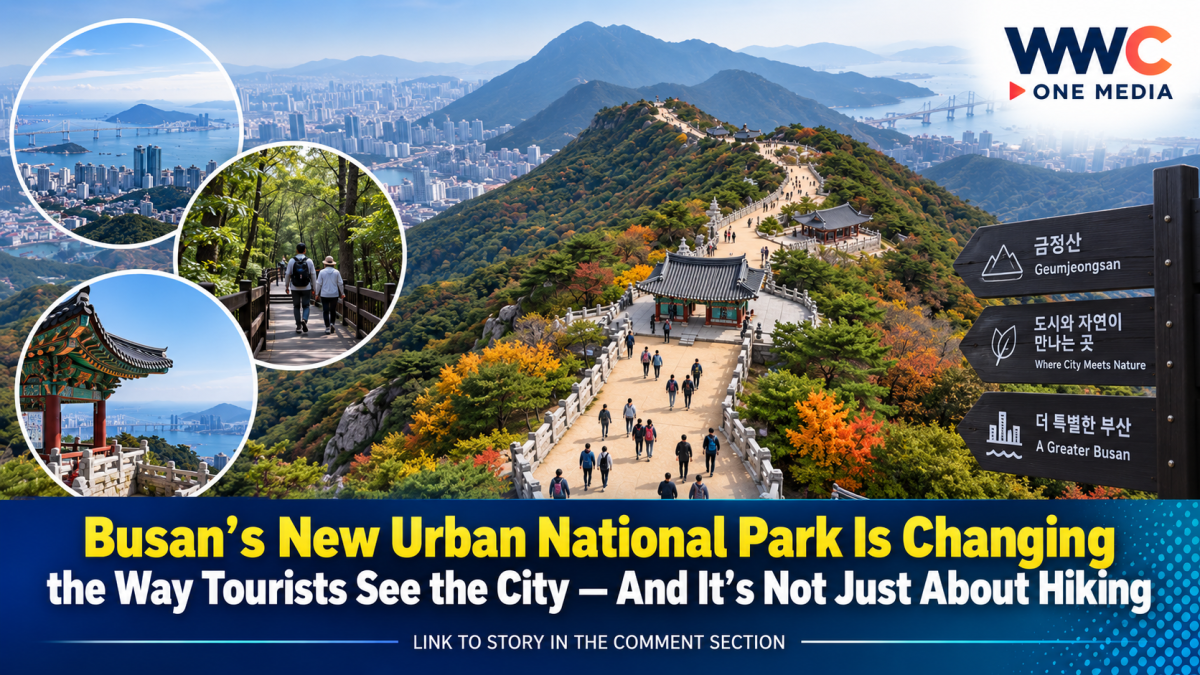
Dense forest replaces high-rise buildings. Historic Buddhist sites sit alongside mountain trails, while sections of Geumjeongsanseong Fortress run across the ridges.
From higher elevations, hikers can look across Busan, the Nakdong River estuary, the Gimhae Plain and parts of Yangsan. On descending trails, views can extend toward the skyscrapers of Haeundae and Gwangan Bridge.
It is precisely that combination — nature, history and a major city skyline — that Busan hopes will give the destination a new identity.
The mountain is attracting more than hardcore hikers
One of the most interesting aspects of the emerging destination is the diversity of people using it.
The Korea Times reported encounters with visitors from Taiwan, France and the United States, alongside Korean hikers traveling from other parts of the country.
A 66-year-old visitor from Seoul said he had known little about Mount Geumjeong before hearing about its national-park designation.
Meanwhile, younger international travelers were discovering the mountain online or incorporating it into wider trips around South Korea.
That matters for Busan.
The city isn’t simply trying to attract dedicated mountaineers.
It is attempting to turn Geumjeongsan into a multi-generational and international tourism experience.
More than 200 trails create a giant outdoor network
Geumjeongsan isn’t a single hike.
The mountain contains a network of more than 200 trails, according to The Korea Times, allowing visitors to choose different distances and starting points.
One major route runs from the fortress’s North Gate toward Godang Peak, the East Gate, Wonhyobong Peak, the Third Watchtower and the South Gate — roughly 13 kilometers.
Another route begins around the South Gate and can incorporate the cable car toward Geumgang Park before continuing on foot. Hikers can also shorten their journeys by descending at intermediate points.
That flexibility could be crucial to attracting casual travelers who aren’t looking for an all-day mountain expedition.
And then there’s Beomeosa Temple
For visitors who don’t want their trip to be only about exercise, Mount Geumjeong offers another major attraction: Beomeosa Temple.
The historic Buddhist temple sits at the foot of the mountain and provides one of the principal gateways into the hiking network.
Busan’s official tourism information describes Beomeosa as a major historic temple established during the Silla period, with important cultural properties within its grounds.
That creates an unusual tourism combination:
Subway → temple → forest → mountain → fortress → city views.
Travelers can experience several different sides of Busan without traveling far outside the metropolitan area.
One of Korea’s great fortress landscapes is part of the experience
Another major attraction is Geumjeongsanseong Fortress, whose walls follow the mountain ridges.
Busan’s official Geopark information identifies it as Korea’s largest fortress, with the present fortress dating to 1703 during the reign of King Sukjong.
The fortress isn’t simply a historical backdrop.
It has become part of the hiking experience itself.
Visitors can walk sections of the wall while moving between mountain gates and peaks, effectively turning a history lesson into an outdoor adventure.
That combination gives Geumjeongsan something many urban hiking destinations struggle to create:
a story behind the scenery.
Busan wants tourists to stay after the hike
This may be the most important part of the city’s strategy.
Busan doesn’t want visitors to climb the mountain, take a few photographs and immediately leave.
Officials are trying to connect the hiking experience to restaurants, cafes, traditional culture, hot springs and local businesses.
The city’s tourism bureau says the objective is to create connected routes so visitors spend more time in the surrounding communities rather than simply hiking and going home.
That means a future Geumjeongsan itinerary could look very different from a conventional hiking trip.
A visitor might:
Hike in the morning → eat local food → explore the fortress → experience a temple program → visit a traditional market → relax in Dongnae hot springs.
In tourism economics, that’s a much more valuable visitor.
Busan is turning hiking into a cultural experience
One example is the Soul Trail in Mount Geumjeong program.
The experience combines trekking around Beomeosa with meditation, temple food and tea.
According to The Korea Times, the program runs 20 times from July through November 2026 and includes a version designed for foreign participants. Seasonal programming changes the experience, with activities including meditation, sound-focused walking, temple food and tea.
Other programs connect foreign visitors with the mountain, temple and fortress through cultural experiences.
There is also Geumjeong Fortress Guard, a program incorporating local businesses in Sanseong Village.
The district says participation, which stood at 580 in 2019, is expected to approach 2,000 this year.
The economic goal is bigger than tourism numbers
The strategy has a simple objective:
Make visitors spend more time — and more money — outside Busan’s traditional tourist zones.
That means restaurants, cafes, markets, hot springs and cultural attractions can potentially benefit from the national park’s growing profile.
It also represents a deliberate attempt to diversify Busan’s tourism image.
For decades, the city’s international reputation has been strongly associated with the sea.
Now officials want the mountain to become a second tourism pillar.
Geumjeong District chief Yoon Il-hyun described the goal as making the Mount Geumjeong area another axis of local tourism and developing it into a new “K-Trail.”
The numbers behind the mountain are impressive
Geumjeongsan National Park covers approximately 66.9 square kilometers, spanning several Busan districts as well as Yangsan in South Gyeongsang Province.
The area is also ecologically significant.
The Korea Times reports that the park provides habitat for 1,782 wildlife species, including 14 endangered species.
Busan’s official tourism information also highlights the mountain’s extensive network of natural and cultural attractions, including Beomeosa Temple, Geumjeongsanseong Fortress and the surrounding historic landscape.
So the national-park designation isn’t simply a tourism marketing exercise.
It also places greater emphasis on conserving a substantial urban ecosystem.
Why international travelers may find it especially attractive
For foreign visitors, accessibility could be one of Geumjeongsan’s strongest selling points.
A traveler staying in central Busan can combine a morning in the city with an afternoon in the mountains without committing to a long-distance excursion.
That is particularly appealing for visitors who want something beyond the usual Busan itinerary.
Recent international travel coverage has likewise highlighted Busan’s combination of mountains, historic neighborhoods, markets and coastal attractions as part of a broader South Korean tourism experience.
Geumjeongsan adds another layer:
a national-park experience without leaving the metropolitan area.
But there’s a bigger story unfolding here
South Korea has spent years transforming elements of its traditional culture and landscapes into globally marketable experiences.
K-pop exports.
K-food.
K-dramas.
Now, increasingly, K-trails and outdoor experiences are entering that conversation.
Geumjeongsan could become a particularly interesting example because it isn’t an isolated wilderness destination.
It sits directly beside a major international city.
The visitor can move from subway station to ancient temple, from temple to forest, from forest to fortress and from fortress to a panoramic view of one of Korea’s biggest urban areas.
That’s a powerful tourism proposition.
Busan’s next tourism battle may be fought in the mountains
The city’s challenge now is to convert curiosity into repeat visitation without damaging the environment or overwhelming the communities around the mountain.
The infrastructure already gives Busan an advantage.
The park has public transportation access, historic attractions, established hiking routes, local food and cultural experiences.
The task is connecting all of them into one compelling visitor journey.
If that works, Geumjeongsan could change how international tourists think about Busan.
Not just as Korea’s seaside city.
But as a place where the city and the mountains meet.
And that may be exactly what Busan needs as it looks for its next big tourism story.




Leave a Reply