
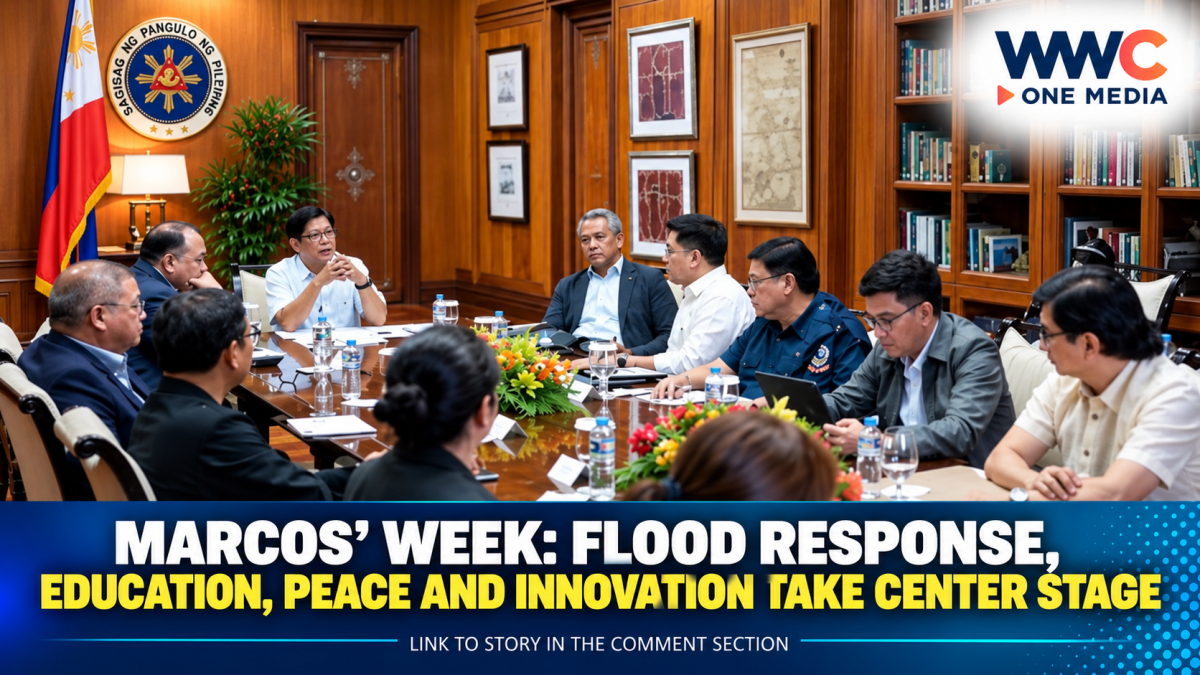
MANILA, Philippines — President Ferdinand Marcos Jr. spent the week confronting some of the country’s most urgent concerns—from worsening flooding and disrupted classes to education access, peace-building and the search for Filipino-made solutions to national problems.
The developments highlighted a broader government push to combine immediate disaster response with longer-term reforms, as Malacañang dealt with the effects of heavy rains while advancing programs in education, infrastructure, peace and innovation.
Flooding puts government response under renewed scrutiny
Flood management remained one of the most visible issues confronting the administration.
Marcos pushed government agencies and local officials to strengthen disaster preparedness and strictly enforce no-build zones, particularly in areas vulnerable to flooding. The President has also pressed for the implementation of a long-discussed flood-management infrastructure master plan as severe weather continues to expose weaknesses in drainage and flood-control systems.
The administration’s response came as flooding disrupted transportation and daily activities in parts of Luzon, including traffic problems along the North Luzon Expressway.
The Palace also announced measures intended to ease the impact on motorists affected by flooding, while government agencies continued work on flood mitigation and infrastructure repairs.
The issue is increasingly being framed not simply as an emergency-response problem but as a long-term infrastructure and climate-resilience challenge.
Schools face another disruption
Education was another major focus of the President’s week.
Following rain, flooding and haze, Marcos ordered the implementation of alternative learning modes and learning-continuity measures in affected schools to prevent weather-related disruptions from further affecting students.
The move follows a difficult period for schools across the country. Earlier reports from the Department of Education showed that 1,594 schools and 9,597 classrooms had been affected by recent storms and enhanced southwest monsoon conditions.
The administration is also seeking to modernize the rules governing class suspensions and resumptions. DepEd has said it plans to submit a proposed Executive Order revising the framework under Executive Order No. 66, with the goal of making decisions more responsive to actual local conditions.
Marcos has also called for greater climate-change education among Filipino students, arguing that young people need to understand the risks posed by increasingly severe weather events.
Billions more for public-school teachers
The administration also moved to provide additional funding for the expanded career progression program for public-school teachers.
The government announced the release of P8.68 billion to support the career progression initiative, including salary-related requirements arising from the reclassification of positions. The measure is expected to affect more than 93,000 public-school teachers.
The move comes as education remains one of the administration’s central priorities, with Marcos repeatedly emphasizing the need to improve both access and quality.
Free higher education gets another boost
On Friday, Marcos signed amendments to the Universal Access to Quality Tertiary Education Act, expanding the government’s support for Filipino students pursuing college and technical-vocational education.
According to the Palace, the number of beneficiaries of free higher education has increased from about 2 million to 2.6 million students in the first semester of the current academic year.
The President also highlighted the expansion of scholarship programs and government support for students pursuing priority degree programs and technical-vocational courses.
For the administration, the objective is not simply to get more young Filipinos into college or training programs but to help them finish their education and enter the workforce with stronger skills.
Peace takes center stage in September
The week also marked the opening of the 2026 National Peace Consciousness Month, with Marcos urging Filipinos to protect and strengthen the country’s peace gains.
The observance coincides with significant anniversaries in the country’s peace process, including the 30th anniversary of the 1996 Government of the Philippines-Moro National Liberation Front Final Peace Agreement and the 40th anniversary of the 1986 Mount Data Peace Accord involving the government and Cordillera peace groups.
Marcos stressed that peace requires continuous participation and responsibility, particularly as the government works to preserve stability and translate peace gains into development.
The President has separately assured the Bangsamoro people that the government will work to ensure that the upcoming BARMM parliamentary elections on September 14 are safe and credible.
The Cordillera peace agenda was likewise highlighted during the President’s engagements this week, with Marcos pledging continued support for the region’s push for autonomy and development.
Filipino innovators asked to solve real-world problems
Innovation was another major theme.
On September 3, Marcos honored five winners of the 2026 Presidential Filipinnovation Awards, recognizing Filipino-developed technologies and products addressing problems ranging from food security and energy access to flooding, waste management and medical care.
Among the recognized innovations were technologies involving biodiesel production, native chicken development, renewable energy for off-grid communities, waste disposal and a prototype medical ventilator.
Marcos urged Filipino innovators to work more closely with government, industry and investors so that promising ideas can move beyond laboratories and become practical solutions for communities.
The bigger picture
Taken together, the week’s developments show an administration trying to address immediate problems while simultaneously building longer-term programs.
Flooding forced the government to focus on preparedness and infrastructure. Weather disruptions pushed education officials to rethink how schools respond to emergencies. Education reforms expanded financial support for students while additional funding was provided for teachers.
At the same time, the administration placed renewed emphasis on peace-building and encouraged Filipino innovators to develop technologies capable of addressing some of the country’s most persistent problems.
The government’s challenge now is implementation.
Flood-control plans must translate into projects that actually protect communities. Education funding must result in better learning outcomes and fewer disruptions. Peace agreements must continue producing tangible benefits, while innovations must find pathways from awards and prototypes into widespread public use.
For Filipinos watching the administration’s next moves, the question is no longer simply what policies were announced this week—but which of them will deliver measurable results on the ground.



Leave a Reply