
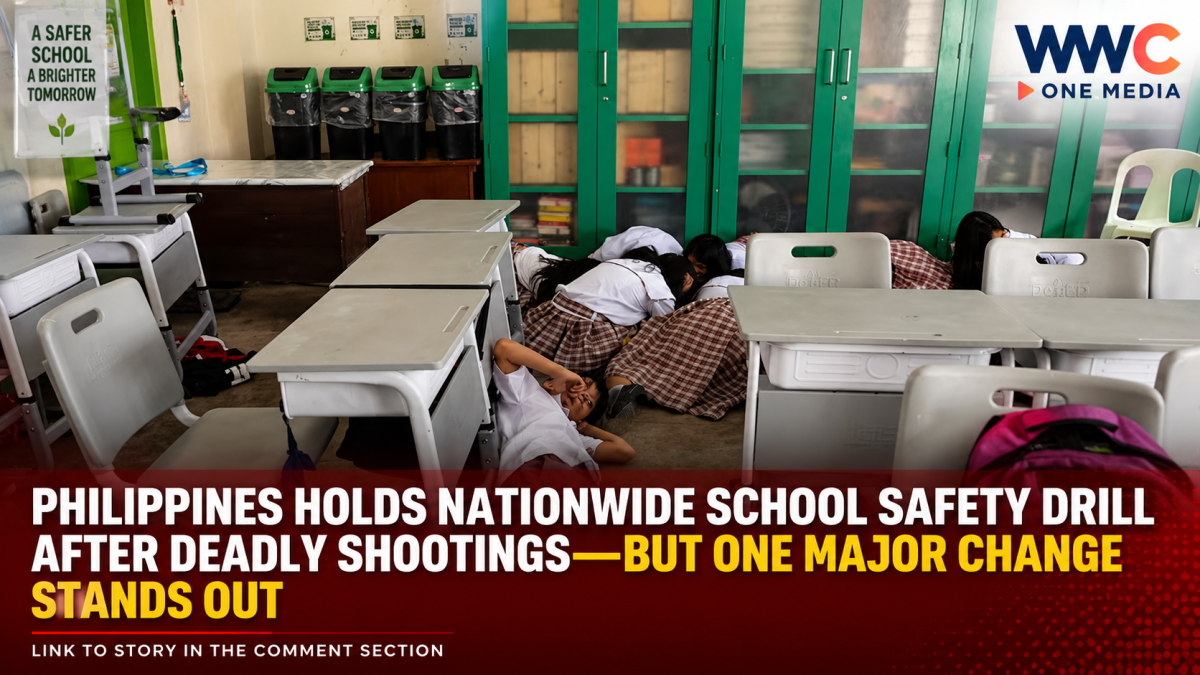
MANILA, Philippines — Philippine schools have carried out a nationwide safety exercise following a string of deadly school shootings, with authorities focusing on preparedness, rapid coordination and protecting students without exposing them to unnecessarily traumatic simulations.
The Department of Education (DepEd) conducted the National Simultaneous School Safety Drill on September 3, bringing schools and emergency-response agencies together to rehearse how they would respond to an armed-threat or other human-induced emergency.
At Carlos F. Gonzales High School in San Rafael, Bulacan, thousands of students participated in a lockdown exercise. When the warning alarm sounded, students and teachers practiced securing classrooms, barricading doors, closing windows and curtains, turning off lights and moving away from exposed areas.
GMA News reported that about 3,500 students at the Bulacan school participated in the exercise. Police and medical responders also took part, testing how authorities and school personnel could coordinate during an emergency.
But unlike an earlier exercise staged in July, the September drill did not feature a mock attacker, weapons or a realistic shooting reenactment.
DepEd changed the format after medical and psychiatric groups warned that highly realistic simulations could cause psychological distress among children.
Education Undersecretary Malcolm Garma said the new approach centered on an alarm-triggered safety response rather than acting out an attack. The agency described the exercise as a school safety drill, rather than an active-shooter reenactment.
From lockdown to reunification
The exercise was designed to go beyond simply teaching students to hide.
Schools also practiced emergency communication, police coordination, evacuation procedures, headcounts, first aid and the eventual reunification of students with their parents.
The reunification component is particularly significant because DepEd identified confusion over where students and parents should go after a real emergency as one of the lessons emerging from the June shooting in Tacloban City.
Under the revised protocol, students, parents, responders and medical personnel are expected to converge at designated locations rather than leaving families to search for one another immediately after an incident.
Reuters reported that the Bulacan exercise included a broader emergency-response sequence involving police coordination, lockdowns, evacuation, headcounts, first aid for simulated casualties and psychosocial support.
The shootings that triggered the response
The nationwide initiative follows two major school shooting incidents in the Philippines this year.
On June 22, a shooting at a high school in Tacloban City killed three students and wounded others. The incident prompted renewed scrutiny of security procedures inside schools and how authorities respond after violence occurs.
Then, on August 18, a separate shooting at a high school in Zamboanga City left a student dead. Authorities said the alleged gunman, also a student, subsequently died by suicide. The incident became another catalyst for the nationwide safety initiative.
Associated Press reported that the Philippine exercise also came amid renewed concern over school gun violence elsewhere in Southeast Asia, including deadly incidents in Thailand involving young perpetrators.
Why DepEd changed the drill
The original nationwide exercise was scheduled for August 25 but was postponed.
DepEd said the additional time was needed to incorporate recommendations concerning weather preparedness, child protection and psychosocial support. Mental-health organizations had also raised concerns about exposing children to hyper-realistic violence during school exercises.
The revised drill therefore prohibited elements such as:
- Mock attackers or active-aggressor role players
- Real or simulated weapons
- Graphic depictions of violence
- Simulated gunfire
- Artificial casualties designed to make the scenario highly realistic
- Other fear-inducing elements
Instead, students were oriented on what to do when a warning is issued and practiced securing themselves in classrooms and following established emergency procedures.
DepEd Secretary Sonny Angara said the objective was to build “calm operational confidence” rather than fear, emphasizing that physical security and students’ psychological well-being should be treated as connected priorities.
Police and local governments join the response
The exercise was not limited to DepEd.
The Philippine National Police (PNP), local government units, the Office of Civil Defense, Bureau of Fire Protection and local disaster-response offices participated in various parts of the exercise.
Authorities tested emergency notification and dispatch procedures, perimeter security and coordination between schools and first responders.
The revised protocol also incorporates the Run-Hide-Fight concept for active-threat situations, although DepEd’s implementation emphasizes age-appropriate orientation and avoiding unnecessary exposure to frightening simulations.
A key component is the use of the country’s Unified 911 emergency system, which DepEd said can connect school officials with the appropriate police response.
A new reality for Philippine schools?
School shootings remain relatively uncommon in the Philippines, but the incidents in Tacloban and Zamboanga have forced schools and government agencies to reconsider how prepared campuses are for human-induced emergencies.
GMA News previously reported that the country has tens of thousands of public and private schools, making permanent police coverage at every campus impractical. That has increased the importance of school-level preparedness, rapid reporting and coordinated emergency procedures.
The September exercise is therefore being treated not simply as a one-day event but as part of a longer effort to develop institutional “muscle memory.”
DepEd has indicated that additional safety exercises could follow as officials refine the protocol with mental-health and child-protection experts.
For Philippine students and parents, the biggest takeaway may be this: preparedness is becoming part of everyday school safety—but authorities are now trying to make sure that learning how to respond to violence does not itself become a source of trauma.
WWC ONE MEDIA J.M.S



Leave a Reply