
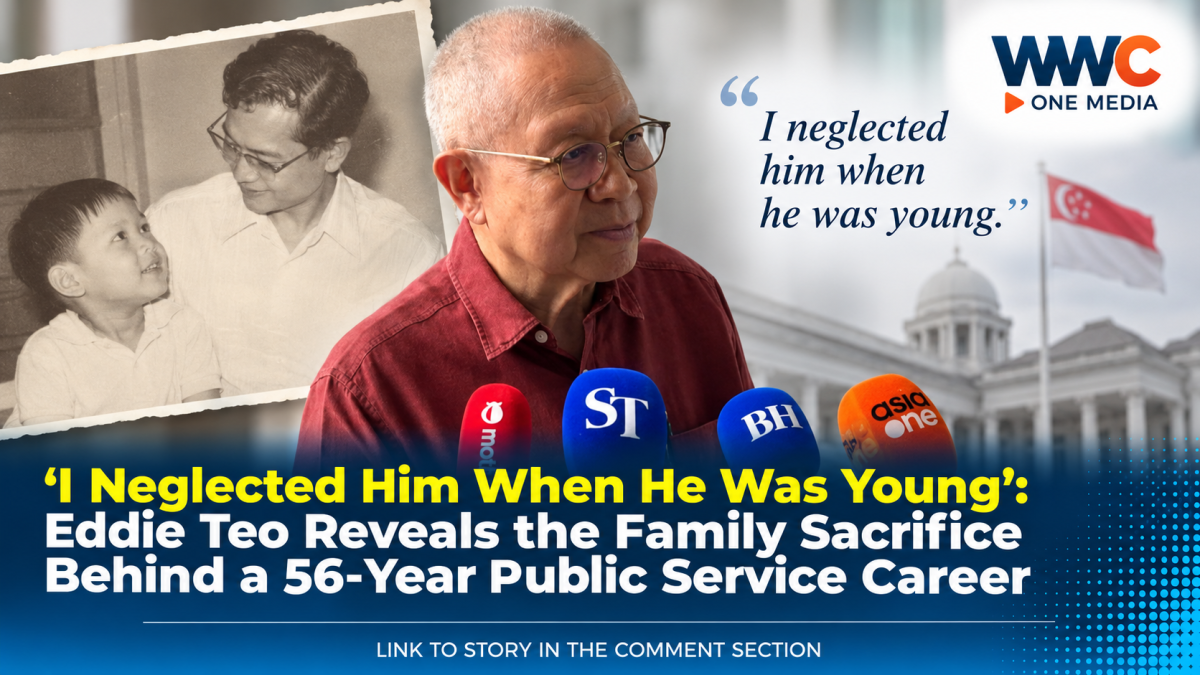
SINGAPORE — September 5, 2026 — Behind decades of confidential intelligence work and some of Singapore’s most senior public-service positions was a sacrifice that former Security and Intelligence Division (SID) director Eddie Teo says he still thinks about: time with his family.
In an interview with the media on Aug. 13, Teo reflected candidly on the personal cost of a career that began in Singapore’s external intelligence service in 1970 and eventually took him to some of the country’s highest public-service positions.
Recalling a tribute written by his son John Teo after he received Singapore’s Order of Temasek (With Distinction) this year, the former intelligence chief admitted: “I was very touched by that because I know I neglected him when he was young.”
Teo said he did not spend as much time with his son as he should have.
“But that’s life. You choose what you do, and you can’t go back and change things, so I try to make up for it now by spending more time with family,” he said.
The unusually personal reflection offers a rare glimpse into the human side of a career largely conducted away from public view.
A career built behind the scenes
Teo joined the Ministry of Defence’s Security and Intelligence Division in 1970 and became its director in 1979, a position he held until 1994.
According to MINDEF, he was the longest-serving director of SID.
The agency itself was established in 1966 as a small intelligence unit within the then-Ministry of Interior and Defence. It later became known as the Security and Intelligence Division and developed into Singapore’s external intelligence agency.
Teo’s responsibilities eventually extended well beyond intelligence.
After leaving SID, he served as Permanent Secretary for Defence, Permanent Secretary in the Prime Minister’s Office, Singapore’s High Commissioner to Australia and chairman of the Public Service Commission.
He later became chairman of the Council of Presidential Advisers, a position he held until June 1, 2026.
Altogether, Teo has described his career as 56 years of public service.
‘Your weekend is gone’
Teo recalled a period when working in Singapore’s top intelligence circles meant being constantly available.
Among the most demanding figures he encountered was founding prime minister Lee Kuan Yew, who, according to Teo, could continue working deep into the night and make calls to intelligence officials outside normal working hours.
Teo recalled receiving calls from Lee around midnight and being assigned operations on Fridays or Saturdays.
“So your weekend is gone,” he said.
Despite the demands, Teo said he never seriously considered leaving public service.
He described the opportunity to work with Lee and former deputy prime minister Goh Keng Swee as a privilege and said their example shaped his own approach to public service.
Working with Lee Kuan Yew came with extraordinary responsibility
One of the unusual privileges of Teo’s SID career was facilitating meetings between Singapore’s political leadership and foreign intelligence counterparts.
He recalled that many foreign counterparts wanted to meet Lee Kuan Yew.
But Teo said he could not simply arrange meetings for everyone who requested one.
“If I do that, I’ll lose my job,” he joked.
According to Teo, Lee was interested particularly in people whom Singapore could learn from, educate or otherwise benefit from engaging.
The meetings therefore went beyond ceremonial diplomacy. They could also serve as opportunities for Singapore’s leaders to exchange perspectives with influential figures from other countries.
S R Nathan was another major influence
Teo also spoke about the late former president S R Nathan, who had previously served as SID director.
When Teo took over the organisation in 1979, Nathan had been his predecessor — and Teo acknowledged that he had “very big shoes to fill.”
Nathan was not simply a former boss. Teo described him as an important mentor whose support remained significant throughout his career.
Teo also reflected on one decision he later came to reconsider: during his tenure, SID officers were generally not publicly recognised with National Day awards because of security concerns.
He said later directors changed that approach, allowing deserving SID officers to receive public recognition.
“I owe S R Nathan a lot,” Teo said.
The threats Singapore faced have changed
When Teo joined SID, the security environment was markedly different from today.
He recalled dealing with the Communist Party of Malaya and monitoring racial politics in the aftermath of the 1969 race riots.
But Teo said he also anticipated that Islamic terrorism would become a growing threat and established a small group within SID to study the issue.
Today, the intelligence landscape has expanded considerably.
MINDEF says SID’s work now encompasses challenges ranging from geopolitical developments and terrorism to emerging concerns such as supply-chain resilience and energy security.
The agency’s core mission, however, remains unchanged: providing policymakers with intelligence assessments that are objective, accurate and grounded in facts.
Teo stressed that intelligence should inform policy rather than be manipulated to justify it.
“We must never twist or change our assessments to fit policy,” he said.
Why SID is becoming more visible
The timing of Teo’s reflections is significant.
SID is marking its 60th anniversary in 2026, and the agency has recently taken an unusual step for such a secretive organisation: increasing its public visibility.
On Sept. 4, Prime Minister Lawrence Wong attended a closed-door commemoration marking six decades of SID’s work.
MINDEF described SID as a key national security agency that provides critical intelligence and assessments to Singapore’s political leadership and government.
SID has also launched an official website and LinkedIn presence to help attract Singaporeans with expertise in areas including analysis, technology, operations, international partnerships and corporate functions.
PM Wong said the agency now operates in an environment where security, economics and technology are increasingly intertwined.
Trade, investment, supply chains and access to technology can all have strategic implications, he noted.
‘The most fundamental factor’ is people
For Wong, technology alone cannot guarantee SID’s effectiveness.
He said the most fundamental factor behind the agency’s success is its people.
The Prime Minister said SID needs officers with sharp minds, sound judgment, deep expertise and a strong sense of mission, while also requiring integrity, courage and resilience.
Because much of SID’s work cannot be publicly recognised, officers must also be prepared to serve without public attention or acclaim.
That theme closely echoes Teo’s own reflections.
His career was built largely in an organisation whose work is deliberately kept away from public view.
Singapore’s highest civilian honour
Teo’s reflections come only weeks after he received the Order of Temasek (With Distinction), one of Singapore’s highest civilian honours.
The award was conferred on Aug. 9, 2026, and Teo received it alongside Chief Justice Sundaresh Menon.
The Prime Minister’s Office lists Teo as a recipient of the Order of Temasek (With Distinction) for 2026.
At the time, Teo said the recognition meant a great deal to him after 56 years of public service.
He also acknowledged that a government career may not make someone as wealthy as a successful career in the private sector — but argued that public service could still be deeply worthwhile and interesting.
Now, a different chapter begins
After decades of responsibility, Teo said retirement feels different.
He stepped down as chairman of the Council of Presidential Advisers on June 1, 2026.
In his interview, he joked that his wife now expects him to travel with her around the world.
After 56 years, he said, it was good to feel that the weight of responsibility had finally been lifted from his shoulders.
“I am now free,” he said.
For a man whose professional life revolved around national security, intelligence and confidential decision-making, retirement may therefore represent something his career rarely allowed him to have: time.
And perhaps that is why his most revealing reflection was not about intelligence operations, political leaders or national security.
It was about his son.
After spending decades protecting Singapore largely out of public view, Teo acknowledged that one of the costs of that mission was time he could never get back.
Now, he says, he is trying to make up for it.
WWC ONE MEDIA J.M.D


Leave a Reply