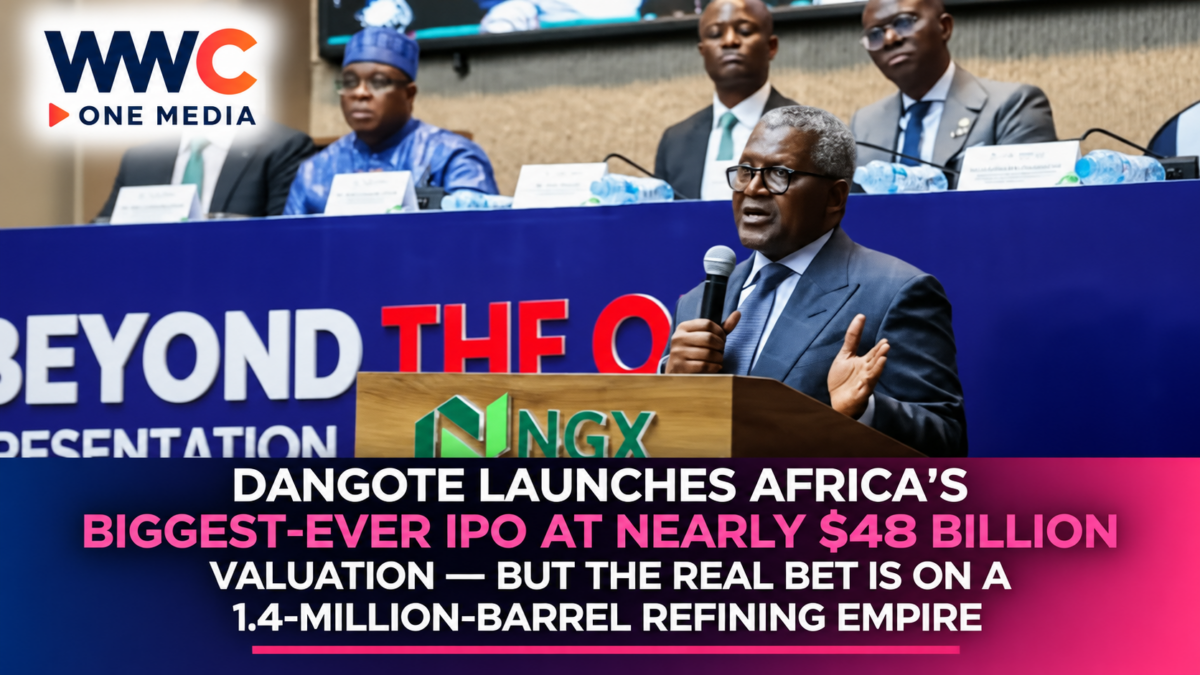
LAGOS — Africa’s richest man is asking ordinary investors to buy into one of the continent’s most ambitious industrial bets: a $20 billion Nigerian refinery that has already transformed regional fuel markets and could become the world’s largest refinery if its planned expansion succeeds.
Dangote Petroleum Refinery and Petrochemicals has launched what is expected to become:
Africa’s biggest initial public offering ever.
The offer involves:
4.1 billion new shares
priced at:
₦525 each.
If fully subscribed, the refinery will raise approximately:
₦2.15 trillion
or about:
$1.6 billion.
The implied company valuation is roughly:
₦63 trillion
or:
$47.6 billion.
That means investors are being asked to value the refinery at more than twice the roughly:
$20 billion
it cost to build.
And Aliko Dangote is betting that millions of Africans will want a piece of it.
DANGOTE WANTS 10 MILLION RETAIL INVESTORS
The most extraordinary target may not be the valuation.
It is the number of shareholders.
Dangote Petroleum Refinery CEO:
David Bird
said the company wants to attract as many as:
10 million retail investors.
That would exceed the approximately:
4.5 million retail subscribers
who participated in Saudi Aramco’s landmark 2019 IPO.
If Dangote reaches that target, this will not simply be Africa’s biggest IPO.
It could become one of the largest mass-market shareholder drives ever attempted.
The company has deliberately marketed the offering as:
“The IPO for the People.”
YOU CAN BUY IN WITH JUST 10 SHARES
The minimum subscription is:
10 shares.
At ₦525 per share, that means an investor can participate with:
₦5,250.
That relatively low entry point is intentional.
Dangote wants the IPO to extend beyond:
Pension funds
Banks
and
Institutional investors.
The company is targeting ordinary households and first-time stock-market investors.
Applications can be made through approved digital investment platforms, banks and brokers.
Nigeria’s SEC has warned investors to use only official subscription channels because scammers have already tried to exploit public interest surrounding the offering.
THE OFFER CLOSES OCTOBER 13
The IPO opened on:
September 14, 2026.
It is scheduled to close on:
October 13.
Shares are expected to begin trading on the:
Nigerian Exchange
in late November.
If the flotation reaches its intended valuation, the refinery could become one of the largest listed companies in Africa almost immediately.
Some estimates suggest it could account for an enormous share of the Nigerian stock market’s capitalization.
That alone could change the international profile of the Lagos exchange.
THIS IS NOT A STARTUP ASKING INVESTORS TO FUND A DREAM
Unlike many high-profile IPOs, Dangote Refinery is already operating.
The refinery has reached its current capacity of approximately:
700,000 barrels per day.
It processes crude into products including:
Gasoline
Diesel
Jet fuel
Naphtha
and other petroleum products.
That makes the IPO fundamentally different from an early-stage infrastructure project.
Investors are buying into an operating industrial asset.
The question is whether the valuation already assumes too much future success.
THE REFINERY MADE $1.82 BILLION IN SIX MONTHS
Financial performance provides part of the bullish argument.
Dangote Refinery recorded more than:
$13 billion in revenue
during the first half of 2026.
Net profit was approximately:
$1.82 billion.
That represented a major turnaround from earlier periods when the refinery was still ramping production and carrying heavy startup costs.
Those numbers help explain why Dangote believes the business can support a valuation approaching:
$50 billion.
But investors are paying largely for what comes next.
DANGOTE WANTS TO DOUBLE CAPACITY
The long-term target is:
1.4 million barrels per day.
Management wants to achieve that level by around:
the first quarter of 2029.
If successful, the expanded refinery could become:
the largest single-site refinery in the world.
It would surpass major global facilities including Reliance Industries’ enormous:
Jamnagar complex in India.
That is the real strategic bet behind the IPO.
Dangote is trying to build a refining operation with global scale from Africa.
THE EXPANSION COULD COST MORE THAN $14 BILLION
Reuters Breakingviews estimates the expansion program at approximately:
$14.3 billion.
The $1.6 billion public offering will therefore cover only part of the required capital.
Dangote will need a combination of:
Operating cash flow
Debt
Future equity offerings
and potentially
International capital markets
to complete the project.
That makes the IPO less an endpoint than the beginning of another large fundraising cycle.
DANGOTE ALREADY RAISED $2.5 BILLION BEFORE THE IPO
The company also raised approximately:
$2.5 billion
through a private placement earlier this year.
Participants included large institutional investors such as:
Africa Finance Corporation.
That gave professional investors exposure before the public offering.
Combined with the IPO, Dangote could raise more than:
$4 billion
in equity financing around the refinery.
But the expansion still requires billions more.
THE REFINERY HAS ALREADY CHANGED NIGERIA’S FUEL ECONOMY
For decades, Nigeria lived with one of the strangest contradictions in global energy.
It was:
one of Africa’s largest crude-oil producers
while simultaneously importing large amounts of:
gasoline
diesel
and
jet fuel.
Nigeria exported crude.
Foreign refineries processed it.
Then Nigeria imported expensive refined products back into the country.
Dangote Refinery was designed to break that cycle.
NIGERIA HAS MOVED FROM IMPORTER TOWARD EXPORTER
As production ramped up, Nigeria reduced its dependence on imported refined fuels.
Dangote has also begun exporting products beyond Nigeria.
Its fuel has reached markets in:
Africa
Europe
and other regions.
That means Nigeria is increasingly exporting:
higher-value refined products
rather than simply shipping crude abroad.
Economically, that matters.
Refining can create:
Industrial jobs
Tax revenue
Foreign-exchange earnings
and
Domestic supply security.
EUROPE IS ALREADY BUYING DANGOTE JET FUEL
The refinery has emerged as an important exporter of:
jet fuel.
Reuters Breakingviews notes that Dangote became Europe’s largest source of jet fuel imports for several consecutive months.
That is an extraordinary shift.
A refinery outside Lagos is now competing directly with:
Middle Eastern
European
and
Asian refiners
for international fuel markets.
Recent global refining shortages have made that particularly profitable.
THE IRAN CRISIS HAS MADE REFINING EVEN MORE VALUABLE
Global energy disruption has strengthened the economics.
Conflict involving Iran and disruptions around the:
Strait of Hormuz
have tightened supplies of refined fuels.
Diesel and jet-fuel margins have risen.
That benefits large export-oriented refiners.
Dangote’s timing therefore looks unusually favorable.
But this is also one of the biggest risks in the valuation.
Today’s unusually high refining margins may not last forever.
REFINERIES ARE CYCLICAL BUSINESSES
A refinery does not earn the same profit every year.
Its profitability depends on the difference between:
crude-oil costs
and
the selling price of refined products.
That difference is known as the:
refining margin.
When gasoline, diesel and jet fuel are scarce, margins can surge.
When refining capacity is abundant and demand weakens, margins can collapse.
Dangote investors therefore are not buying a predictable utility.
They are buying a cyclical commodity-processing business.
AND THE IPO VALUATION IS NOT CHEAP
Reuters Breakingviews estimates the offer values the company at approximately:
8.3 times projected 2026 EBITDA.
That is above the valuation multiples of some established U.S. refiners such as:
Valero
and
Phillips 66.
Why would Dangote command a premium?
The bullish case rests on:
Higher growth
Lower operating costs
Regional scarcity of refining capacity
and
The planned doubling of production.
But a premium valuation creates a higher bar for execution.
INVESTORS ARE EFFECTIVELY PAYING FOR THE 2029 REFINERY TODAY
At nearly:
$48 billion,
the IPO price reflects more than the refinery’s current output.
Investors are effectively being asked to assign significant value to the future:
1.4-million-barrel-per-day facility.
That means delays could hurt.
So could:
Cost overruns
Lower refining margins
Crude shortages
or
Operational disruptions.
The expansion needs to arrive broadly on schedule for the valuation thesis to work.
DANGOTE CAN PROCESS DOZENS OF DIFFERENT CRUDES
One competitive advantage is flexibility.
The refinery can process around:
36 different crude grades.
That allows it to buy oil from multiple suppliers depending on:
Price
Availability
and
Quality.
That flexibility is important because Nigeria has struggled at times with domestic crude availability.
Dangote has imported crude from countries including the United States when local supply was insufficient.
The ability to switch feedstocks lowers supply risk.
BUT NIGERIAN CRUDE SUPPLY REMAINS A POLITICAL ISSUE
The refinery’s relationship with Nigeria’s oil industry has not always been smooth.
Dangote executives have previously criticized difficulties obtaining enough domestic crude.
Nigeria’s government wants local refineries to receive enough oil to reduce fuel imports.
Oil producers, meanwhile, have commercial incentives to sell where they receive the best terms.
That creates tension.
A refinery twice today’s size would require:
far more crude feedstock.
Securing it economically will be crucial.
FOREIGN EXCHANGE IS ANOTHER RISK
Nigeria has experienced years of:
currency volatility
and
foreign-exchange shortages.
A refinery buying crude in dollars but earning some revenue in naira can face significant currency risk.
Export sales help.
Selling fuel internationally produces:
hard-currency revenue.
But exchange-rate movements can still affect:
Debt servicing
Input costs
and
Investor returns.
For foreign shareholders, the naira itself is part of the investment thesis.
THIS IPO COULD TRANSFORM NIGERIA’S STOCK MARKET
The transaction is important far beyond Dangote.
Nigeria has one of Africa’s largest economies.
But its public equity market remains relatively small compared with the country’s population and economic potential.
A major, profitable industrial company coming to market could attract:
New retail investors
Foreign institutions
and
Pension capital.
It could also encourage other large privately owned Nigerian businesses to list.
That is why the IPO matters to the wider African capital-market story.
KENYAN INVESTORS CAN NOW PARTICIPATE
The IPO is also becoming increasingly pan-African.
Kenya’s Capital Markets Authority has approved a mechanism allowing eligible Kenyan investors to participate through:
global depositary receipts.
That means investors in East Africa can gain exposure to the Nigerian refinery without directly navigating Nigeria’s domestic market infrastructure.
UGANDA HAS ALSO OPENED THE DOOR
Uganda’s Capital Markets Authority has likewise approved domestic participation.
That expands the offering beyond Nigeria.
Dangote increasingly wants the refinery to become something resembling:
an African-owned multinational industrial champion.
The 10-million-investor target makes much more sense when viewed through that lens.
This is not being marketed simply as:
a Nigerian oil stock.
It is being marketed as:
African industrial ownership.
THE ARAMCO COMPARISON IS DELIBERATE
Saudi Aramco’s 2019 IPO became one of the most famous listings in history.
It attracted roughly:
4.5 million retail investors.
Dangote wants:
10 million.
Of course, the two companies are very different.
Aramco controls enormous oil reserves and produces crude.
Dangote primarily:
refines crude into fuels and petrochemicals.
Aramco is also vastly larger.
But Dangote is using Aramco as the benchmark for something else:
mass public participation.
THE IPO COULD CREATE MILLIONS OF FIRST-TIME SHAREHOLDERS
This may be one of the offering’s most important long-term consequences.
Many Africans hold wealth primarily through:
Cash
Property
Small businesses
and
Bank deposits.
Equity ownership remains relatively low.
If millions of people participate in a highly visible IPO through mobile investing platforms, they may remain capital-market participants afterward.
That could deepen African equity markets.
It could also expand the customer base for:
Brokers
Fintech apps
Asset managers
and
Pension products.
DIGITAL INVESTING PLATFORMS ARE CENTRAL TO THE OFFER
Nigeria’s fintech ecosystem allows investors to subscribe digitally.
That is a major difference from African IPOs a generation ago.
An investor no longer necessarily needs to visit a physical broker’s office.
They can participate through approved electronic platforms.
Demand was reportedly strong enough to overwhelm some digital investment services when the offer launched.
That demonstrates both the opportunity and the infrastructure challenge.
THE SEC IS ALREADY WARNING ABOUT SCAMS
The level of public interest has also attracted fraud.
Nigeria’s Securities and Exchange Commission warned the public against:
Fake websites
WhatsApp solicitations
Unofficial payment requests
and
Promises of guaranteed allocations.
Investors were told to use only:
SEC-approved receiving agents
and
Official application channels.
A retail IPO targeting millions of first-time investors naturally creates opportunities for scammers.
Investor protection will therefore be an important test.
DANGOTE WILL STILL CONTROL THE COMPANY
Calling it a:
“People’s IPO”
does not mean control is changing hands.
AP reports Aliko Dangote and related interests are expected to retain about:
87% ownership
after the offering.
That means public investors will own only a minority stake.
Dangote will remain firmly in control.
For investors, that creates both advantages and risks.
His track record built the refinery.
But minority shareholders will have limited ability to influence strategic decisions.
CORPORATE GOVERNANCE WILL MATTER MORE AFTER THE LISTING
Once public shareholders arrive, expectations change.
Investors will demand:
Transparent financial statements
Clear dividend policies
Related-party transaction disclosure
Board independence
and
Predictable capital allocation.
A private industrial empire can make decisions differently from a large listed company.
The IPO therefore represents not only a financing transition.
It is also a governance transition.
DIVIDENDS COULD BE A MAJOR ATTRACTION
Dangote has signaled that the refinery wants to become an attractive dividend-paying company.
Reports around the offering have discussed the possibility of distributions linked to:
U.S.-dollar earnings.
That could be particularly attractive to Nigerian investors worried about:
Naira depreciation.
But dividends depend on:
Profitability
Debt requirements
and
Expansion spending.
A company spending more than $14 billion to double capacity may need to retain large amounts of cash.
Investors should not assume high dividends automatically.
THE NEXT STOP COULD BE NEW YORK
Dangote has already outlined another ambition.
After the refinery completes its planned expansion, he wants to pursue an international listing.
The likely destination:
New York.
Dangote said a U.S. listing could follow once the refinery reaches approximately:
1.4 million barrels per day.
That puts a potential international flotation around:
2029 or later.
A NEW YORK LISTING WOULD CHANGE THE COMPANY AGAIN
A U.S. listing could provide access to:
Dollar-based institutional capital
Global energy funds
Major index investors
and
Much deeper liquidity.
But it would also bring:
Stricter disclosure
Greater analyst scrutiny
and
Higher corporate-governance expectations.
Dangote appears to believe scale will make those trade-offs worthwhile.
AFRICAN COMPANIES HAVE STRUGGLED IN NEW YORK BEFORE
The record is mixed.
Companies marketed as African growth stories have not always performed well after U.S. listings.
Jumia is one prominent example.
Its shares initially soared after the 2019 IPO before losing much of their value.
Dangote’s argument is different.
He is not selling:
a technology growth story.
He is selling:
physical refining capacity
generating billions in revenue.
Whether U.S. investors value that distinction remains to be seen.
DANGOTE IS ALSO BUILDING ANOTHER REFINERY IN KENYA
The African strategy extends beyond Nigeria.
Dangote is pursuing a second refinery near:
Lamu, Kenya.
The planned facility could process around:
700,000 barrels per day.
Reuters reported Dangote intends to finance it using a combination of:
Internal cash
Bonds
and
Another IPO.
The project has an estimated cost around:
$15 billion to $16 billion.
THE KENYA PROJECT IS ALREADY FACING OPPOSITION
The project is controversial.
A consumer-rights group has mounted a legal challenge over:
Transparency
and
Disclosure.
Local communities and environmental groups have also raised concerns about the proposed site’s proximity to:
Lamu’s sensitive coastal ecosystem.
The dispute demonstrates an important reality.
Africa urgently wants more refining and infrastructure.
But huge industrial projects still face:
Environmental
Social
and
Governance challenges.
IF BOTH REFINERIES SUCCEED, AFRICA’S FUEL MAP COULD CHANGE
Imagine:
1.4 million barrels per day in Nigeria
plus
700,000 barrels per day in Kenya.
That would create more than:
2 million barrels per day
of refining capacity controlled by Dangote across West and East Africa.
Africa currently imports large quantities of refined petroleum despite producing significant crude oil.
New local refining capacity could redirect billions of dollars of that trade inside the continent.
That would be economically significant.
AFRICA HAS LONG EXPORTED RAW MATERIALS AND IMPORTED FINISHED PRODUCTS
This is the structural issue behind the entire Dangote strategy.
African countries export:
Crude oil
Copper
Cocoa
Lithium
and
Other raw materials.
They frequently import higher-value products made from those same resources.
That means much of the:
Processing
Industrial employment
and
Profit
occurs elsewhere.
Dangote Refinery represents an attempt to move more of that value chain onto the continent.
IT IS INDUSTRIAL POLICY WITHOUT BEING STATE-OWNED
Many large refining projects historically were built by governments.
Dangote’s project is different.
It is privately controlled.
But its economic significance resembles a national industrial-policy project.
Nigeria gains:
Refining capacity
Fuel security
Industrial employment
and
Potential export earnings
without the state directly owning the facility.
That model could influence future infrastructure projects across Africa.
BUT MARKET POWER IS A REAL CONCERN
There is another side.
A refinery of this size can become extraordinarily powerful inside a domestic fuel market.
Critics of Dangote have long raised concerns about:
Market concentration
and
Political influence.
Dangote rejects claims that his businesses improperly rely on monopoly power.
The refinery argues that its scale lowers costs and allows Nigeria to compete internationally.
Public listing may help by increasing:
Transparency
and
External shareholder scrutiny.
But competition policy will remain important.
BIGGER IS NOT AUTOMATICALLY BETTER
The planned capacity expansion offers clear economies of scale.
But it also creates concentration risk.
If one refinery supplies an enormous share of a region’s fuel, an outage can have widespread effects.
That means governments will need to balance:
Industrial efficiency
with
Energy security.
Multiple suppliers and storage systems will still matter.
THE IPO ARRIVES AT AN UNUSUALLY FAVORABLE MOMENT
Timing matters.
Global refining markets are tight.
Fuel prices are elevated.
Nigeria is reducing its reliance on imports.
Dangote is generating meaningful profit.
Oil-market disruption has raised the strategic value of refining.
And African retail investors are increasingly able to buy shares digitally.
Few of those conditions existed when construction began roughly a decade ago.
The IPO is arriving when the story looks strongest.
AND THAT MAY ALSO BE THE RISK
IPOs often happen when conditions are attractive to the seller.
Investors need to ask whether the current environment represents:
normal earnings
or
peak earnings.
If diesel and jet-fuel margins normalize, profits could fall.
If oil prices decline sharply, product prices may weaken.
If global recession reduces transport demand, refining margins could shrink.
Paying a premium multiple during unusually favorable conditions increases risk.
THE $48 BILLION QUESTION IS WHETHER THE SCARCITY PREMIUM LASTS
The investment case depends partly on scarcity.
Africa lacks sufficient modern refining capacity.
Europe has also lost refining capacity.
Global disruptions have increased the value of large efficient plants.
Dangote is charging investors for that scarcity.
But markets respond to high profits.
Competitors eventually invest.
Existing refineries expand.
Demand changes.
The premium can disappear.
That is why the $47.6 billion valuation deserves close attention.
THE BIGGER STORY: THIS IPO IS NOT REALLY JUST ABOUT AN OIL REFINERY
Dangote’s offering is important because several major African economic questions converge in one company.
Can Africa finance its biggest industrial projects through:
African capital markets?
Can millions of ordinary people become shareholders in infrastructure once owned only by billionaires and institutions?
Can Nigeria move from exporting:
raw crude
to exporting:
higher-value fuels?
Can African stock exchanges attract companies big enough to compete for global investor attention?
And can a locally built industrial group eventually become credible enough to list in:
New York?
Dangote is effectively trying to answer all of those questions at once.
The numbers are enormous.
A:
$47.6 billion valuation.
A:
$1.6 billion public offering.
A target of:
10 million investors.
A refinery already processing:
700,000 barrels per day.
And a plan to double that to:
1.4 million barrels per day by 2029.
If the expansion succeeds and the IPO creates millions of new shareholders, it could become one of the most consequential capital-market events Africa has seen.
But the price investors are paying assumes that the refinery can continue delivering:
High utilization
Strong refining margins
Reliable crude supply
and
A massive expansion on schedule.
That is a demanding combination.
Dangote’s IPO could prove that Africa can finance world-scale industrial champions at home — but at nearly $48 billion, investors are already being asked to pay today for much of the refining empire he still has to build.