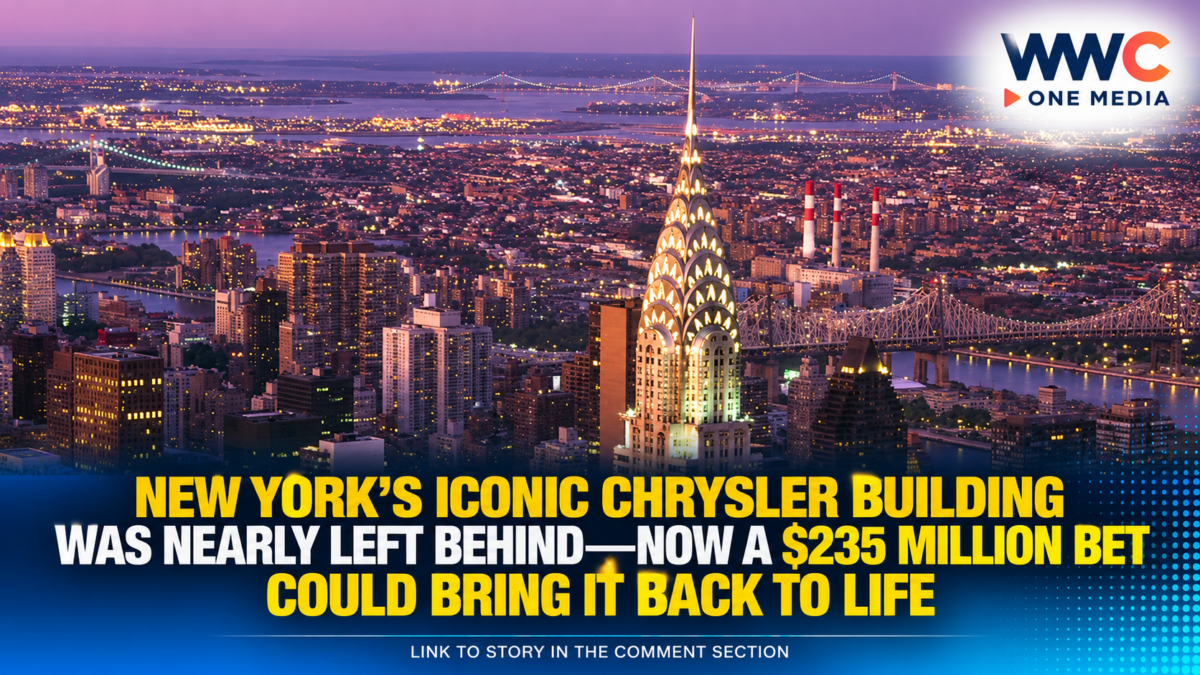
NEW YORK — One of New York City’s most recognizable skyscrapers is getting a second chance.
The Chrysler Building, the Art Deco landmark that has dominated the Manhattan skyline for nearly a century, is entering a major new chapter after real estate giant Tishman Speyer and institutional partners finalized a 150-year ground lease and committed $235 million to restore and modernize the property.
The deal comes after years of declining occupancy, financial problems, ownership turmoil and deterioration that left one of America’s most famous office towers struggling to keep pace with its surroundings.
Now the strategy is radically different: turn the aging landmark into a high-end, boutique office destination at precisely the moment demand for premium Manhattan offices is accelerating.
A $235 million gamble on a New York icon
Tishman Speyer, the company behind Rockefeller Center, is taking stewardship of the 77-story, 1,046-foot Chrysler Building alongside global institutional investors, with Canada’s Public Sector Pension Investment Board (PSP Investments) serving as a lead investor.
The arrangement is technically a 150-year ground lease, rather than a conventional purchase of the land.
That distinction matters because The Cooper Union for the Advancement of Science and Art owns the land beneath the skyscraper and has done so since the early 1900s. The new operator will make ground-lease payments to Cooper Union while investing heavily in the building itself.
The total announced investment is $235 million, covering the transaction and planned redevelopment work.
And the renovation will be extensive.
From neglected landmark to luxury office tower
The Chrysler Building has suffered from years of underinvestment.
The FT reported that the tower had fallen to less than 50% occupied, while the building’s condition and escalating ground-lease costs made it increasingly difficult to compete with newer Manhattan office properties.
The New York Post likewise reported that the property had faced a vacancy rate of roughly 50%, far above the levels seen in the surrounding Grand Central office district.
Tishman Speyer’s plan is designed to reverse that.
The company intends to restore the building’s distinctive exterior and famous Art Deco crown while upgrading outdated infrastructure, including cooling, electrical, elevator and air-handling systems.
The transformation will also include new tenant amenities.
A planned indoor-outdoor amenity center on the 61st floor will include lounge, gathering, food and beverage space, while additional wellness, fitness and meeting facilities are planned for the underground arcade.
Tishman Speyer also plans to pre-build a large portion of currently vacant or soon-to-be-vacant floors so that prospective tenants can move into finished offices faster.
That is a major change in strategy for a building competing in a market where companies increasingly want premium, move-in-ready workplaces rather than lengthy construction projects.
Why would anyone bet big on offices now?
That is the question at the heart of the deal.
The U.S. office market remains highly uneven after the pandemic transformed workplace patterns. Older, lower-quality buildings in less desirable locations have struggled with vacancies and falling values.
But the top end of the market is telling a different story.
The FT reported that Manhattan office leasing volume had reached 32.9 million square feet year-to-date, making it the strongest year-to-date period since 2000, when the comparable figure was 40.1 million square feet.
Demand for the most expensive office space has also strengthened.
The FT cited data from JLL and CBRE showing that leases for Manhattan offices priced at $100 or more per square foot reached an all-time high last year.
That is the market Tishman Speyer is targeting.
Rather than trying to compete with cheaper office towers, the Chrysler Building is being repositioned around location, architecture, prestige and amenities.
Grand Central is becoming the building’s biggest advantage
Location could be the Chrysler Building’s secret weapon.
The tower sits at 405 Lexington Avenue, less than a five-minute walk from Grand Central Terminal.
That gives tenants direct access to one of Manhattan’s most important transportation hubs at a time when employers are trying to persuade workers to return to the office.
The surrounding district has also undergone a transformation.
The arrival of JPMorgan Chase’s new headquarters nearby has helped raise the profile of the Grand Central area and strengthened demand for premium office space.
The Chrysler Building is therefore not being revived in isolation.
It is being positioned as part of a broader Midtown Manhattan comeback.
The building has already experienced an extraordinary financial journey
The $235 million investment looks particularly striking when compared with the Chrysler Building’s previous valuations.
In 2008, Abu Dhabi’s government purchased a 90% stake for about $800 million, according to the FT.
Just over a decade later, the property changed hands for only about $150 million when Signa and RFR acquired it.
The dramatic decline illustrates how much the economics of older Manhattan office buildings have changed.
But the Chrysler Building’s financial troubles were not solely about the tower itself.
A major complication has been the ground lease.
Cooper Union owns the land, meaning whoever controls the building must pay rent for the underlying property.
The FT reported that annual ground rent increased from $7.75 million to $32.5 million in 2018, putting significant pressure on the building’s finances.
The New York Post reported further scheduled increases, including an expected rise to approximately $41 million in 2028 under the previous arrangements.
That makes the new deal particularly important.
Tishman Speyer isn’t simply buying a famous tower.
It is taking on a complicated long-term real estate asset with substantial restoration needs and continuing ground-rent obligations.
The previous ownership ended in financial turmoil
The Chrysler Building’s latest crisis was tied to the collapse of its previous ownership structure.
RFR Holding, associated with developer Aby Rosen, had taken control of the property with Signa, the Austrian real estate group founded by René Benko.
Signa’s financial collapse in 2023 triggered a broader crisis for the property.
RFR subsequently faced problems with ground-rent payments. Commercial real-estate publications reported that Cooper Union ultimately moved to evict the leaseholder after roughly $21 million in unpaid ground rent accumulated, leading to a legal battle over control of the property.
A court ultimately allowed Cooper Union to regain control.
That cleared the way for a new operator — and eventually brought Tishman Speyer back into the picture.
Tishman Speyer knows the building better than most
There is another twist to the story.
This isn’t Tishman Speyer’s first relationship with the Chrysler Building.
The company had previously owned an interest in the property and worked on its redevelopment decades ago. Commercial real-estate records trace the company’s involvement back to the late 1990s.
That history gives Tishman Speyer something many prospective buyers would not have had: institutional familiarity with one of Manhattan’s most complicated buildings.
The company also owns and operates Rockefeller Center, another landmark New York property where it has pursued extensive modernization and repositioning.
The Chrysler Building’s iconic status is part of the business plan
The skyscraper isn’t famous merely because it is tall.
Completed in 1930, the Chrysler Building became one of the defining achievements of the Art Deco era.
It briefly held the title of world’s tallest building before the Empire State Building surpassed it.
Its stainless-steel crown, distinctive geometric ornamentation and gargoyle-like eagles have made it one of the most recognizable buildings anywhere in the world.
It has also appeared in films including Spider-Man and Men in Black 3, reinforcing its place in popular culture.
That cultural value can become an economic asset when paired with premium office space.
For companies competing for employees and clients, occupying an iconic landmark can provide something a generic office tower cannot: brand identity.
But the revival still faces a major test
The biggest question is whether Manhattan’s luxury-office recovery is strong enough to support the enormous investment required to modernize the Chrysler Building.
The market data are encouraging, but the recovery is not uniform.
Premium, centrally located buildings have benefited from companies consolidating into higher-quality offices, while older and less competitive properties continue to struggle.
The Chrysler Building therefore needs to prove that its extraordinary architecture can translate into extraordinary leasing demand.
Tishman Speyer appears to be betting that it can.
Its strategy is straightforward: restore the landmark, modernize its infrastructure, provide high-end amenities and use the building’s proximity to Grand Central as a major selling point.
A symbol of New York’s office-market divide
The Chrysler Building’s comeback could ultimately become a case study in the future of American commercial real estate.
For years, the dominant narrative surrounding offices was about vacancies, remote work and collapsing property values.
But the latest Manhattan data suggest a more complicated reality.
The office market isn’t simply recovering. It is splitting into winners and losers.
Buildings with exceptional locations, architecture, transportation access and amenities can command premium rents, while older properties without those advantages face a much more difficult future.
The Chrysler Building has one of the strongest locations in Manhattan.
Now it needs the investment to match it.
The Bottom Line
The Chrysler Building is not being rescued because the old office model suddenly returned.
It is being repositioned because premium office space in the right part of Manhattan is proving remarkably resilient.
Tishman Speyer and its institutional partners are betting $235 million that one of New York’s greatest architectural icons can become a high-end workplace once again.
The building’s history makes the gamble extraordinary: an $800 million valuation in 2008, a roughly $150 million sale more than a decade later, financial distress, unpaid ground rent and years of uncertainty have all brought the landmark to this point.
Now the Chrysler Building has a new steward, a 150-year ground lease and a massive restoration plan.