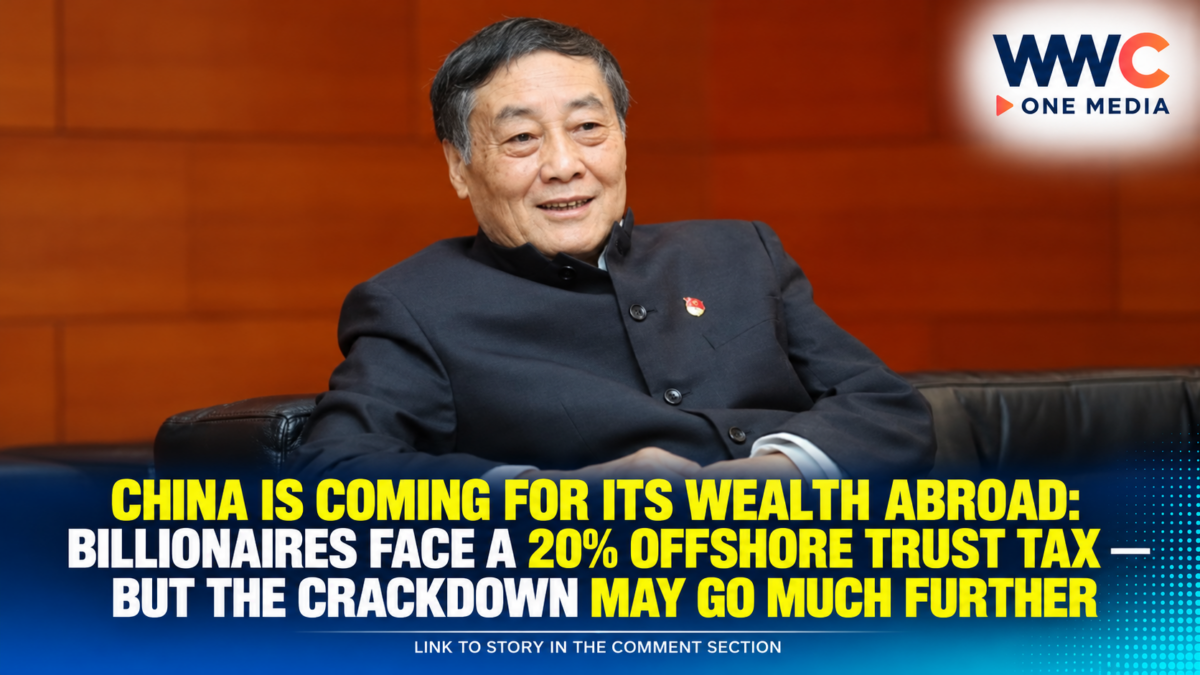
BEIJING — China’s wealthiest citizens are facing a dramatically tougher tax environment as Beijing moves to bring offshore trusts and overseas investment income under much closer scrutiny—sending shock waves through the private-banking and wealth-management industries in Hong Kong, Singapore and Tokyo.
The crackdown is accelerating under President Xi Jinping’s broader push to reduce inequality, strengthen tax compliance and make China’s wealthiest citizens contribute more to the state.
Starting October 22, authorities will begin collecting taxes under newly clarified rules covering income generated through offshore trusts, including interest, dividends and certain gains. The rules also establish tax treatment when assets are transferred into offshore trusts and when trusts are terminated or otherwise undergo major changes.
For wealthy Chinese families that spent years building structures in places such as Hong Kong, Singapore and other offshore jurisdictions, the message is unmistakable:
Moving wealth offshore no longer automatically puts it beyond Beijing’s tax reach.
And this may only be the beginning.
Beijing Is Closing a Long-Standing Gap
On July 24, China’s Ministry of Finance and State Taxation Administration issued detailed rules governing individual income tax on offshore trusts.
The measures were accompanied by separate administrative rules explaining how taxpayers and trustees must report the relevant information. Both sets of rules took effect immediately.
China’s tax authorities describe the policy as an effort to clarify existing obligations under the country’s individual income-tax law rather than simply creating an entirely new tax category.
Official guidance says the rules are intended to address situations in which offshore trusts have been used to transfer assets, conceal wealth or evade taxes, while improving transparency and tax compliance.
That distinction matters.
The headline-grabbing 20% rate is not a universal 20% charge on the entire value of every offshore trust.
Rather, different taxable events and categories of income are brought into China’s individual-income-tax system, with the relevant taxable income generally subject to the applicable rate.
What the New Rules Actually Cover
Under the new framework, when a Chinese tax resident transfers property into an offshore trust, the transaction can be treated as a taxable transfer of property.
The taxable amount is generally based on the gain, rather than simply imposing a 20% tax on the entire value of the assets being transferred. International tax advisers including Morgan Lewis have highlighted this distinction.
The rules also cover income generated while the trust operates.
Depending on the nature of the income, this can include:
- Capital gains and other property-transfer income
- Interest
- Dividends and bonuses
- Income associated with distributions
- Tax consequences when a trust is terminated
- Certain consequences when an individual changes tax-residency status
China’s tax authority has also specified reporting requirements for existing offshore trusts.
This turns what was once a relatively opaque area of cross-border wealth planning into a much more clearly regulated tax environment.
The 90-Day Window Is Now Running Out
For existing structures, the timing is particularly important.
China provided a three-month voluntary disclosure period following the July announcement, giving affected taxpayers time to report and settle certain obligations without the same late-payment consequences that could otherwise apply.
That window runs to October 22.
For wealthy families and their advisers, the deadline has therefore become a major planning date.
They need to establish:
What assets are inside the trust?
When were those assets transferred?
What income did they generate?
Who is the beneficial owner?
Where is the taxpayer resident?
What taxes have already been paid overseas?
And, perhaps most importantly:
What does Beijing already know?
The Answer to That Last Question Is Becoming Clearer
China’s tax authorities are no longer relying solely on taxpayers voluntarily declaring their offshore wealth.
Reuters reported in August that tax officials and financial institutions were increasingly scrutinizing offshore trusts, overseas insurance products and other investment structures used by wealthy Chinese individuals.
Reuters also reported that the crackdown is forcing wealthy Chinese to reassess trust arrangements and investment holdings, with some raising cash to prepare for potential tax liabilities.
The stakes are enormous.
BCG estimated earlier this year that mainland Chinese ultra-high-net-worth individuals had as much as $1.2 trillion parked in overseas markets including Hong Kong, Singapore and other lower-tax jurisdictions.
That is the pool of wealth now sitting under a much brighter regulatory spotlight.
Offshore Trusts Were Never Just About Hiding Money
It is important not to portray every offshore trust as an illegal tax-avoidance structure.
Offshore trusts are widely used for legitimate purposes including:
- Succession planning
- Family governance
- Asset management
- Cross-border investments
- Risk management
- Intergenerational wealth transfers
China’s own tax authorities acknowledge that offshore trusts can be used for legitimate wealth succession and international asset allocation.
The problem, according to Beijing, is that some individuals have also used these structures to transfer assets, conceal wealth or avoid tax obligations.
The new framework is therefore aimed at bringing the entire structure into clearer tax compliance.
That is what makes the change so consequential.
Singapore Is Feeling the Pressure
Singapore has become one of the biggest private-wealth centres for wealthy Chinese families.
Over the past several years, Chinese entrepreneurs and investors have established family offices, trusts and investment structures in the city-state.
Now Singapore’s wealth-management industry is having to answer a new question:
Does an offshore structure in Singapore actually protect a Chinese tax resident from China’s tax authorities?
The answer is increasingly complicated.
Singapore lawyers and wealth advisers have reported a surge in inquiries from China-linked clients trying to understand their potential liabilities and compliance obligations.
The issue is not simply where the money sits.
It is also about tax residency, control, beneficial ownership and the origin of the assets.
A foreign passport or permanent residency elsewhere does not necessarily eliminate Chinese tax obligations.
Singapore lawyers cited by Malaysian and Singaporean reporting have stressed that citizenship and tax residency are not the same thing.
Hong Kong Faces an Even Bigger Test
Hong Kong has traditionally been one of the world’s most important offshore wealth centres and a natural destination for Chinese capital.
BCG data cited by the FT put cross-border wealth booked in Hong Kong at around $2.9 trillion in 2025, making it the world’s largest offshore wealth centre by that measure.
That creates a major vulnerability.
If wealthy Chinese families become more cautious about offshore structures—or move assets elsewhere—Hong Kong’s private-banking, trust and asset-management industries could feel the impact.
At the same time, Hong Kong remains deeply integrated with mainland China.
That makes it difficult to treat the city as an entirely separate jurisdiction when Beijing is pursuing a broader tax-enforcement campaign.
The Rich Are Already Looking for Alternatives
The crackdown has prompted some wealthy Chinese investors to investigate alternative jurisdictions and structures.
Reuters reported that wealthy individuals are reassessing their offshore trusts, while Singapore-based advisers have described increased demand for advice on how to manage the new rules.
The FT has also reported that some wealthy Chinese clients and their advisers are examining the United States and other jurisdictions as potential alternatives.
But there is an important catch.
Moving money does not necessarily eliminate the tax obligation.
If the underlying taxpayer remains subject to Chinese tax rules, simply shifting assets from Singapore to another financial centre may not solve the problem.
The new environment is therefore forcing wealthy families to think less about where to hide assets and more about how to structure assets legally while remaining compliant.
Beijing’s Global Tax Reach Is Expanding
The offshore-trust rules are part of a broader movement toward stronger enforcement of taxes on overseas income.
The FT has reported that Chinese authorities are examining overseas investments and income declarations and, in some cases, looking back much further than the most recent tax years.
Reuters previously reported that China’s campaign was pushing wealthy investors to reassess offshore structures amid concerns that enforcement could broaden.
That possibility is creating an entirely different psychological environment for China’s wealthy.
For years, the central question for many families was:
How do we move our wealth overseas?
Now the question is increasingly:
How much of that wealth does Beijing already know about?
Xi’s “Common Prosperity” Agenda Returns to the Spotlight
The crackdown also fits into Xi Jinping’s broader political campaign around “common prosperity.”
The slogan became a central theme of Beijing’s policy agenda several years ago, emphasizing a reduction in extreme inequality and encouraging wealthier citizens and corporations to contribute more to society.
Tax enforcement provides Beijing with a direct mechanism to pursue that objective.
But there is another reason the timing matters.
China’s fiscal position has become increasingly difficult.
The property-market downturn has reduced revenue from land sales, traditionally an important source of funding for local governments.
Reuters Breakingviews estimated that local governments have lost roughly 4.5 trillion yuan ($630 billion) in annual land-sale revenue since the property bubble burst in 2021.
That creates pressure to find alternative sources of government revenue.
Tax enforcement is one of them.
Beijing Needs Money—But It Also Needs Confidence
This is where the policy becomes risky.
A stronger tax system can improve government finances.
But an aggressive crackdown on wealthy individuals can also have unintended consequences.
Entrepreneurs may become more cautious.
Investors may move capital.
Business owners may delay investments.
Families may accelerate efforts to relocate.
And foreign investors could become concerned about whether China’s rules are becoming more unpredictable.
Reuters Breakingviews warned that Beijing risks “swinging the tax pendulum too far”, arguing that the campaign could undermine economic confidence even as it raises revenue.
That is the central policy dilemma.
China wants wealthy citizens to contribute more.
But it also wants them to keep investing.
The Potential Impact Goes Beyond Billionaires
The crackdown is not necessarily limited to famous billionaires.
China’s rules apply according to tax status and the nature of taxable income—not simply according to whether someone is a billionaire.
That means wealthy entrepreneurs, executives, investors and families with offshore investment structures could all face greater compliance requirements.
KPMG noted that the July rules establish tax obligations across the life cycle of offshore trusts, reinforcing China’s approach to individual income-tax administration.
That could dramatically increase the workload for private banks, trustees, lawyers, accountants and family offices.
The people managing China’s offshore wealth may therefore become almost as important as the people owning it.
A New Business for Asia’s Wealth Managers
There is an ironic consequence to the crackdown.
China’s new rules could actually create more business for tax advisers, lawyers and wealth-management firms.
Every affected family needs help determining:
- Tax residency
- Asset valuation
- Trust documentation
- Historical income
- Beneficiary status
- Cross-border tax credits
- Reporting obligations
- Potential restructuring
Singapore, Hong Kong and Tokyo are therefore not necessarily going to lose all China-linked wealth.
Instead, their wealth industries may have to evolve.
The business could shift from simply managing money to managing increasingly complicated cross-border compliance.
The Taxman Is Also Looking Backward
Perhaps the most unsettling element for wealthy Chinese investors is the possibility of historical scrutiny.
The FT has reported that Chinese officials have been examining offshore investments and undeclared income in some cases going back as far as 2000.
That does not mean every offshore asset held since 2000 will automatically be taxed.
But it does signal a much more aggressive enforcement posture.
For families that accumulated fortunes over decades, reconstructing old transactions could become extremely complicated.
Records may be incomplete.
Assets may have changed ownership.
Companies may have been sold.
Trust beneficiaries may have changed.
And tax residency may have shifted multiple times.
That is why advisers are urging clients to start with a full historical review.
The Next Question: Will Beijing Go After More?
This may be the most important unanswered question.
Barclays analysts told the FT that the offshore-trust measures could represent the first steps toward wider scrutiny of overseas income, including exporter earnings held offshore, overseas investment income and overseas employment income.
Inheritance or estate taxation could also eventually become part of the debate, although that remains a possibility rather than an announced policy.
China currently does not have a broad inheritance tax comparable to those imposed in some major economies.
If Beijing eventually introduced one, the consequences for wealthy families would be far greater.
But that should not be presented as an imminent policy decision.
For now, the confirmed move is the much clearer taxation and reporting framework for offshore trusts.
China’s Tax Crackdown Could Reshape Asian Finance
For years, Hong Kong and Singapore benefited from China’s rapid wealth creation.
Chinese entrepreneurs created fortunes on the mainland and then increasingly diversified those fortunes overseas.
The money helped build private-banking businesses, family offices, luxury-property markets and investment-management industries across Asia.
Now Beijing is effectively changing the rules of that relationship.
The question is no longer whether Chinese wealth will go offshore.
It is whether offshore financial centres can continue to manage that wealth without becoming part of Beijing’s expanding tax-information and compliance ecosystem.
The Bottom Line
China’s new offshore-trust tax rules mark a major change in the way Beijing approaches wealth held outside the mainland.
The July 24 rules clarify how Chinese individual income tax applies when residents transfer assets into offshore trusts and when those trusts generate income, while detailed administrative rules establish reporting and compliance requirements.
The rules include a 20% tax rate for relevant categories of taxable income, but it is inaccurate to describe the policy as a blanket 20% tax on every offshore asset or on the gross value of every trust.
The immediate deadline is October 22, when the voluntary-disclosure window expires.
For wealthy Chinese families, the stakes are enormous. Reuters estimates that as much as $1.2 trillion in wealth held by mainland Chinese ultra-high-net-worth individuals sits in overseas markets such as Hong Kong and Singapore.
For Hong Kong and Singapore, the implications could be equally significant.
Their wealth-management industries were built partly around managing Chinese capital.
Now they must operate in an environment where Beijing is demanding greater transparency and tax compliance from the people who own that money.
And that leaves the biggest question hanging over Asia’s private-wealth industry:
Is China’s offshore tax crackdown simply about collecting billions in unpaid taxes—or is Beijing preparing to bring an even larger share of the country’s global wealth back under its control?