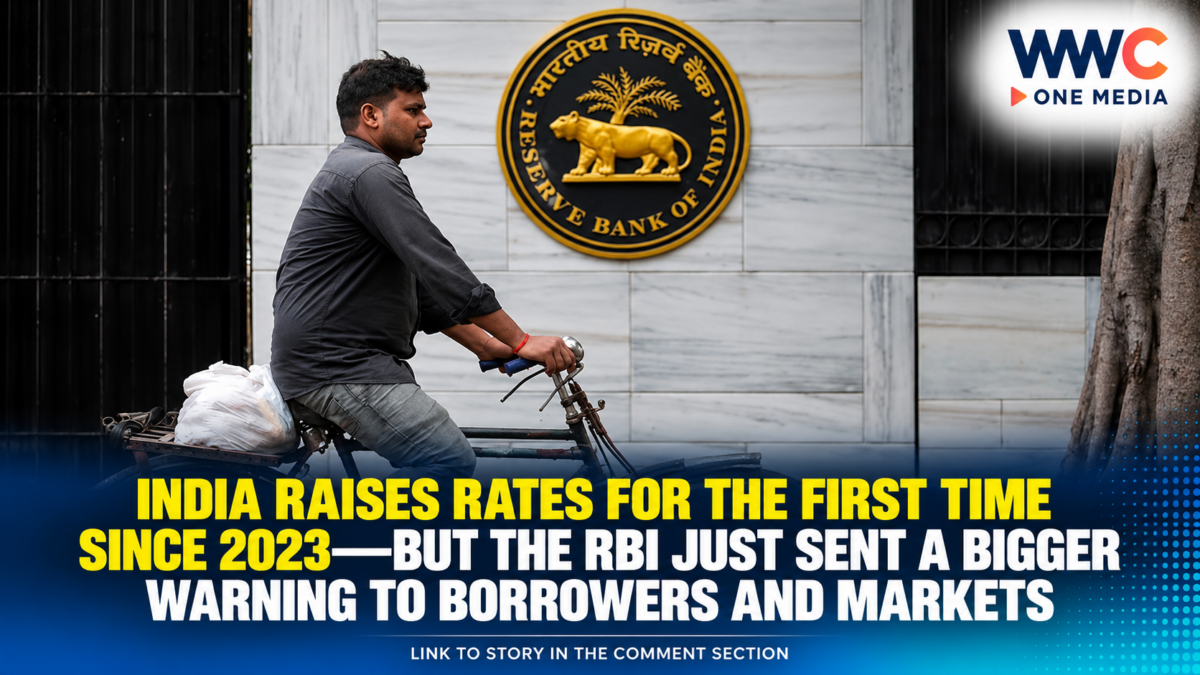
MUMBAI — India’s central bank has slammed the brakes on its easing cycle, raising interest rates for the first time since 2023 as surging energy costs, accelerating inflation and pressure on the rupee force policymakers to confront a rapidly changing economic environment.
The Reserve Bank of India (RBI) raised its benchmark repo rate by 25 basis points to 5.50% on Wednesday, October 7, 2026.
The six-member Monetary Policy Committee voted unanimously for the increase.
But the rate hike itself was only half the story.
The RBI also shifted its monetary-policy stance from “neutral” to “calibrated tightening”—a signal that policymakers are no longer preparing the ground for rate cuts and could raise rates again if inflationary pressures intensify.
For Indian households, businesses and investors, that changes the outlook dramatically.
The era of falling borrowing costs may be over.
Why Did the RBI Raise Rates Now?
The RBI’s decision comes at an unusual moment for India.
The country’s economy is still growing rapidly.
India’s GDP expanded 7.8% year on year in the April-June quarter, stronger than the central bank’s previous expectation of 7%.
The RBI has also raised its FY2026-27 growth forecast to 7.1% from 6.7%, according to Indian Express reporting on the policy decision.
Normally, such strong growth would give a central bank little reason to panic.
But inflation has become a problem again.
Consumer inflation accelerated to 4.82% in August, according to Reuters, exceeding the RBI’s 4% medium-term target for a third consecutive month.
The central bank now expects inflation to rise further.
The RBI’s FY2026-27 inflation forecast was increased to 5.2% from 5.0%, Indian Express reported.
That combination—strong growth plus rising inflation—has given the RBI room to raise rates without fearing that it is immediately pushing the economy into recession.
Oil Is Making Everything Worse
One of the biggest threats hanging over India’s economy is crude oil.
India imports more than 90% of its crude oil, leaving the world’s most populous nation highly exposed to global energy-price shocks.
The ongoing Middle East conflict has pushed energy prices higher, increasing the cost of fuel, transportation, fertilizer and other essential goods.
For India, the problem is particularly severe because expensive oil does more than raise prices at petrol stations.
It also increases the country’s import bill.
That can weaken the rupee, increase inflation and put pressure on India’s current account.
It is a chain reaction.
Higher oil → higher import costs → weaker rupee → more expensive imports → higher inflation.
The RBI is now trying to stop that cycle before it becomes entrenched.
The Rupee Is Another Major Problem
India’s currency has already been under heavy pressure.
The rupee had fallen roughly 14% against the U.S. dollar in the year through May, according to the FT.
On Tuesday, just before the RBI decision, Reuters reported that the rupee fell to a two-month low of 96.42 per dollar, pressured by equity outflows and a stronger dollar.
The RBI has been using other tools to support the currency, including foreign-exchange operations and measures designed to encourage dollar inflows.
But interest rates are another weapon.
Higher Indian rates can make rupee-denominated assets more attractive relative to foreign assets and can discourage speculative bets against the currency.
The RBI therefore faces two linked problems:
Inflation is rising, and the currency is vulnerable.
The Most Important Phrase: “Calibrated Tightening”
Markets paid close attention to the RBI’s change in language.
The central bank moved from a “neutral” policy stance to “calibrated tightening.”
That is not a minor wording change.
Indian Express reported that Governor Sanjay Malhotra indicated that rate cuts are effectively off the table in the near term, with future action now more likely to involve either a hike or a pause depending on economic conditions.
In other words, the RBI has changed the direction of the conversation.
Previously, investors could reasonably ask:
When will the next rate cut come?
Now the question is:
How many more rate increases could be coming?
Economists Are Already Divided on the Next Move
The possibility of additional hikes has become a major market question.
Goldman Sachs economists have forecast four additional rate increases totaling 1 percentage point by the end of the first half of 2027, according to the FT.
That would put the repo rate at 6.50% if every projected hike were delivered.
Other economists are less aggressive.
Reuters quoted Capital Economics economist Abhijit Surya as expecting another 25-basis-point increase in both December and February, taking the rate to 6%.
Barclays’ Aastha Gudwani, meanwhile, expected only one additional 25-basis-point hike during the remainder of FY2027, potentially in February.
The disagreement illustrates just how uncertain India’s inflation outlook has become.
The direction is clearer than the destination.
The RBI is tightening. But nobody knows exactly how far it will have to go.
Indian Borrowers Will Feel the Impact
The immediate consequence for households is straightforward.
Higher policy rates generally make borrowing more expensive.
That can eventually push up the cost of:
- Home loans
- Personal loans
- Vehicle financing
- Corporate borrowing
- Working-capital loans
Indian Express reported that the rate increase is expected to raise borrowing costs for consumers and businesses, while potentially improving returns for depositors.
For borrowers who recently benefited from India’s lower-rate environment, the shift could therefore come as a shock.
A 25-basis-point increase may appear small.
But if the RBI delivers several more hikes, the cumulative effect could become significant.
India’s Economy Is Strong Enough to Absorb Higher Rates—for Now
The surprising part of the RBI’s decision is that India is not currently experiencing an obvious growth collapse.
The economy grew 7.8% in the April-June quarter, according to Reuters.
That is considerably stronger than the RBI’s earlier 7% forecast.
The central bank consequently upgraded its full-year growth outlook to 7.1%.
That means policymakers believe the economy has enough momentum to withstand somewhat higher borrowing costs.
But there are warning signs.
The FT reported that BMI, a Fitch Ratings company, has warned that India’s growth mix is deteriorating, with consumer demand cooling and a previous surge in exports beginning to unwind.
That creates a difficult balancing act.
If the RBI raises rates too aggressively, it could damage consumption and investment.
If it waits too long, inflation could become harder to control.
Weather Could Add Another Inflation Shock
India’s inflation problem is not entirely about oil.
Food prices remain a major concern.
The FT reported that analysts are watching a weaker-than-usual monsoon and the emergence of a strong El Niño pattern, which could affect agricultural output and push food prices higher.
That matters because food represents a large component of household spending in India.
A poor harvest can therefore have a much larger impact on living costs than it would in some advanced economies.
And if food inflation accelerates at the same time as energy prices remain high, the RBI could face an even more difficult policy environment.
The Stock Market Is Already Feeling the Pressure
Indian financial markets did not celebrate the rate hike.
The Nifty 50 fell 0.4%, according to the FT, leaving the benchmark down about 13% for the year at the time of the report.
Government bond yields also moved higher.
The yield on India’s 10-year government bond rose to 7.24%, its highest level since April 2024, according to the FT.
Higher bond yields can increase financing costs throughout the economy.
They can also make bonds more attractive relative to equities, potentially putting additional pressure on stock valuations.
For investors, the policy shift therefore changes the equation.
India may still have one of the world’s fastest-growing major economies.
But fast growth does not automatically mean easy money.
India’s Dollar Strategy Shows How Serious the Pressure Has Become
The RBI has not relied solely on interest rates to protect the financial system.
The central bank has also encouraged dollar inflows through temporary schemes targeting India’s large overseas diaspora.
According to the FT, those measures raised approximately $143.6 billion, helping replenish foreign-exchange reserves and inject liquidity into India’s banking system.
That is an enormous number.
It demonstrates how seriously Indian policymakers are treating external financing and currency risks.
India wants to keep its economy growing rapidly while protecting the rupee from an oil-driven external shock.
The problem is that those objectives can sometimes conflict.
India’s Oil Dependence Is the Achilles’ Heel
India’s extraordinary economic growth has made it one of the world’s most important consumers of energy.
But its dependence on imported crude creates a vulnerability that the RBI cannot eliminate through monetary policy alone.
If oil prices remain elevated for an extended period, higher interest rates can only partially offset the resulting inflationary pressure.
The government may need to use other tools—tax changes, subsidies, strategic reserves or fiscal measures—to cushion consumers.
That makes the oil market one of the most important variables for India’s economic outlook over the coming months.
Could India Face a “Higher for Longer” Era?
That is now the question confronting investors.
The RBI’s language suggests policymakers are prepared to tolerate tighter financial conditions for longer if necessary.
Indian Express described the stance shift as a signal that the central bank is preparing markets for a potentially higher-for-longer interest-rate environment.
If inflation continues rising, the RBI could hike again.
If oil prices fall and inflation stabilizes, it could pause.
If growth weakens dramatically, policymakers may eventually have to reconsider.
But one thing has changed:
The assumption that India’s next major monetary-policy move would be a rate cut is no longer safe.
The Bigger Global Picture
India’s move also comes as other major central banks have become more cautious about inflation.
The U.S. Federal Reserve raised its policy rate last month for the first time in three years, according to Indian Express, while other central banks have also tightened policy.
That matters for India because global interest rates influence capital flows.
If U.S. yields rise while Indian rates remain comparatively low, investors may shift money toward dollar assets.
That can weaken the rupee.
A weaker rupee then makes imported oil more expensive.
That can increase inflation.
The RBI is therefore operating within a global financial system in which decisions made in Washington and elsewhere can directly affect India’s inflation and currency outlook.
The Real Test Comes Next
The October rate hike was widely expected by economists.
The bigger surprise was arguably the RBI’s decision to change its policy stance to “calibrated tightening.”
That tells investors the central bank is no longer treating the latest inflation surge as a temporary disturbance.
It is preparing for the possibility that price pressures could persist.
The economy remains remarkably strong.
GDP growth is accelerating.
But oil prices are high, the rupee is vulnerable, food inflation could rise and global monetary conditions are tightening.
That combination could force the RBI into a much longer rate-hiking cycle than markets initially expected.
The Bottom Line
India has raised its benchmark repo rate by 25 basis points to 5.50%, the first increase since February 2023, while switching its policy stance from neutral to calibrated tightening.
The decision reflects a striking contradiction at the heart of India’s economy.
Growth is booming—but inflation risks are returning.
The economy expanded 7.8% in the latest quarter, prompting the RBI to raise its FY2027 growth forecast to 7.1%. At the same time, August inflation reached 4.82%, above the RBI’s 4% target, while elevated oil prices and a weak rupee threaten to push prices even higher.
For households, businesses and investors, the message is increasingly clear:
Cheap money is no longer the default.
And if oil prices stay high and inflation accelerates, Wednesday’s 25-basis-point increase may turn out to be only the beginning.
The question now isn’t whether India’s rate-cut cycle has ended.
It is how high the RBI will ultimately have to go to keep inflation from becoming the next major threat to India’s growth story.