
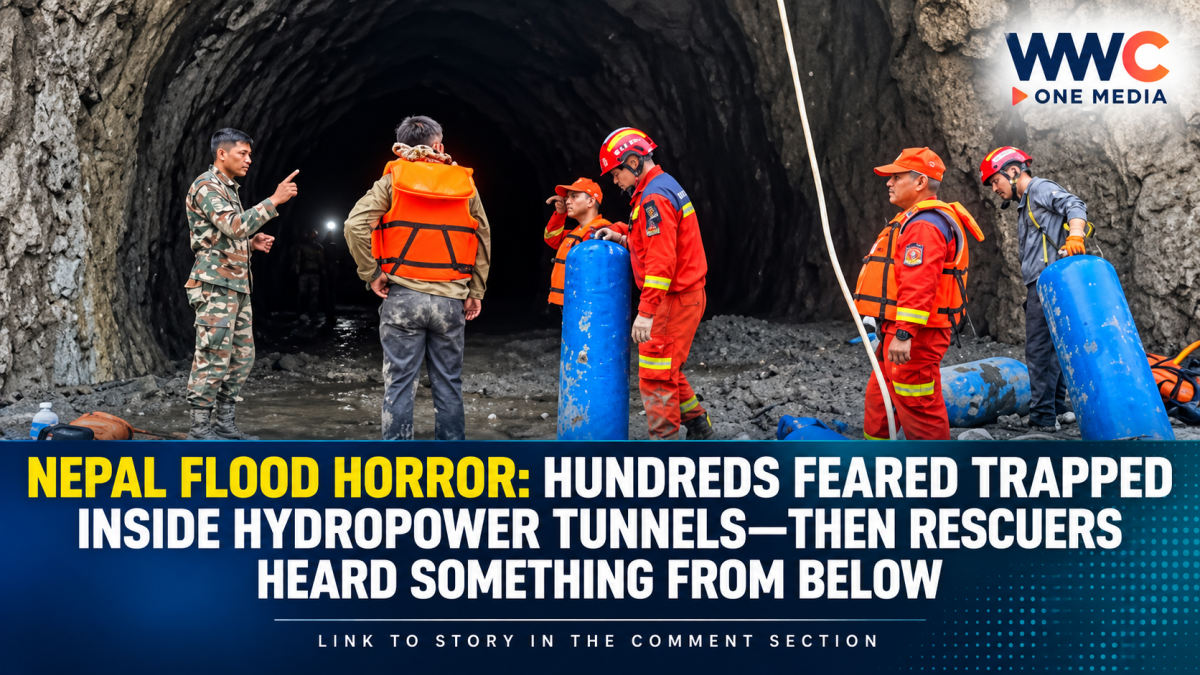
KATHMANDU — A rescue operation deep beneath Nepal’s flood-ravaged Himalayan valleys has delivered a rare breakthrough after two hydropower workers were pulled alive from a debris-filled tunnel, nine days after catastrophic flooding swept through the region.
The rescue, confirmed on Friday, Sept. 4, has renewed hopes for hundreds of other workers who may still be trapped inside underground facilities after the Aug. 26 disaster.
The two men — 30-year-old mechanical foreman Sanjay Shah and 45-year-old mechanical supervisor Kabir Maharjan — were rescued from a tunnel at the Trishuli-3A Hydropower Project in Rasuwa district. They were taken for medical treatment after being found alive beneath the enormous mass of mud, rocks and debris.
The breakthrough came after rescuers spent days battling blocked entrances, unstable debris and difficult terrain to reach the tunnel system.
A rescue that changed the outlook
Before the breakthrough, rescuers had struggled to determine whether workers trapped inside Nepal’s hydropower tunnels were still alive.
The flood disaster was triggered by a massive glacial and rock collapse near the Nepal-China border, sending an extraordinary surge of water, mud and boulders down the Trishuli valley.
The destruction was particularly severe around hydropower installations, many of which sit along the river system.
At one point, authorities estimated that hundreds of people connected to hydropower projects were missing, with some believed to have taken shelter underground when the flood struck.
Reuters reported that about 900 people were reported missing from six hydropower plants, while other assessments have placed the number of workers believed trapped inside tunnels at roughly 500. The precise number has been difficult to establish because communications, roads and access routes were destroyed.
The rescue of Shah and Maharjan has therefore become more than an isolated survival story.
It is now evidence that some underground spaces may have provided protection from the worst of the flood.
Why rescuers are looking underground
Hydropower tunnels became an unexpected source of hope because some of the underground structures appear to have survived the initial destruction better than infrastructure above ground.
Australian tunnel expert Arnold Dix, who has been assisting the rescue operation, previously said workers could potentially have survived in larger underground spaces containing air, water and supplies.
He cautioned, however, that the situation inside the tunnels was extremely dangerous.
Unlike a conventional tunnel collapse, rescuers in Nepal were confronting a disaster in which the surrounding landscape had effectively been destroyed by the flood. Mud, rocks and other debris had been pushed deep into tunnel entrances and access routes.
That made simply reaching the workers one of the biggest challenges.
At some locations, rescuers had to use excavators, controlled blasting and other equipment to clear enormous quantities of debris.
At the Upper Trishuli 3A project, rescuers reportedly spent almost six days simply reaching a tunnel entrance because it had been buried.
Technology meets a race against time
The rescue effort has also become an unusual international engineering operation.
A WhatsApp group involving hundreds of engineers has been used to share tunnel drawings, project layouts, information about missing workers and technical advice with people on the ground.
CNA, citing Reuters, reported that the group grew to more than 500 engineers and specialists as the search intensified.
Satellite imagery, computer modelling, helicopters and heavy machinery have also been deployed to overcome the destruction of roads and infrastructure.
Specialists from India, China, South Korea and Australia have been assisting Nepal’s rescue teams.
The operation remains extraordinarily difficult because rescuers must determine which routes are structurally safe while removing tonnes of material that may have shifted during the disaster.
Nepal’s hydropower sector takes a major hit
The human toll is only one part of the disaster.
Nepal has spent years expanding hydropower as the backbone of its electricity system and as a potential source of export revenue.
The Aug. 26 floods have now exposed how vulnerable that strategy can be to extreme events in the Himalayas.
Reuters reported that the disaster wiped out roughly 10% of Nepal’s electricity generation capacity.
Mongabay reported that 281 megawatts of installed capacity were wiped out or badly damaged, while another 388 MW under construction was damaged. Transmission infrastructure was also affected, cutting another estimated 150 MW from the national grid.
The financial consequences could be substantial.
Reuters reported that commercial insurance losses from the floods could exceed 20 billion Nepalese rupees, or about US$132 million, even before potential claims related to deaths and injuries are fully accounted for. Hydropower projects are expected to make up most of those insurance claims.
A disaster with consequences beyond Nepal
The floods have raised broader questions about the safety of critical infrastructure in a rapidly changing Himalayan environment.
Glacial hazards, extreme rainfall, landslides and flooding are increasingly important considerations for countries building roads, bridges, hydropower stations and other infrastructure in mountainous regions.
Experts cited by CNA said the disaster could also force policymakers and engineers to reconsider how critical infrastructure is designed and protected.
Interestingly, while bridges and other structures above ground were particularly vulnerable, some underground infrastructure appeared to offer greater resilience in certain locations.
That does not mean tunnels are immune to catastrophic flooding. Instead, the experience could influence how future Himalayan infrastructure is designed, particularly where facilities can be protected from direct exposure to rivers and flood channels.
Hope — but the search is far from over
The rescue of Shah and Maharjan has provided an extraordinary moment of hope amid one of Nepal’s deadliest recent disasters.
Their survival demonstrates that people trapped underground may endure for considerably longer than rescuers initially feared if they have access to air, water and protected spaces.
But rescue teams are still facing blocked tunnels, unstable debris and uncertain information about exactly where missing workers may be located.
The question now is whether the breakthrough at Trishuli-3A can be repeated elsewhere.
For families still waiting for loved ones, every sound from beneath the rubble matters.
And after nine days of darkness, the rescue of two workers has given Nepal a reason to keep digging.
WWC ONE MEDIA M.J.E




Leave a Reply