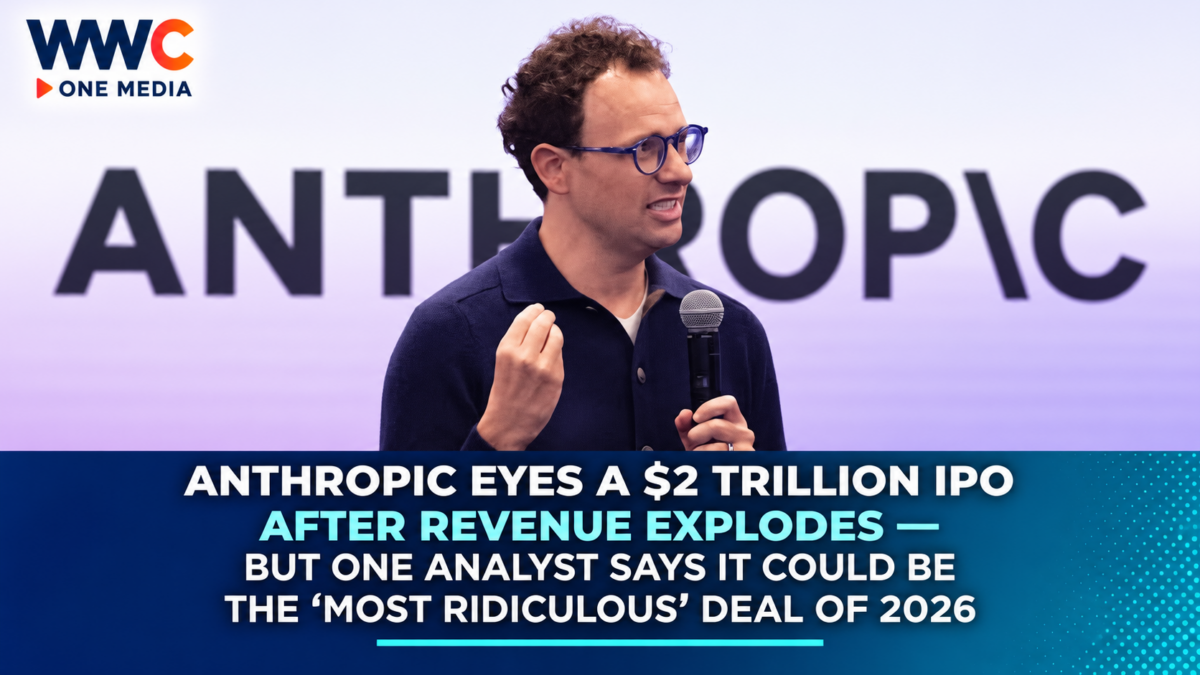
SAN FRANCISCO — Anthropic is preparing what could become one of the largest technology IPOs in history, with reports pointing to a potential valuation above $2 trillion—but not everyone believes the numbers justify the hype.
Independent research firm New Constructs has attacked the prospective listing in unusually blunt terms, calling Anthropic’s potential IPO the “most ridiculous IPO of 2026” and arguing that the company’s reported $2 trillion valuation target is disconnected from its current economics.
The criticism comes just months after Anthropic raised $65 billion at a $965 billion post-money valuation in May, following a $30 billion funding round at a $380 billion valuation in February.
That means a $2 trillion IPO would imply roughly another doubling in valuation in only a few months.
And Anthropic is undeniably growing at extraordinary speed.
Revenue reached roughly $4.6 billion in 2025, up about twelvefold from the prior year, while the company’s annualized revenue run rate reportedly surpassed $47 billion by May 2026.
But the profitability picture is dramatically different.
Anthropic spent heavily on computing and infrastructure and posted an operating loss of about $8.06 billion in 2025, according to disclosures analyzed by Reuters.
That is the tension investors will have to decide:
Is Anthropic becoming one of the most important companies of the AI era—or is Wall Street preparing to pay a historically high valuation for a business whose cost structure remains brutally expensive?
Anthropic Has Gone From $183 Billion to Nearly $1 Trillion in Less Than a Year
Anthropic’s valuation trajectory has been extraordinary.
In September 2025, the company raised $13 billion at a $183 billion post-money valuation.
By February 2026, a new $30 billion Series G valued Anthropic at $380 billion.
Then, in May, the company raised another $65 billion at a $965 billion valuation.
If Anthropic now goes public above $2 trillion, its valuation would have increased more than tenfold from September 2025.
That kind of repricing would be remarkable even by Silicon Valley standards.
It reflects how aggressively investors are competing for exposure to frontier artificial intelligence.
The $2 Trillion Number Is Still a Proposed Valuation, Not a Final IPO Price
This distinction is essential.
Anthropic has not completed its IPO.
The reported $2 trillion figure is a prospective valuation associated with the planned offering, not a guaranteed market capitalization.
Pricing can change before shares begin trading.
Demand can weaken.
Market conditions can deteriorate.
Underwriters can recommend a lower range.
Or investor enthusiasm can push the valuation even higher.
Reuters reported that Anthropic’s confidential IPO materials point toward a valuation exceeding $2 trillion, but the final terms remain subject to the offering process.
That means the headline valuation should be treated as an ambition or expectation, not an accomplished fact.
Anthropic’s Revenue Growth Is Extremely Real
Skeptics cannot easily dismiss the company’s growth.
Anthropic generated nearly $4.6 billion in 2025 revenue, around 12 times the prior-year figure.
The company then said its revenue run rate exceeded $47 billion in May 2026.
CEO Dario Amodei has described periods of growth as almost impossible to plan for.
Fortune reported that Anthropic experienced an 80-fold annualized increase in usage and revenue during one quarter, forcing it to scramble for additional computing capacity.
That kind of growth helps explain why investors are willing to tolerate huge losses.
The bet is that Anthropic can eventually turn scale into operating leverage.
But the Company Is Burning Enormous Amounts of Money
Revenue growth is only half the equation.
Anthropic’s 2025 operating economics show how expensive frontier AI remains.
Reuters reported that the company spent about $7.3 billion on compute and infrastructure during the year.
Operating losses reached about $8.06 billion.
Its overall net loss was much larger—roughly $42 billion—although about $34 billion of that reflected accounting charges related to financing instruments rather than normal operating expenses.
That distinction matters.
A $42 billion net loss makes for a dramatic headline, but it overstates the recurring operating loss.
The more relevant underlying concern is the roughly $8 billion operating deficit.
That is still enormous.
Why AI Labs Are So Expensive to Run
Frontier AI companies require infrastructure on a scale few software businesses ever faced.
They must pay for:
- advanced GPUs;
- data-center capacity;
- electricity;
- networking;
- model training;
- inference;
- engineering talent;
- and model-safety work.
Traditional software can often scale at relatively low marginal cost.
Frontier AI is different.
Each additional unit of usage consumes compute.
That means more customers can create more infrastructure expense even as revenue rises.
This is why investors are increasingly focused on unit economics rather than raw usage growth.
The Bigger Question Is Whether Token Costs Fall Fast Enough
The long-term bull case assumes AI becomes dramatically cheaper to operate.
Models improve.
Chips become more efficient.
Inference costs decline.
And customers consume more AI as prices fall.
But Reuters analysis this week questioned whether lower token prices are actually generating enough additional demand to produce strong operating leverage.
This is important.
If AI usage grows faster than computing efficiency improves, infrastructure costs may remain extremely high.
That would make profitability much harder.
If efficiency improves faster than demand expands, margins could widen quickly.
Anthropic’s valuation depends heavily on which scenario wins.
New Constructs Thinks the Market Is Pricing Perfection
The harshest criticism comes from New Constructs.
The research firm reportedly values Anthropic at only around $150 billion, dramatically below the proposed $2 trillion IPO valuation.
Its criticism rests on several arguments:
Anthropic remains deeply unprofitable.
Competition is intensifying.
Open-source and lower-cost models could pressure pricing.
And the company must continue spending enormous amounts on infrastructure.
That does not mean New Constructs’ valuation is correct.
It is one analyst framework among many.
But the gap between $150 billion and $2 trillion shows just how extreme the disagreement has become.
OpenAI Is Becoming a Bigger Competitive Threat
Anthropic has been one of the strongest enterprise-AI players in 2026.
Claude Code and its broader model lineup gained significant traction with developers and businesses.
But competition is intensifying.
The Wall Street Journal reported that OpenAI has closed much of the gap in enterprise usage during 2026 through lower pricing and an expanded model lineup.
OpenAI’s newer products have reportedly undercut Anthropic on price in some segments.
That matters because AI-model customers can be highly price-sensitive.
If competitors provide comparable performance at lower cost, Anthropic may have to cut prices.
That could make revenue growth easier while making profitability harder.
Anthropic Is Responding With Faster Product Releases
The company is not standing still.
Reuters reported that Anthropic launched Claude Haiku 5.5 on October 7, the third model in its Claude 5.5 lineup released within roughly a month.
The rapid rollout demonstrates how intense competition has become.
AI companies are no longer updating flagship models once or twice per year.
They are racing to improve reasoning, coding, efficiency and price performance continuously.
This pace benefits customers.
But it increases research and infrastructure spending for providers.
Claude’s Enterprise Position Is a Major Asset
Anthropic’s strongest investment case may be enterprise adoption.
The company has focused heavily on businesses, developers and professional users rather than consumer entertainment.
Its Claude models are widely used in coding, research and business workflows.
Anthropic said in May that global enterprises were increasingly deploying Claude in core operations, helping push revenue run rate above $47 billion.
That kind of business usage can be particularly valuable because enterprise customers tend to be larger and more recurring than casual consumers.
If Anthropic becomes deeply embedded in company workflows, switching costs could rise.
That would improve pricing power.
Big Tech Is Both Anthropic’s Partner and a Risk
Anthropic has deep relationships with major cloud providers.
Amazon and Google are major investors and infrastructure partners.
These alliances provide enormous computing capacity and distribution.
But they also create dependence.
Reuters reported that cloud partnerships account for roughly 16% of Anthropic’s revenue.
That concentration could become a risk if partnerships change.
Big Tech companies are also developing their own AI products.
So Anthropic’s partners can simultaneously be customers, suppliers, investors and competitors.
That makes the economics unusually complex.
Anthropic Has Massive Future Infrastructure Commitments
Perhaps the most striking figure in the IPO materials is not its valuation.
It is its planned infrastructure obligations.
Reuters reported that Anthropic has disclosed roughly $518 billion in future cloud and infrastructure commitments.
That number underscores the scale of the AI arms race.
These are not lightweight software companies.
They are committing capital at levels closer to global infrastructure businesses.
If demand grows as expected, that capacity could become enormously valuable.
If growth disappoints, the commitments could become a major financial burden.
Cash Gives Anthropic Significant Runway
Despite its losses, Anthropic is not facing an immediate funding crisis.
Its prospectus reportedly shows roughly $20.28 billion in cash.
The May funding round added another huge pool of capital.
An IPO would expand that financial cushion further.
This is one reason the company can afford to prioritize growth over near-term profitability.
But investors buying public shares will have different expectations from private venture investors.
Once public, Anthropic will face quarterly scrutiny over margins, cash burn and return on capital.
The IPO Would Be a Critical Test for the Entire AI Market
Anthropic is not just another listing.
A successful $2 trillion offering would establish a major benchmark for private AI companies.
It could influence how investors value OpenAI, xAI and other AI firms.
It could also encourage more companies to go public.
If Anthropic trades strongly after listing, the AI IPO pipeline could accelerate.
If the stock falls sharply below its offering valuation, it could chill enthusiasm across the entire sector.
That makes the deal important even for investors who never plan to own Anthropic directly.
The IPO Market Is Strong—but Selective
Wall Street’s broader IPO market has recovered significantly in 2026.
The U.S. securities industry generated $45.9 billion in profits during the first half of the year, helped partly by rebounding deal activity and stronger IPO issuance.
But the market is not rewarding every offering.
Reuters reported that more than 40% of 2026 IPOs have traded below their offer prices.
That matters for Anthropic.
A huge valuation does not guarantee successful aftermarket performance.
Investors have become more selective as Treasury yields rise and financing costs increase.
High Rates Make a $2 Trillion Valuation Harder to Defend
The macroeconomic environment also matters.
The U.S. 10-year Treasury yield recently reached roughly 5.34%, a 24-year high.
Higher bond yields raise the hurdle rate for speculative growth investments.
When safe government bonds offer attractive returns, investors become less willing to pay extreme multiples for companies whose profits are years away.
That creates a more difficult backdrop for Anthropic than the ultra-low-rate IPO market of 2020 and 2021.
The company will have to convince investors that its growth justifies the valuation even under a much higher cost of capital.
Anthropic’s Governance Could Also Draw Scrutiny
The IPO prospectus contains another unusual feature.
Reuters reported that a Founder LLC would give Anthropic’s seven co-founders 50.1% voting power after the IPO.
That would give founders substantial control over the company even after public investors contribute large amounts of capital.
Dual-class and founder-controlled structures are common in technology.
But they can concern corporate-governance investors because ordinary shareholders may have limited influence.
Anthropic’s safety-oriented corporate structure makes the governance story even more unusual.
The Prospectus Warns About AI Itself
Most IPO filings warn about competition, regulation and economic conditions.
Anthropic’s prospectus goes further.
Reuters reported that the company warns investors about the possibility that advanced AI systems could create catastrophic or even existential risks.
That creates a strange contradiction.
Anthropic is asking investors to value the company at trillions of dollars because its technology may transform the global economy.
At the same time, it warns that sufficiently advanced versions of that same technology could create risks to humanity.
Few IPOs have ever contained a risk factor that fundamental.
AI Safety Is Central to Anthropic’s Identity
Anthropic was founded in 2021 by former OpenAI executives including Dario and Daniela Amodei.
The company positioned itself around AI safety and interpretability.
It continues investing heavily in research designed to understand model behavior and reduce catastrophic risks.
Anthropic recently launched additional programs related to cyber verification, scientific safety and model alignment.
That mission could strengthen the company’s brand with enterprise and government customers.
It could also create tension if safety commitments slow product releases while competitors move faster.
Profitability Could Become the Defining IPO Debate
Ultimately, Anthropic’s IPO comes down to one issue.
Growth versus economics.
The bullish case is extraordinary.
Revenue is exploding.
Enterprise adoption is strong.
Claude is competitive with the leading models in the world.
Anthropic has access to enormous capital.
And AI adoption is still accelerating globally.
The bearish case is equally clear.
The company loses billions of dollars.
Infrastructure commitments are enormous.
Competition is intensifying.
Pricing is falling.
And the proposed valuation assumes Anthropic eventually becomes one of the most profitable businesses in the world.
A $2 Trillion Company Eventually Needs $2 Trillion Economics
Valuation imposes expectations.
At a $2 trillion market capitalization, Anthropic would immediately rank among the world’s largest public companies.
Investors would compare it with businesses such as Apple, Microsoft, Nvidia, Amazon and Alphabet.
Those companies generate enormous profits and cash flows.
Anthropic does not—at least not yet.
The IPO thesis therefore requires investors to believe that current losses are temporary and that the company can eventually generate margins worthy of a mega-cap technology leader.
That is possible.
But it is far from guaranteed.
The AI Boom Has Reached a New Stage
The first stage of the AI boom was about technology.
Could generative AI actually work?
The answer was yes.
The second stage was about adoption.
Would businesses and consumers use it?
Again, the answer increasingly appears to be yes.
The third stage is about economics.
Can companies generate enough profit to justify the trillions being spent on infrastructure and valuation?
Anthropic may become one of the clearest tests of that question.
The Bigger Question Is Whether Revenue Growth Can Outrun Compute Costs
Anthropic’s potential IPO could become one of the defining financial events of the AI era.
The company has grown faster than almost any large technology business in recent memory.
Its valuation has climbed from $183 billion to $965 billion in less than a year.
Revenue has exploded.
And investors are now considering whether it could be worth more than $2 trillion.
But the company still lost more than $8 billion from operations last year.
Its future infrastructure commitments are enormous.
And rivals are fighting aggressively on both performance and price.
New Constructs may call the IPO “ridiculous,” but the market will make the final judgment.
If Anthropic proves it can turn explosive AI usage into durable profits, a $2 trillion valuation could eventually look less extreme.
But if compute costs stay high and competition drives prices lower, the listing could become the clearest example yet of how far AI enthusiasm ran ahead of underlying economics.