
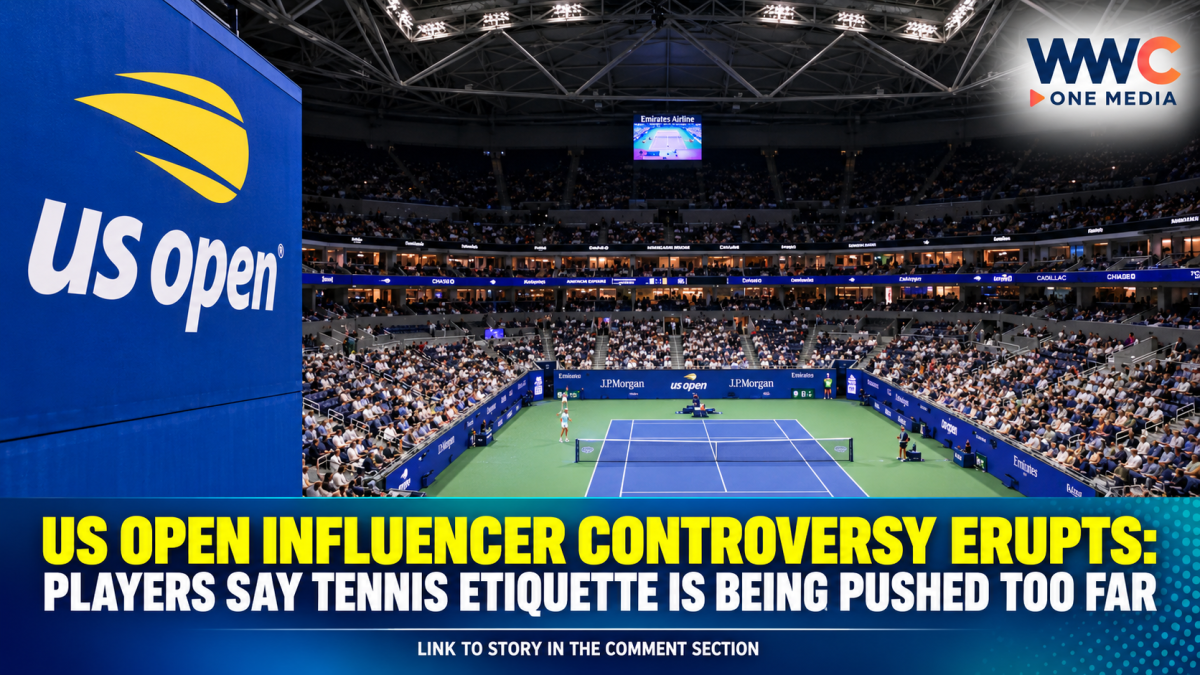
NEW YORK — The 2026 US Open has found itself at the center of an unexpected controversy, and this time the debate isn’t about a shocking upset or a championship favorite.
It is about influencers, smartphones, ring lights and whether the pursuit of viral content is beginning to clash with the traditions of professional tennis.
The issue erupted after spectators filming and posing during Naomi Osaka’s first-round match against Anastasia Zakharova created enough noise and distraction for the chair umpire to intervene. Videos from the incident quickly spread online, triggering a wider debate over spectator behavior at one of tennis’ biggest events.
Osaka later made clear that she sees value in bringing new audiences to tennis—but believes that growth cannot come at the expense of the players.
“Obviously if you come to a sporting event, you have to respect the sport.”
Osaka said content creators can help introduce tennis to their audiences, but added that the phenomenon needs to be managed better and that spectators should understand the sport’s rules and etiquette.
The viral moments that changed the conversation
The controversy wasn’t limited to ordinary crowd noise.
At Osaka’s opening match, a group in a suite was reprimanded by chair umpire Kader Nouni after recording a video during a point. Another incident involved the use of a bright ring light while play was underway.
The scenes were particularly jarring to traditional tennis fans because movement, noise and bright lights can become significant distractions when players are preparing to serve or competing in the middle of a point.
Another social-media post showed a spectator posing for photographs inside Arthur Ashe Stadium while Madison Keys was playing a point against Alina Korneeva, further intensifying criticism online.
The incidents prompted the US Open to reinforce its messaging to spectators. Video boards began displaying reminders asking fans to refrain from flash photography and other lighting during matches. Organizers also said ticket and suite holders were being reminded about activities that could interfere with play.
But here’s the important distinction: not every influencer is responsible
The controversy has sometimes blurred two different groups: credentialed content creators covering the tournament and ordinary ticket-holding fans creating social-media content.
The USTA has expanded its official creator program significantly.
Approximately 100 content creators received credentials for the 2026 tournament, compared with 54 in 2025. The credentialed group includes independent creators as well as social-media teams from established media organizations.
But ESPN’s examination of the controversy found that the people involved in the viral disruption during Osaka’s match were not USTA-credentialed content creators. That distinction is important because the online backlash has frequently lumped all social-media creators together.
The USTA says the creator program is designed to reach audiences who increasingly consume sports through social platforms, with formal guidelines governing access and content capture.
Tennis stars are divided—but the message is clear
The players themselves aren’t necessarily against influencers.
Jessica Pegula acknowledged the value of creators showcasing the US Open experience, but said there is a line that shouldn’t be crossed.
Her concern is what happens when photography, selfie lights or other content activity interferes with players who are competing for their careers and livelihoods.
Coco Gauff offered a similar perspective, suggesting that some newcomers may simply be unfamiliar with tennis etiquette.
Her point was essentially that someone attending a sporting event for the first time should learn how that particular sport operates—including when it is appropriate to stand, move around or take photographs.
Meanwhile, Daniil Medvedev has taken a more relaxed approach.
The 2021 US Open champion believes expanding tennis’ audience is overwhelmingly positive and argued that isolated problems can be addressed when they occur.
Frances Tiafoe has also been supportive of bringing more people into the sport.
Why the US Open is embracing creators
There is a bigger business and cultural story behind the controversy.
The US Open has increasingly positioned itself as more than a traditional tennis tournament. It has become a major New York entertainment event, combining elite competition with food, fashion, celebrities, nightlife and social-media culture.
The USTA says the creator program helps the tournament reach fans who consume sports differently from traditional television audiences.
That strategy appears to be working.
Front Office Sports reported that the 2025 US Open drew approximately 1.14 million attendees, setting an attendance record after the tournament’s creator program generated millions of social engagements.
The men’s ATP Tour has also expanded its relationship with TikTok, with Reuters reporting a more than 25% increase in posts using #tennis during 2025.
So the dilemma for tennis is becoming increasingly obvious:
How do you make the sport more accessible and culturally relevant without allowing the content surrounding the sport to overwhelm the competition itself?
What is proper US Open etiquette?
For longtime tennis fans, the expectations are relatively straightforward.
Spectators should remain quiet during points, avoid unnecessary movement while play is underway and refrain from using flash or bright lighting that could distract players.
Walking around, taking photographs and socializing are generally more appropriate during breaks in play rather than during active points.
Madison Appel, a college tennis player and tennis coach who also works as an influencer, has argued that the solution isn’t necessarily to exclude influencers—it is to educate people about tennis etiquette before they enter the stands.
That may ultimately be the middle ground the US Open needs.
The bigger question for tennis
The influencer controversy has exposed a tension that goes well beyond one viral video.
Tennis needs new fans.
It needs younger audiences.
It needs social-media engagement.
And tournaments increasingly rely on creators to make major sporting events part of the wider cultural conversation.
But players also need an environment in which they can compete without having to wonder whether a ring light, loud TikTok recording or photo shoot will interrupt the next point.
The 2026 US Open may therefore become a test case for the future of spectator sports: Can traditional sporting etiquette survive in an era where almost every seat in the stadium can also become a content studio?
For now, the message from the players appears less anti-influencer than pro-respect.
The US Open can welcome the cameras.
It can embrace social media.
But when the players are serving, the tennis still has to come first.
WWC ONE MEDIA J.M.S

Leave a Reply