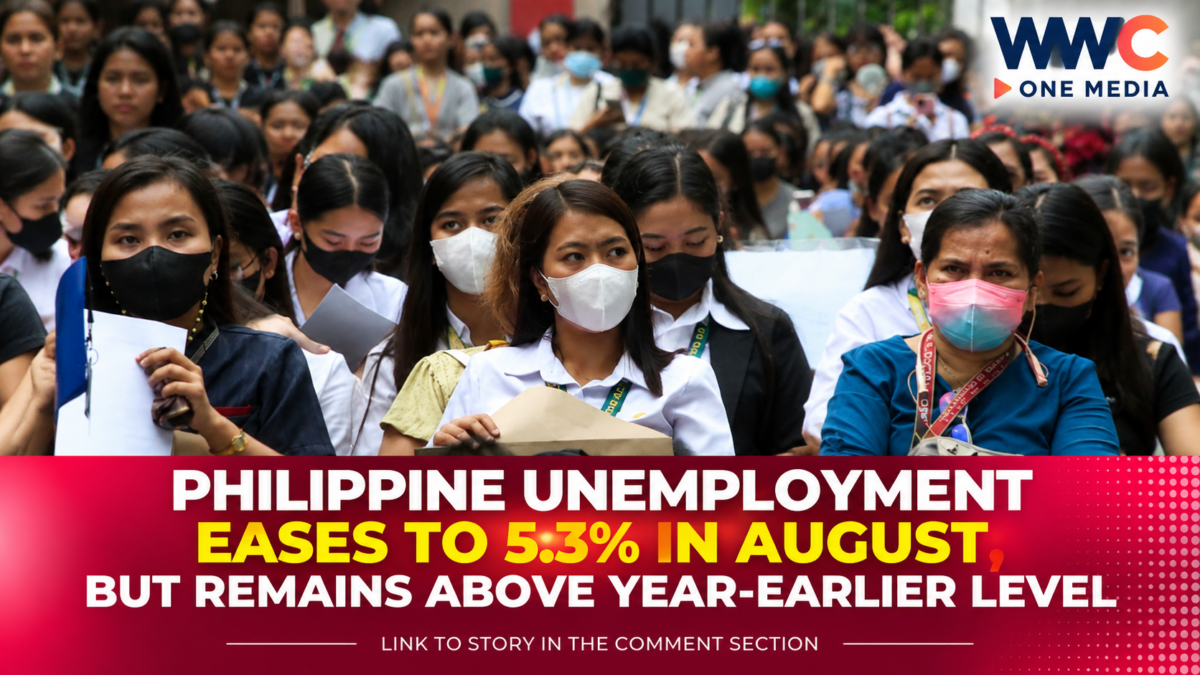
MANILA, Philippines — The Philippines’ unemployment rate eased to 5.3% in August, down from 6% in July, but remained significantly higher than the 3.9% recorded a year earlier, highlighting continued pressure in the country’s labor market.
The Philippine Statistics Authority (PSA) estimated that 2.77 million Filipinos were unemployed in August, down from 3.14 million in July but still well above the 2.03 million recorded in August 2025.
The latest figures suggest that the labor market improved on a month-to-month basis, although employment conditions remained weaker than they were a year earlier.
Unemployment falls after July surge
August’s 5.3% unemployment rate represented a notable improvement from July, when joblessness reached 6%, the highest level recorded in the latest period.
The decline translated to about 370,000 fewer unemployed people compared with July.
However, the year-on-year comparison tells a different story. The number of unemployed Filipinos was roughly 740,000 higher than the 2.03 million recorded in August 2025.
The PSA said the August decline was partly influenced by changes in the size of the labor force, rather than solely by a large increase in employment.
Fewer people entered the labor force
The country’s labor force participation rate (LFPR) rose to 64% in August, from 63.6% in July, but remained below the 65.1% recorded a year earlier.
The August rate represented approximately 52.56 million Filipinos aged 15 and above who were either working or looking for work. That was higher than the 52.36 million recorded in July and the 52.13 million recorded in August 2025.
The movement in unemployment therefore needs to be viewed alongside labor-force participation. A lower unemployment rate does not necessarily mean that all of the improvement came from stronger hiring, because the number of people actively participating in the labor market also affects the unemployment measure.
Employment rises from July but trails 2025
The country’s employment rate increased to 94.7% in August, from 94% in July.
The number of employed Filipinos rose to 49.79 million, up from 49.21 million a month earlier.
But employment remained below the 50.10 million recorded in August 2025. The year-on-year decline shows that the labor market had not fully recovered to its position a year earlier despite the month-to-month improvement.
The services sector continued to account for the largest share of jobs, employing 61.7% of all employed Filipinos.
Agriculture accounted for 20.9%, while industry represented 17.3%.
Agriculture and education lead employment gains
Several industries recorded increases in employment compared with a year earlier.
Agriculture and forestry posted the largest increase, adding around 532,000 workers.
Education followed with approximately 298,000 additional workers, while accommodation and food service activities added about 195,000.
Transportation and storage increased employment by around 185,000, while human health and social work activities added about 142,000.
At the same time, some major industries recorded significant declines.
Manufacturing posted the largest annual decrease, with employment falling by around 350,000. Fishing and aquaculture followed with a decline of about 335,000, while wholesale and retail trade and the repair of motor vehicles and motorcycles shed approximately 269,000 jobs.
Public administration and defense, including compulsory social security, also recorded a decline of around 220,000 workers.
Fewer working hours amid bad weather
The labor market data also showed that Filipinos who remained employed worked fewer hours on average.
Average weekly working hours fell to 39.2 hours in August, from 40.6 hours in July and 41 hours a year earlier.
The decline was partly associated with adverse weather conditions and flooding during the month.
National Statistician Claire Dennis Mapa said bad weather was a major reason workers reported shorter working hours, with heavy rains and flooding causing work disruptions and suspensions.
The reduction in working hours is significant because headline employment figures alone do not capture how much work employed people are actually able to perform.
Underemployment remains a concern
Another indicator points to continuing weakness in the labor market: underemployment.
The underemployment rate stood at 11.9% in August, equivalent to around 5.90 million employed Filipinos who wanted additional working hours, another job or a new job with longer hours.
Although the rate improved from 12.9% in July, it was still higher than the 10.7% recorded in August 2025.
About 64.5% of underemployed workers had worked fewer than 40 hours during the reference week, while 35.5% had worked at least 40 hours but still wanted additional employment opportunities or working hours.
This means that the challenge facing the Philippine labor market extends beyond simply finding jobs. A significant number of employed workers are still seeking more hours or better employment opportunities.
Young workers face additional pressure
The August figures also showed weaker labor-force participation among young Filipinos.
The LFPR for people aged 15 to 24 fell to 32.7%, from 33.3% a year earlier and 33.7% in July.
The youth employment rate, however, improved to 84.3% in August, from 81.4% in July, although it remained below the 88.3% recorded a year earlier.
Of the approximately 5.95 million employed young people, around 587,000 were underemployed, resulting in a youth underemployment rate of 9.9%.
The figures suggest that younger Filipinos remain an important part of the country’s employment challenge, particularly as they transition from education into the workforce.
Labor market still faces a mixed picture
The August data presents a mixed picture for the Philippine economy.
On a monthly basis, the labor market improved: unemployment fell from 6% to 5.3%, employment increased by about 580,000 and underemployment declined from 12.9% to 11.9%.
But compared with a year earlier, several indicators remain weaker.
Unemployment is higher, employment is lower and underemployment has increased. Average working hours have also fallen.
The data therefore does not point to a simple recovery or deterioration. Instead, it shows a labor market that has improved from the difficult conditions seen in July while continuing to face significant challenges compared with 2025.
What the figures mean for the economy
The labor market will remain an important indicator for policymakers as the Philippines deals with elevated inflation and changing economic conditions.
A stronger employment market can support household incomes and consumption, while persistent unemployment and underemployment can constrain spending and household financial security.
The August figures also underline the importance of the quality of jobs being created. Rising employment is more meaningful when workers are able to obtain sufficient hours, stable incomes and opportunities for advancement.
For now, the latest PSA data offers some relief after July’s sharp increase in unemployment. But with 2.77 million Filipinos still without jobs and another 5.90 million seeking more work, the labor market remains an area of concern.
The immediate trend has improved, but the year-on-year numbers show that the country’s employment recovery still has ground to cover.