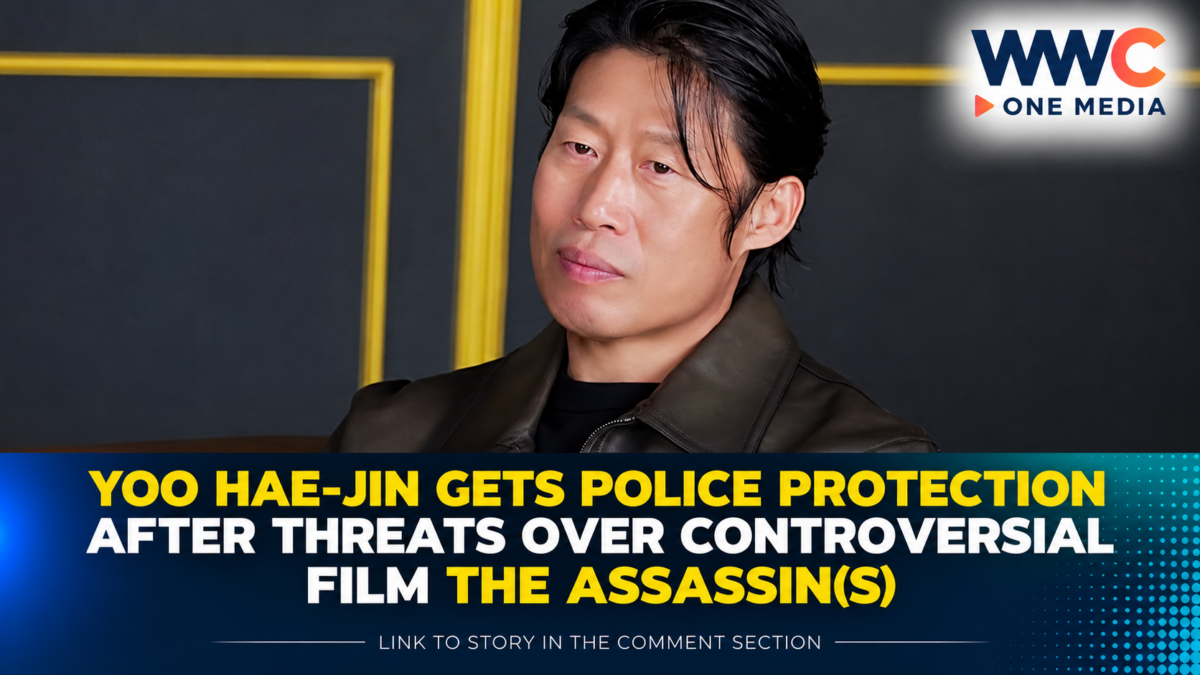
SEOUL, South Korea — South Korean actor Yoo Hae-jin has been placed under police protection after threats and protests targeting him intensified over his role in the controversial historical thriller The Assassin(s).
Seoul Seongbuk Police Station said on Oct. 6 that it had provided Yoo with a smartwatch linked to the emergency 112 system and increased patrols around his residence.
Police did not assign a dedicated officer to accompany the actor, but said additional protective measures could be introduced if authorities determine that the threat to his safety increases.
The measures came after conservative civic groups staged a protest outside a residence believed to belong to Yoo and after threatening comments targeting the actor appeared online.
The controversy centres on The Assassin(s), which revisits the 1974 assassination attempt against then-President Park Chung-hee that instead resulted in the death of his wife, First Lady Yuk Young-soo.
Police step in after protests outside actor’s home
Yoo’s agency requested police protection as concerns over his safety grew.
On Oct. 4, conservative groups gathered outside his home in northern Seoul, demanding that The Assassin(s) stop screening and that the film’s producers and cast apologise.
Police estimated that around 50 people took part in the protest, according to local reports.
Other demonstrations have since been held outside the headquarters of Burger King Korea, where Yoo is an advertising model, and outside Hive Media Corp, the production company behind the film. Protesters have called for boycotts and demanded that the filmmakers apologise over the movie’s portrayal of the historical event.
Seoul Metropolitan Police Agency Commissioner Ko Beom-seok said authorities would respond firmly to threats or attempts to harm the actor.
He also said police would manage demonstrations in accordance with the law while considering additional safety measures if necessary.
Why is The Assassin(s) so controversial?
The film, directed by Hur Jin-ho, dramatises the events surrounding the Aug. 15, 1974 assassination attempt.
The historical attack took place during a ceremony in Seoul. Gunman Mun Se-gwang opened fire at Park Chung-hee but missed the president and fatally wounded Yuk Young-soo.
Mun was arrested at the scene and later executed after investigators concluded that he had acted under orders from North Korea.
That historical conclusion is not disputed in the same way as the movie’s fictionalised interpretation.
The Assassin(s) introduces a different possibility through its story, with fictional investigators questioning whether people within Park’s own government or intelligence apparatus could have been involved.
That premise has angered conservative politicians and civic groups, who accuse the film of distorting history and damaging the legacy of Park and Yuk.
The production team, however, has repeatedly stressed that the movie is a work of fiction and does not seek to establish a new historical conclusion.
Filmmakers say the movie is fictional
The controversy escalated despite the production team’s efforts to clarify its position.
Hive Media said the film was inspired by historical records but was created as a fictional work and without a specific political agenda.
Director Hur has also rejected the interpretation that the movie definitively identifies Park Chung-hee or his government as being behind the assassination.
Instead, the film explores questions surrounding the incident through a fictional investigation.
That distinction has done little to calm critics, particularly those who believe the movie’s narrative could lead audiences to question the established historical account.
A formal complaint was also filed with South Korean police against the director, writer and producers, alleging defamation over the film’s portrayal of the events.
Cast members pulled out of promotional events
The backlash has already affected the film’s promotional activities.
Yoo and co-star Lee Min-ho withdrew from appearances connected to the Busan International Film Festival, while other promotional events involving the movie were cancelled because of safety concerns.
The production team said the decision was made to protect audiences and guests amid the growing controversy.
The film’s planned stage greetings and talk programmes were among the events affected.
The situation prompted South Korea’s Culture Minister Chae Hwi-young to publicly condemn threats against the cast and crew.
Chae said people were free to criticise or judge a movie, but argued that threatening the personal safety of filmmakers and actors crossed a line.
He urged police to protect those involved in the production and to take firm action against intimidation.
He also rejected calls to stop the film from being screened, saying any potential legal issues should be handled through the courts.
South Korea’s film industry rallies behind the cast
The controversy has also prompted an unusually strong response from the wider Korean film industry.
A coalition of 19 film industry organisations issued a joint statement supporting the cast and crew.
The groups acknowledged that movies dealing with sensitive historical events can generate disagreement and criticism, particularly among people personally connected to those events.
But they stressed that criticism of a film should be kept separate from threats against individuals involved in making it.
The organisations said no filmmaker or actor should have their personal safety threatened simply because they participated in a controversial production or expressed an artistic opinion.
Yoo’s agency, VAST Entertainment, has also said it is collecting threatening posts and other material and would take action to protect the actor’s rights and safety.
The film has still performed strongly at the box office
Despite the controversy, The Assassin(s) has attracted a substantial audience in South Korea.
The film was released on Sept. 23 and surpassed 2 million admissions on Oct. 3, its 11th day in cinemas, according to figures from the Korean Film Council.
The controversy has also kept the movie at the centre of public discussion.
While critics have called for boycotts and an end to screenings, the film has continued to draw moviegoers and has returned to the top of the South Korean box office during parts of its theatrical run.
The situation illustrates how a historical drama can become entangled with South Korea’s continuing political divisions over the country’s authoritarian past.
Controversy follows the film to Singapore
The dispute is particularly relevant in Singapore because The Assassin(s) has been selected as the opening film of the 37th Singapore International Film Festival, which runs from Oct. 21 to Nov. 1.
The film stars Yoo alongside Park Hae-il and Lee Min-ho.
The festival had previously announced that director Hur and cast members including Shim Eun-kyung and Park Sung-hoon would attend the opening.
The controversy has already prompted South Korea’s conservative People Power Party to call for the Singapore festival to remove the film from its opening programme.
As of the latest reports, however, the film remains scheduled to open SGIFF.
The Singapore festival has described the movie as part of its international programme, while the controversy surrounding its historical interpretation remains primarily a matter of debate in South Korea.
A debate over history, fiction and artistic freedom
At the heart of the dispute is a difficult question: how far can filmmakers go when turning a real and politically sensitive historical event into fiction?
Supporters of the movie argue that filmmakers should be able to explore alternative interpretations and raise questions through fictional storytelling.
Critics argue that doing so with a traumatic national event risks blurring the distinction between documented history and speculation.
The dispute has become particularly intense because Park Chung-hee remains a deeply divisive figure in South Korean history.
His supporters credit him with helping drive the country’s rapid economic development, while critics point to his authoritarian rule and suppression of political freedoms.
Yuk Young-soo, meanwhile, remains an important figure for many South Koreans, particularly among conservatives.
That historical divide has made the film far more politically charged than an ordinary historical thriller.
Yoo Hae-jin’s safety now becomes part of the controversy
For Yoo, who plays the detective at the centre of the film’s fictional investigation, the dispute has moved beyond criticism of his acting or the movie itself.
Police protection, protests outside his home and threatening online comments have transformed the controversy into a personal safety issue.
Authorities have made clear that people have the right to protest and criticise the movie, but threats or attempts to intimidate individuals will be dealt with separately.
For now, Yoo has been given additional security measures while the film continues its theatrical run.
The Assassin(s) is also preparing to reach an international audience through the Singapore International Film Festival later this month.
What began as a fictionalised examination of one of South Korea’s most controversial historical events has now become a much broader debate over historical memory, political division, artistic freedom and the limits of protest.
And with police now taking steps to protect its leading actor, the controversy surrounding The Assassin(s) has clearly moved far beyond the cinema screen.