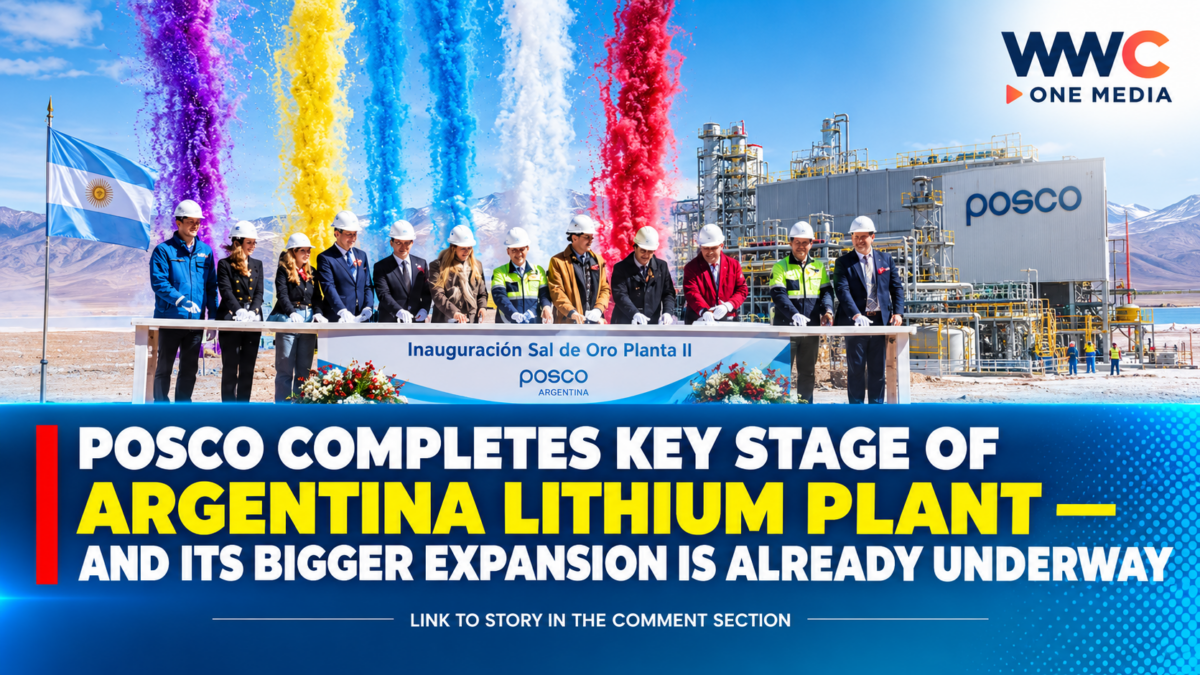
POSCO Holdings has completed the upstream process of its second brine-lithium plant in Argentina, marking a major step in the South Korean group’s push to secure lithium resources and strengthen its battery-material supply chain.
The facility is located near the Hombre Muerto salt flat, a major lithium-producing region in Argentina’s Puna highlands at an elevation of around 4,000 meters.
POSCO said the second plant’s upstream facilities have an annual production capacity of 23,000 tons of lithium carbonate. With its existing first plant capable of producing 25,000 tons annually, the group’s total lithium carbonate capacity in Argentina now reaches 48,000 tons per year.
The second plant represents an investment of approximately $954 million, highlighting the scale of POSCO’s long-term bet on lithium as demand for battery materials continues to evolve.
But the Argentina facility is only one part of the production chain.
Lithium carbonate produced at the new plant is scheduled to be linked to a downstream facility being built at the Yulchon Industrial Complex in South Korea’s South Jeolla Province.
That facility is expected to be completed in 2027 and will convert lithium carbonate into battery-grade lithium hydroxide, with an annual production capacity of 25,000 tons. Together with output from the first plant, POSCO aims to establish a brine-based lithium-hydroxide production system capable of producing 50,000 tons annually.
The latest milestone comes eight years after POSCO secured mining rights at the Hombre Muerto salt flat in 2018.
The company began developing its own lithium-extraction technology in 2010 before moving to secure overseas resources. Its first Argentina plant has an annual capacity of 25,000 tons and began commercial production in 2024.
The expansion is also designed to go beyond the second plant.
POSCO Argentina signed a memorandum of understanding with the governments of Salta and Catamarca to advance the third and fourth stages of the Sal de Oro project. The longer-term goal is to build a lithium production system capable of reaching 100,000 tons annually by 2033.
Argentina’s government said the second facility will produce about 23,000 tons of lithium carbonate annually, with the output destined for export. Commercial operations are expected to ramp up gradually during 2027.
The project also has a significant local economic footprint. Argentina’s government said the Sal de Oro project has generated more than 5,000 jobs, including about 600 direct positions at POSCO Argentina, while working with more than 270 local suppliers.
For POSCO, the project is about more than simply increasing production. The company is seeking to connect resource acquisition in Argentina with processing and battery-material production in South Korea, creating a more integrated supply chain for lithium products.
The company also sees future demand from energy-storage systems and lithium-iron-phosphate batteries as potential growth areas for additional lithium production.
With the second plant now reaching a major construction milestone and plans for Plants 3 and 4 already moving forward, POSCO’s Argentina strategy is entering a much larger phase.
The bigger question now is how quickly the company can turn its expanding lithium resource base into the 100,000-ton production system it has targeted for 2033.
WWC ONE MEDIA G,A